Question 1 of 20Speed and following distance (Alaska)
Practice test 2 of 10 — Alaska permit test
Practice test 2 questions
Question 2 of 20Road signs
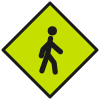
What does this sign warn you about?
Question 3 of 20Licensing and insurance (Alaska)
Without a parent, guardian, or licensed adult 21 or older, during which hours may an Alaska provisional driver not drive?
Question 4 of 20Road signs (Alaska)
According to the Alaska manual, what do orange flags and signs on the road mark?
Question 5 of 20Sharing the road
An orange triangle with a red border on the back of a vehicle means:
Question 6 of 20Right of way
A green light lets you go straight, but a car is still turning left in front of you from the last light. What should you do?
Question 7 of 20Emergencies and equipment
Your brakes suddenly stop working. What should you do first?
Question 8 of 20Road signs
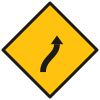
What does this sign warn you about?
Question 9 of 20Road signs
What does the color red on a sign usually mean?
Question 10 of 20Signals and pavement markings
What does a green arrow pointing left mean?
Question 11 of 20Road signs
Yellow signs with black symbols are used to:
Question 12 of 20Road signs
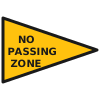
Why is this sign placed on the left side of the road?
Question 13 of 20Road signs
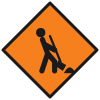
This orange sign shows a person with a shovel. What does it warn you about?
Question 14 of 20Speed and following distance
You are towing a trailer. How should your following distance change?
Question 15 of 20Speed and following distance (Alaska)
What is the speed limit in an Alaska school zone unless another limit is posted?
Question 16 of 20Speed and following distance
Why should you slow down as you near the top of a hill?
Question 17 of 20Parking and stopping
Traffic is backed up and you are about to cross railroad tracks. What should you do?
Question 18 of 20Safe driving and hazards (Alaska)
In Alaska, headlights must be on starting how long after sunset?
Question 19 of 20Parking and stopping
How should you start to parallel park?
Question 20 of 20Safe driving and hazards
It starts to rain during the day. What should you do with your headlights?
1 of 20
The timer starts when you answer the first question. Keyboard: A–D or 1–4 to answer, N next, P previous.
Answers and explanations (text version)
The correct answer to each question above, why it is right, and where it comes from. Try the test first.
Question 1: D. Two seconds
The Alaska manual notes that 13 AAC 02.090 "requires at a minimum the 2 second rule," though the manual itself recommends four seconds.
Handbook: Following Other Vehicles — How to Avoid Rear End Collisions
Question 2: A. People may be crossing the road ahead
This pedestrian crossing sign warns that people may be crossing. Slow down and yield to anyone in the crosswalk.
Handbook: Chapter: Traffic signs — Warning signs
Question 3: D. 1:00 am to 5:00 am
The Alaska manual says provisional drivers "MAY NOT operate a motor vehicle between the hours of 1:00 am and 5:00 am" unless a qualifying adult is along.
Handbook: Provisional Licenses — Provisional Licenses
Question 4: A. A high hazard area, such as road work
The Alaska manual says orange flags and signs indicate a "high hazard area" for maintenance and construction.
Handbook: Control of Vehicle — Drivers to Exercise Due Care
Question 5: B. It is a slow-moving vehicle
An orange triangle with a red border marks a slow-moving vehicle, such as a tractor.
Handbook: Chapter: Sharing the road — Slow-moving vehicles
Question 6: B. Let it finish its turn before you go
Vehicles still in the intersection when the light changes must be allowed to clear it before you go.
Handbook: Chapter: Right of way — Signals and right of way
Question 7: C. Pump the brakes and shift to a lower gear
Pump the brake pedal to build pressure and shift to a lower gear, then use the parking brake slowly if needed.
Handbook: Chapter: Emergencies and vehicle equipment — Brake failure
Question 8: B. The road curves to the right ahead
This curve sign means the road bends to the right ahead. Slow down before you reach the curve.
Handbook: Chapter: Traffic signs — Warning signs
Question 9: C. Stop, yield, or something is not allowed
Red is used for stop, yield and signs that ban an action, such as do not enter.
Handbook: Chapter: Traffic signs — Sign shapes and colors
Question 10: B. You may turn left; oncoming cars must stop
A green arrow gives you a protected turn in that direction. Oncoming traffic should be stopped, but still watch for people in the crosswalk.
Handbook: Chapter: Traffic signals and pavement markings — Traffic signals
Question 11: B. Warn you about the road ahead
Yellow is the color of general warning signs. They tell you about curves, crossings and other hazards ahead.
Handbook: Chapter: Traffic signs — Sign shapes and colors
Question 12: C. So a driver about to pass will see it
A driver getting ready to pass looks to the left, so the no-passing zone pennant is placed there where it will be seen.
Handbook: Chapter: Traffic signs — Warning signs
Question 13: B. People working on or near the road
This sign warns of workers on or near the road. Slow down and give them space.
Handbook: Chapter: Traffic signs — Work zone signs
Question 14: D. Leave more space than usual
Towing adds weight, so it takes longer to stop. Leave more space than usual.
Handbook: Chapter: Speed and following distance — Following distance
Question 15: A. 20 mph
The speed laws in the Alaska manual list "School zone, 20 mph" for roads that are not otherwise posted.
Handbook: Speed Laws — Speed Laws
Question 16: B. You cannot see what is over the top
You cannot see past the top of a hill, so slow down in case a car or object is stopped on the other side.
Handbook: Chapter: Speed and following distance — Speed and road conditions
Question 17: D. Wait until there is room past the tracks
Never stop on railroad tracks. Wait before the tracks until there is room for your whole car on the far side.
Handbook: Chapter: Parking and stopping — Stopping at railroad tracks
Question 18: A. 1/2 hour
Alaska’s lighting law says headlights must be on "from 1/2 hour after sunset to 1/2 hour before sunrise."
Handbook: Use of Lighting Equipment — Lighting Law
Question 19: A. Pull up beside the car in front of the space
Signal, then pull up alongside the car in front of the space before you start to back in.
Handbook: Chapter: Parking and stopping — Parallel parking
Question 20: D. Turn them on so others can see you
Turn on your headlights in rain so other drivers can see you; many states require it.
Handbook: Chapter: Safe driving and hazards — Night and weather
Practice test 2 of 10 for the General Knowledge Test (written test for the instruction permit); taken online at home or at a DMV office (Alaska DMV): 20 questions · 16 of 20 (80%) to pass · 25 minutes.