Question 1 of 30Safe driving and hazards
Practice test 2 of 10 — Arizona permit test
Practice test 2 questions
Question 2 of 30Turning, passing and lanes (Arizona)
In Arizona, you plan to turn into a driveway just beyond an intersection. According to the manual, when should you start to signal?
Question 3 of 30Signals and pavement markings
What do two broken yellow lines side by side usually mark?
Question 4 of 30Signals and pavement markings
You reach an intersection where the traffic lights are not working at all. In general, what should you do?
Question 5 of 30Turning, passing and lanes (Arizona)
At the posted times on an Arizona freeway, who may NOT use the HOV lane?
Question 6 of 30Road signs
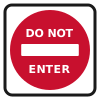
Where are you most likely to see this sign?
Question 7 of 30Road signs
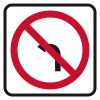
What is not allowed where this sign is posted?
Question 8 of 30Road signs (Arizona)

On an Arizona road, what does this triangle-shaped sign tell you to do?
Question 9 of 30Speed and following distance (Arizona)
For most driving, how much following distance does the Arizona manual tell you to keep?
Question 10 of 30Signals and pavement markings (Arizona)
At an Arizona pedestrian-activated crosswalk signal, the lights are flashing red. What may you do?
Question 11 of 30Safe driving and hazards
How often should you check your mirrors?
Question 12 of 30Speed and following distance (Arizona)
Unless another limit is posted, what is the Arizona speed limit in a business or residential district?
Question 13 of 30Road signs
A sign says "SLOWER TRAFFIC KEEP RIGHT". What does it mean?
Question 14 of 30Road signs
A sign shaped like a triangle with one point facing down means:
Question 15 of 30Speed and following distance
What does a minimum speed limit on a highway help prevent?
Question 16 of 30Right of way
In general, how should you treat a funeral procession?
Question 17 of 30Safe driving and hazards
What is an "escape route" when driving?
Question 18 of 30Turning, passing and lanes
Your left arm is held straight out the window. What does it mean?
Question 19 of 30Sharing the road
You are behind a truck and cannot see its side mirrors. What does this mean?
Question 20 of 30Alcohol, drugs and penalties (Arizona)
In Arizona, you lose your driving privilege on the spot if a test shows an alcohol concentration of at least what?
Question 21 of 30Sharing the road
How much of the lane does a motorcycle need?
Question 22 of 30Sharing the road
What are the "no zones" around a large truck?
Question 23 of 30Sharing the road (Arizona)
In Arizona, a vehicle with the slow-moving vehicle emblem cannot go faster than what speed?
Question 24 of 30Right of way
A person is walking across the street in a crosswalk ahead of you. What must you do?
Question 25 of 30Alcohol, drugs and penalties
What kinds of tests are covered by implied consent laws?
Question 26 of 30Turning, passing and lanes
When joining a highway, what should you look for?
Question 27 of 30Road signs
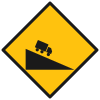
This sign shows a truck on a downward slope. What does it warn you about?
Question 28 of 30Road signs
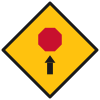
What should you do when you see this sign?
Question 29 of 30Signals and pavement markings
What does a flashing yellow arrow pointing left mean?
Question 30 of 30Emergencies and equipment
Your car breaks down on the highway. What should you do?
1 of 30
Answer each question to see the explanation. Keyboard: A–D or 1–4 to answer, N next, P previous.
Answers and explanations (text version)
The correct answer to each question above, why it is right, and where it comes from. Try the test first.
Question 1: D. It takes your eyes and mind off the road
Texting takes your eyes, hands and mind off driving, which makes a crash much more likely.
Handbook: Chapter: Safe driving and hazards — Distracted driving
Question 2: C. Not until you are in the intersection
"If you plan to turn beyond an intersection, do not signal until you are in the intersection," since drivers there may pull into your path.
Handbook: Section 2: Safe Driving Practices — Communicating
Question 3: A. A lane whose direction changes at set times
Double broken yellow lines usually mark a reversible lane, where the direction of travel changes at set times.
Handbook: Chapter: Traffic signals and pavement markings — Pavement markings
Question 4: B. Treat it as an all-way stop
In general, when signals are dark, treat the intersection as an all-way stop and take turns going.
Handbook: Chapter: Traffic signals and pavement markings — Traffic signals
Question 5: A. A car with only the driver in it
You may not drive a vehicle "carrying fewer than two persons, including the driver, in an HOV lane at the posted times."
Handbook: Section 2: Safe Driving Practices — High-Occupancy-Vehicle (HOV Lanes)
Question 6: C. At the end of a one-way road or exit ramp
Do not enter signs face drivers at the wrong end of a one-way road or a highway exit ramp, so no one drives in against traffic.
Handbook: Chapter: Traffic signs — Regulatory signs
Question 7: D. Turning left
This sign bans left turns. You may go straight or turn right if those moves are allowed.
Handbook: Chapter: Traffic signs — Regulatory signs
Question 8: C. Yield to cross traffic or merging traffic
The triangle "requires that you yield the right-of-way to cross traffic or to merging traffic."
Handbook: Section 3: Roadway and Vehicle Knowledge — Regulatory Signs
Question 9: B. At least 3 seconds
"Allow at least a 3-second following distance for most driving situations," and more when conditions are poor.
Handbook: Section 5: Actively Avoiding Crashes — Braking and Stopping
Question 10: A. Stop, then go once the walker clears your half
Flashing red lights mean "STOP. Then proceed with caution after pedestrian finishes crossing the driver's half of the roadway."
Handbook: Section 3: Roadway and Vehicle Knowledge — Pedestrian Activated Signals
Question 11: B. Every few seconds
Check your mirrors every few seconds so you always know what is behind and beside you.
Handbook: Chapter: Safe driving and hazards — Seeing and scanning
Question 12: A. 25 mph
When no limit is posted, Arizona sets "25 mph in any business or residential district."
Handbook: Section 3: Roadway and Vehicle Knowledge — Speed Limits
Question 13: B. Slower drivers should use the right lane
If you are driving slower than other traffic, keep to the right lane so faster cars can pass on the left.
Handbook: Chapter: Traffic signs — Regulatory signs
Question 14: C. Yield
The downward-pointing triangle is used only for the yield sign.
Handbook: Chapter: Traffic signs — Sign shapes and colors
Question 15: C. Crashes caused by big speed gaps
A minimum speed limit keeps very slow cars off the highway, since big speed gaps lead to crashes.
Handbook: Chapter: Speed and following distance — Special speed zones
Question 16: B. Yield and do not cut into the line
In general, yield to a funeral procession and do not cut into it, even if your light is green.
Handbook: Chapter: Right of way — Special situations
Question 17: A. Open space you can steer into
An escape route is open space you can steer into if you suddenly need to avoid a crash.
Handbook: Chapter: Safe driving and hazards — Defensive driving
Question 18: C. You are turning left
An arm held straight out is the hand signal for a left turn.
Handbook: Chapter: Turning, passing and lane use — Signaling
Question 19: C. The truck driver cannot see you
If you cannot see the truck's mirrors, the driver cannot see you. Drop back so you can.
Handbook: Chapter: Sharing the road — Large trucks and buses
Question 20: B. 0.08 percent
If a test shows "0.08 percent or more," you "will lose your driving privilege on the spot."
Handbook: Section 5: Actively Avoiding Crashes — DUI Penalties
Question 21: B. The full width of a lane
A motorcycle needs the full width of a lane. Never share a lane with one.
Handbook: Chapter: Sharing the road — Motorcycles
Question 22: D. Blind spots where the driver cannot see you
No zones are the large blind spots around a truck where the driver cannot see you.
Handbook: Chapter: Sharing the road — Large trucks and buses
Question 23: B. 25 mph
The emblem warns you to slow down; "The vehicle with the sign cannot travel faster than 25 mph."
Handbook: Section 4: Sharing the Road with Other Vehicles — Slow Moving Vehicles
Question 24: A. Stop and let the person cross
Pedestrians in a crosswalk have the right-of-way. Stop and let them finish crossing.
Handbook: Chapter: Right of way — Pedestrians
Question 25: D. Breath, blood, or urine tests
Implied consent laws generally cover breath, blood and urine tests for alcohol or drugs.
Handbook: Chapter: Alcohol, drugs and penalties — Testing and implied consent
Question 26: C. A gap in traffic to merge into
Look for a safe gap in traffic, signal, and match your speed to merge into it.
Handbook: Chapter: Turning, passing and lane use — Highway driving
Question 27: C. A steep downhill grade ahead
The truck on a downward slope warns of a steep downhill grade. Check your speed and use a lower gear.
Handbook: Chapter: Traffic signs — Warning signs
Question 28: B. Slow down and get ready to stop
This sign warns of a stop sign ahead. Slow down so you can stop at it.
Handbook: Chapter: Traffic signs — Warning signs
Question 29: A. You may turn left after yielding
A flashing yellow arrow means turns are allowed, but you must first yield to oncoming traffic and pedestrians.
Handbook: Chapter: Traffic signals and pavement markings — Traffic signals
Question 30: D. Pull off the road and turn on hazards
Pull off the road as far as you can and turn on your hazard lights so others can see you.
Handbook: Chapter: Emergencies and vehicle equipment — Breakdowns
Practice test 2 of 10 for the Permit Test (written knowledge test for the Class G instruction permit) (ADOT MVD): 30 questions · 24 of 30 (80%) to pass · no time limit.