Question 1 of 30Speed and following distance
Practice test 2 of 10 — Maine permit test
Practice test 2 questions
Question 2 of 30Safe driving and hazards
Where is ice most likely to form first?
Question 3 of 30Right of way
Two cars arrive at a four-way stop at the same time. The car on your right wants to turn left. Who goes first?
Question 4 of 30Alcohol, drugs and penalties (Maine)
In Maine, passing a stopped school bus with red lights flashing may bring a license suspension of how long?
Question 5 of 30Signals and pavement markings
A solid white line runs along the right edge of the road. What does it mark?
Question 6 of 30Road signs
A "LOW CLEARANCE" sign shows a height. What does it warn you about?
Question 7 of 30Parking and stopping
When you leave your car parked, what should you do?
Question 8 of 30Safe driving and hazards
Rain is so heavy you cannot see the road. What should you do?
Question 9 of 30Road signs
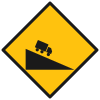
This sign shows a truck on a downward slope. What does it warn you about?
Question 10 of 30Safe driving and hazards (Maine)
Maine law requires headlights whenever it is too dim to see how far ahead?
Question 11 of 30Alcohol, drugs and penalties (Maine)
For a first OUI conviction in Maine at a level of 0.08 to 0.14, for at least how long will you lose your license?
Question 12 of 30Road signs
Signs that are taller than they are wide, in white with black letters, usually:
Question 13 of 30Right of way
A school bus is stopped with red lights flashing and its stop arm out on a two-lane road. What must you do?
Question 14 of 30Speed and following distance
School zone lights are flashing and children are near. What should you do?
Question 15 of 30Alcohol, drugs and penalties
What kind of drug is alcohol?
Question 16 of 30Turning, passing and lanes (Maine)
At 50 to 55 mph on a Maine two-lane road, how long does the manual say a safe pass takes?
Question 17 of 30Speed and following distance (Maine)
You drive through a Maine work zone with posted signs, but no workers are in sight. What should you do?
Question 18 of 30Speed and following distance
You are driving in a neighborhood with homes and parks. What should you do?
Question 19 of 30Speed and following distance
If you double your speed, about how much farther do you travel once you brake?
Question 20 of 30Sharing the road (Maine)
Under Maine law, what is it illegal to do to a horse being ridden near a road?
Question 21 of 30Safe driving and hazards
You need to make a phone call while driving. What is the safest choice?
Question 22 of 30Road signs
A speed sign on a highway shows "MINIMUM 40". What does it mean?
Question 23 of 30Alcohol, drugs and penalties (Maine)
A Maine driver under 21 is found driving with any alcohol at all. For at least how long will they lose their license?
Question 24 of 30Road signs
Brown signs point out:
Question 25 of 30Sharing the road (Maine)
The Maine manual suggests the "Dutch Reach" when you get out of a parked car. What is it?
Question 26 of 30Safe driving and hazards
It starts to rain during the day. What should you do with your headlights?
Question 27 of 30Turning, passing and lanes
On which side should you normally pass another vehicle?
Question 28 of 30Alcohol, drugs and penalties
How does a conviction for driving under the influence usually affect insurance?
Question 29 of 30Turning, passing and lanes
You are pulling away from the curb. What should you do first?
Question 30 of 30Speed and following distance
Can you get a ticket for driving at the posted limit?
1 of 30
Answer each question to see the explanation. Keyboard: A–D or 1–4 to answer, N next, P previous.
Answers and explanations (text version)
The correct answer to each question above, why it is right, and where it comes from. Try the test first.
Question 1: A. Your side vision narrows
The faster you go, the more your field of view narrows, so you may miss hazards to the side.
Handbook: Chapter: Speed and following distance — Speed and road conditions
Question 2: C. On bridges and overpasses
Bridges and overpasses lose heat from above and below, so ice forms on them first.
Handbook: Chapter: Safe driving and hazards — Skids and slippery roads
Question 3: A. The car on your right
When two cars arrive at the same time, the car on the right goes first, no matter which way it is turning.
Handbook: Chapter: Right of way — Stop signs and intersections
Question 4: C. 30 days
Passing a stopped school bus with red lights flashing is listed with offenses suspended "for a period of 30 days".
Handbook: Section 1 – Your Driver’s License — Loss of Driving Privileges
Question 5: A. The edge of the road
A solid white edge line marks the right edge of the road and helps you stay on it at night and in fog.
Handbook: Chapter: Traffic signals and pavement markings — Pavement markings
Question 6: D. An overpass or bridge with limited space above
A low clearance sign shows how much space there is under an overpass or bridge, so tall vehicles can avoid it.
Handbook: Chapter: Traffic signs — Warning signs
Question 7: B. Turn off the engine, take the keys, and lock it
Turn off the engine, take the keys and lock the car so no one can drive it away and it cannot roll.
Handbook: Chapter: Parking and stopping — Leaving a parked car
Question 8: C. Pull off the road safely and wait
If you cannot see the road, pull off safely, turn on your hazard lights, and wait for the rain to ease.
Handbook: Chapter: Safe driving and hazards — Night and weather
Question 9: C. A steep downhill grade ahead
The truck on a downward slope warns of a steep downhill grade. Check your speed and use a lower gear.
Handbook: Chapter: Traffic signs — Warning signs
Question 10: C. 1,000 feet
Lights are required "whenever visibility is too dim for you to see 1000 feet ahead".
Handbook: Section 8 – Managing Time and Space — Communicating
Question 11: C. 150 days
For a first conviction "you lose your license for at least 150 days".
Handbook: Section 3 – Ready to Drive — Keeping Fit to Drive
Question 12: C. Give a rule you must obey
Upright white rectangles are regulatory signs, such as speed limits. They give a rule you must obey.
Handbook: Chapter: Traffic signs — Sign shapes and colors
Question 13: D. Stop, whichever way you are going
On a two-lane road, traffic going both ways must stop for a school bus with flashing red lights and its stop arm out.
Handbook: Chapter: Right of way — School buses
Question 14: D. Slow to the school limit and watch for children
In an active school zone, slow to the posted school zone limit and watch closely for children.
Handbook: Chapter: Speed and following distance — Special speed zones
Question 15: B. A depressant that slows the brain
Alcohol is a depressant. It slows the brain and the body's reactions.
Handbook: Chapter: Alcohol, drugs and penalties — How alcohol affects you
Question 16: C. 10 to 12 seconds
At those speeds "you need from 10 to 12 seconds to complete a pass safely."
Handbook: Section 7 – General Driving — Passing (non expressway)
Question 17: A. Slow down and obey the signs until "End Road Work"
The manual says "Always slow down even if no workers are visible" and obey the signs until "End Road Work".
Handbook: Section 11 – Special Driving Challenges — Work Zones
Question 18: C. Keep your speed low and watch for children
In neighborhoods children may run into the street, so keep your speed low and watch closely.
Handbook: Chapter: Speed and following distance — Special speed zones
Question 19: A. About four times as far
Braking distance grows with the square of speed, so doubling your speed makes it about four times as far.
Handbook: Chapter: Speed and following distance — Stopping distance
Question 20: A. Frighten it on purpose
It is against the law "to purposefully frighten any animal being ridden, driven, or led" near a road.
Handbook: Section 10 – Sharing the Road — Slow Moving Vehicles
Question 21: A. Pull over to a safe place first
Pull over to a safe place before using your phone, since calls take your mind off driving.
Handbook: Chapter: Safe driving and hazards — Distracted driving
Question 22: C. You should not drive below 40 in good conditions
A minimum speed sign means you should not go below 40 when conditions are good, because very slow cars can cause crashes.
Handbook: Chapter: Traffic signs — Regulatory signs
Question 23: A. One year
With any alcohol in your blood "you will lose your driver's license for at least one year".
Handbook: Section 3 – Ready to Drive — Keeping Fit to Drive
Question 24: C. Parks, recreation and places of interest
Brown signs guide you to parks, recreation areas and places of cultural or historic interest.
Handbook: Chapter: Traffic signs — Sign shapes and colors
Question 25: B. Opening your door with your far hand
With the Dutch reach, "the driver will open their door using the right hand", which turns you to look back.
Handbook: Section 10 – Sharing the Road — Bicycles
Question 26: D. Turn them on so others can see you
Turn on your headlights in rain so other drivers can see you; many states require it.
Handbook: Chapter: Safe driving and hazards — Night and weather
Question 27: D. On the left
You should normally pass on the left. Passing on the right is allowed only in certain cases.
Handbook: Chapter: Turning, passing and lane use — Passing
Question 28: B. Insurance costs go up
Insurance costs usually go up a lot after a conviction for driving under the influence.
Handbook: Chapter: Alcohol, drugs and penalties — Penalties
Question 29: A. Signal and check for traffic
Signal and check mirrors and your blind spot before pulling away from the curb.
Handbook: Chapter: Turning, passing and lane use — Signaling
Question 30: C. Yes, if that speed is unsafe for conditions
Yes. Under the basic speed rule you can be ticketed for driving at the limit when conditions make that speed unsafe.
Handbook: Chapter: Speed and following distance — Basic speed rule
Practice test 2 of 10 for the Basic knowledge test (Class C learner's permit written exam) (Maine BMV): 30 questions · 24 of 30 (80%) to pass · no time limit.