Question 1 of 25Speed and following distance
Practice test 2 of 10 — Massachusetts permit test
Practice test 2 questions
Question 2 of 25Emergencies and equipment
You are in a crash and someone is hurt. What should you do?
Question 3 of 25Right of way
You are pulling out of a driveway onto a street. Who must you yield to?
Question 4 of 25Alcohol, drugs and penalties (Massachusetts)
A Massachusetts driver over 21 with no prior OUI offenses refuses a chemical test. How long is the license suspended?
Question 5 of 25Turning, passing and lanes
Your left arm is bent up at the elbow. What does it mean?
Question 6 of 25Safe driving and hazards
Why is driving at night riskier than in the day?
Question 7 of 25Sharing the road
When may a cyclist ride in the middle of a traffic lane?
Question 8 of 25Road signs
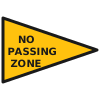
This pennant-shaped sign is on the left side of the road. What does it mark?
Question 9 of 25Road signs
A sign says "SLOWER TRAFFIC KEEP RIGHT". What does it mean?
Question 10 of 25Road signs
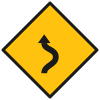
What lies ahead when you see this sign?
Question 11 of 25Turning, passing and lanes (Massachusetts)
On a Massachusetts highway, at least how far before the exit ramp should you signal?
Question 12 of 25Right of way
You are at a stop sign. A car on the cross street is signaling a turn onto your road but has not slowed down yet. What is safest?
Question 13 of 25Alcohol, drugs and penalties
In general, about how fast does the body clear alcohol?
Question 14 of 25Alcohol, drugs and penalties (Massachusetts)
What is the fine for having an open alcohol drink inside a vehicle in Massachusetts?
Question 15 of 25Parking and stopping
Which way should your car face when you park on a two-way street?
Question 16 of 25Parking and stopping
When you park on a hill, what else should you always do?
Question 17 of 25Safe driving and hazards
Water is flowing across the road ahead. What should you do?
Question 18 of 25Parking and stopping (Massachusetts)
When you park or stop on a Massachusetts road, how wide a clear path must you leave for traffic?
Question 19 of 25Sharing the road
Why should you look twice for motorcycles at intersections?
Question 20 of 25Road signs
Which type of sign gives a rule that you must obey by law?
Question 21 of 25Right of way (Massachusetts)
You stopped for a Massachusetts school bus with its red lights flashing and stop sign out. When may you go?
Question 22 of 25Right of way
A person is crossing the middle of a block, not at a crosswalk. What is true?
Question 23 of 25Right of way
You want to turn left at a green light. A car is coming straight toward you. What should you do?
Question 24 of 25Right of way (Massachusetts)
You are passing a horse and rider on a Massachusetts road, and the horse looks scared. What must you do?
Question 25 of 25Turning, passing and lanes
When might you need a three-point turn?
1 of 25
The timer starts when you answer the first question. Keyboard: A–D or 1–4 to answer, N next, P previous.
Answers and explanations (text version)
The correct answer to each question above, why it is right, and where it comes from. Try the test first.
Question 1: B. Slow down and leave more space
Wet roads give your tires less grip, so slow down and leave more space ahead.
Handbook: Chapter: Speed and following distance — Speed and road conditions
Question 2: D. Stop, call 911, and help if you can
Stop, call 911, and give help you are able to give. Do not move injured people unless they are in danger.
Handbook: Chapter: Emergencies and vehicle equipment — Crashes
Question 3: C. All traffic and people walking
When entering a street from a driveway or alley, yield to all traffic on the street and to people on the sidewalk.
Handbook: Chapter: Right of way — Entering a roadway
Question 4: D. 180 days
Refusing a chemical test with no prior OUI offenses brings a 180-day suspension for a Massachusetts driver over 21.
Handbook: Chapter 3: Keeping Your License — License Suspension Periods for Refusing a Chemical Test
Question 5: C. You are turning right
A left arm bent upward at the elbow is the hand signal for a right turn.
Handbook: Chapter: Turning, passing and lane use — Signaling
Question 6: B. You cannot see as far or as clearly
At night you cannot see as far or as clearly, so it is harder to spot hazards in time.
Handbook: Chapter: Safe driving and hazards — Night and weather
Question 7: C. When the lane is too narrow to share safely
Cyclists may use the middle of a lane when it is too narrow for a car and bike to share it safely.
Handbook: Chapter: Sharing the road — Bicycles
Question 8: C. The start of a no-passing zone
The pennant sign marks the start of a no-passing zone. Do not begin to pass from this point on.
Handbook: Chapter: Traffic signs — Warning signs
Question 9: B. Slower drivers should use the right lane
If you are driving slower than other traffic, keep to the right lane so faster cars can pass on the left.
Handbook: Chapter: Traffic signs — Regulatory signs
Question 10: C. A series of curves
The wavy arrow means a winding road with a series of curves. Keep your speed down until it straightens.
Handbook: Chapter: Traffic signs — Warning signs
Question 11: D. 500 feet
Massachusetts drivers should signal their exit at least 500 feet before reaching the exit ramp.
Handbook: Chapter 4: Rules of the Road — Highway Driving
Question 12: C. Wait until it clearly starts to turn
A turn signal is not a promise. Wait until the car clearly starts to turn before you pull out in front of it.
Handbook: Chapter: Right of way — Stop signs and intersections
Question 13: C. About one standard drink per hour
In general, the body clears about one standard drink per hour, and nothing speeds it up.
Handbook: Chapter: Alcohol, drugs and penalties — How alcohol affects you
Question 14: B. $100 to $500
A Massachusetts open container conviction carries a fine of $100 to $500, and drivers under 21 also lose their license.
Handbook: Chapter 3: Keeping Your License — Open Container Law
Question 15: D. The same way as traffic on that side
Park on the right side facing the same way as traffic, so you can pull out safely.
Handbook: Chapter: Parking and stopping — Where not to park
Question 16: C. Set the parking brake
Always set the parking brake on a hill so the car will not roll away.
Handbook: Chapter: Parking and stopping — Parking on hills
Question 17: C. Turn around and find another way
Never drive into flowing water. Even shallow water can sweep a car away, so turn around.
Handbook: Chapter: Safe driving and hazards — Night and weather
Question 18: B. At least 12 feet
When parking or stopping, the Massachusetts manual says to leave "at least a 12-foot wide, clear roadway for traffic to pass."
Handbook: Chapter 4: Rules of the Road — Parking
Question 19: D. They are small and hard to see
Motorcycles are small and easy to miss, so look twice before turning, most of all when turning left.
Handbook: Chapter: Sharing the road — Motorcycles
Question 20: C. A regulatory sign
Regulatory signs, such as speed limit and stop signs, state rules you must obey by law.
Handbook: Chapter: Traffic signs — Regulatory signs
Question 21: B. When the lights stop or the stop sign folds back
Massachusetts drivers must stay stopped until the bus lights stop flashing or the stop sign folds back, then go slowly and watch for children.
Handbook: Chapter 4: Rules of the Road — School Buses
Question 22: B. They should yield, but you must still avoid them
Pedestrians outside a crosswalk should yield to cars, but drivers must still take care not to hit anyone.
Handbook: Chapter: Right of way — Pedestrians
Question 23: D. Wait for the car to pass, then turn
When turning left on a green light, you must yield to oncoming traffic going straight or turning right.
Handbook: Chapter: Right of way — Turning at intersections
Question 24: D. Pull to the side and stop
If an animal you are passing looks scared, Massachusetts law says you must pull your vehicle to the side and stop.
Handbook: Chapter 4: Rules of the Road — Animals and Horse-Drawn Vehicles
Question 25: D. To turn around on a narrow street
A three-point turn is used to turn around on a street too narrow for a U-turn.
Handbook: Chapter: Turning, passing and lane use — Turns
Practice test 2 of 10 for the Learner's permit exam (passenger, Class D) (Massachusetts RMV): 25 questions · 18 of 25 to pass · 25 minutes.