Question 1 of 25Speed and following distance
Practice test 1 of 10 — Nevada permit test
Practice test 1 questions
Question 2 of 25Right of way
At a four-way stop, you and an oncoming car stop at the same time. You want to turn left; they are going straight. Who goes first?
Question 3 of 25Right of way
Why must drivers always yield to trains at a crossing?
Question 4 of 25Alcohol, drugs and penalties (Nevada)
How can you report a suspected drunk driver from a cell phone anywhere in Nevada?
Question 5 of 25Road signs (Nevada)
Over a Nevada freeway lane you see a red X with the word CLOSED. What must you do?
Question 6 of 25Road signs
An Interstate route has three digits, and the first digit is even. What does that usually mean?
Question 7 of 25Parking and stopping (Nevada)
In Nevada, how close to the nearest rail of a railroad may you park?
Question 8 of 25Safe driving and hazards
On a long, dull highway drive, you start to feel drowsy and stare blankly ahead. What should you do?
Question 9 of 25Road signs
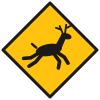
When should you be most alert for animals near this sign?
Question 10 of 25Safe driving and hazards
Why should you keep your windshield clean?
Question 11 of 25Speed and following distance (Nevada)
According to the Nevada manual, when does a school zone speed limit apply on school days, unless posted?
Question 12 of 25Right of way
You are at a crosswalk and a child runs out after a ball. What should you do?
Question 13 of 25Parking and stopping
Before you back out of a driveway, what is the safest step?
Question 14 of 25Right of way
You turn right on a green light. A person is crossing the street you are turning onto. Who has the right-of-way?
Question 15 of 25Signals and pavement markings
What does a green arrow pointing left mean?
Question 16 of 25Road signs
A sign and a police officer at an intersection give you different orders. Whom do you obey?
Question 17 of 25Parking and stopping
May you park in a disability space without a valid placard or plate?
Question 18 of 25Speed and following distance (Nevada)
What speed limit does the Nevada manual list for business and residential areas?
Question 19 of 25Safe driving and hazards
When should you turn on your headlights?
Question 20 of 25Right of way
A school bus ahead of you has flashing yellow lights. What does this mean?
Question 21 of 25Emergencies and equipment
When should you adjust your seat and mirrors?
Question 22 of 25Emergencies and equipment
You see smoke coming from under the hood. What should you do?
Question 23 of 25Speed and following distance
You see brake lights far ahead on the highway. What should you do?
Question 24 of 25Alcohol, drugs and penalties
Marijuana is legal for adults in some states. Is it legal to drive while impaired by it?
Question 25 of 25Signals and pavement markings (Nevada)
In Nevada, how far may you drive in a center left-turn lane before you make your left turn?
1 of 25
The timer starts when you answer the first question. Keyboard: A–D or 1–4 to answer, N next, P previous.
Answers and explanations (text version)
The correct answer to each question above, why it is right, and where it comes from. Try the test first.
Question 1: D. In rain, fog, or at night
Leave more space when it is wet, foggy or dark, since you need more time to see hazards and to stop.
Handbook: Chapter: Speed and following distance — Following distance
Question 2: B. The car going straight
A driver turning left yields to an oncoming car going straight, so let it go first.
Handbook: Chapter: Right of way — Stop signs and intersections
Question 3: B. Trains cannot stop quickly or steer away
A train cannot steer and may need a mile or more to stop, so you must always yield to it.
Handbook: Chapter: Right of way — Railroad crossings
Question 4: D. Dial *647
You can report a suspected drunk driver or a highway emergency "on a cellular phone anywhere in Nevada by dialing *NHP (*647)."
Handbook: Chapter 10: Driving Under the Influence — Clues that a Driver May Be Under the Influence or Impaired
Question 5: A. Do not drive in that lane
A red X with CLOSED means "drivers cannot drive in the lane under the red X," so you must merge into another open lane.
Handbook: Chapter 3: Driving Safely — Active Traffic Management Signs
Question 6: D. It loops around a city or links two Interstates
A three-digit Interstate with an even first digit usually loops around a city or links two Interstates; an odd one is usually a spur.
Handbook: Chapter: Traffic signs — Guide and service signs
Question 7: A. No closer than 50 feet
The Nevada manual says "Never park within 50 feet of the nearest rail of a railroad."
Handbook: Chapter 3: Driving Safely — No Parking Allowed
Question 8: C. Take a break and move your eyes often
Long, dull drives can make you drowsy. Take breaks and keep your eyes moving.
Handbook: Chapter: Safe driving and hazards — Fatigue
Question 9: D. At dawn and at dusk
Deer move most at dawn and at dusk, so take extra care at those times where this sign is posted.
Handbook: Chapter: Traffic signs — Warning signs
Question 10: A. Dirt and glare make it harder to see
A dirty windshield adds glare and makes it harder to see, most of all at night.
Handbook: Chapter: Safe driving and hazards — Night and weather
Question 11: A. 30 minutes before to 30 minutes after school
Nevada school zone limits apply on school days from "a half hour before school begins" until a half hour (30 minutes) after school ends, unless posted.
Handbook: Chapter 3: Driving Safely — School Areas
Question 12: C. Stop and expect more children to follow
Stop for the child and expect another child to follow the ball into the road.
Handbook: Chapter: Right of way — Pedestrians
Question 13: A. Walk around the car to check for children
Small children can be hidden behind a car. Walk around it to check before you back out.
Handbook: Chapter: Parking and stopping — Leaving a parked car
Question 14: C. The person crossing
A green light does not let you turn through a crosswalk in use. The person crossing has the right-of-way, so wait for them.
Handbook: Chapter: Right of way — Pedestrians
Question 15: B. You may turn left; oncoming cars must stop
A green arrow gives you a protected turn in that direction. Oncoming traffic should be stopped, but still watch for people in the crosswalk.
Handbook: Chapter: Traffic signals and pavement markings — Traffic signals
Question 16: C. The police officer
A police officer directing traffic overrides signs and signals, so follow the officer.
Handbook: Chapter: Traffic signs — Regulatory signs
Question 17: C. No, it is not allowed
Disability spaces are only for vehicles with a valid placard or plate. Others may not park there.
Handbook: Chapter: Parking and stopping — Where not to park
Question 18: B. 25 mph
The Nevada manual lists 25 mph as the speed limit for "Business and residential areas," along with some school zones.
Handbook: Chapter 3: Driving Safely — Controlling Speed
Question 19: B. Any time it is hard to see
Turn on your headlights any time it is hard to see, such as at dusk, in rain or in fog.
Handbook: Chapter: Safe driving and hazards — Night and weather
Question 20: C. It is getting ready to stop
Flashing yellow lights mean the bus is about to stop. Slow down and get ready to stop.
Handbook: Chapter: Right of way — School buses
Question 21: B. Before you start to drive
Adjust your seat and mirrors before you start to drive, so you can see well and are not distracted on the road.
Handbook: Chapter: Emergencies and vehicle equipment — Vehicle equipment
Question 22: A. Pull over, get out, and move away
Pull over, turn off the engine, get everyone out and move away. Call for help.
Handbook: Chapter: Emergencies and vehicle equipment — Vehicle fires
Question 23: C. Ease off the gas and get ready to slow
Brake lights far ahead warn of slowing traffic. Ease off the gas early so you can slow smoothly.
Handbook: Chapter: Speed and following distance — Managing space
Question 24: D. No, impaired driving is illegal everywhere
Even where marijuana is legal, driving while impaired by it is illegal everywhere.
Handbook: Chapter: Alcohol, drugs and penalties — Drugs and medicine
Question 25: C. No more than 200 feet
Nevada drivers "may not travel more than 200 feet in a center turn lane" before making a left turn, and these lanes may not be used for passing.
Handbook: Chapter 3: Driving Safely — Highway Markings
Practice test 1 of 10 for the Written Knowledge Test (instruction permit) (Nevada DMV): 25 questions · 20 of 25 (80%) to pass · 60 minutes.