Question 1 of 25Alcohol, drugs and penalties
Practice test 2 of 10 — North Carolina permit test
Practice test 2 questions
Question 2 of 25Signals and pavement markings
What do two broken yellow lines side by side usually mark?
Question 3 of 25Safe driving and hazards
Why should you keep your windshield clean?
Question 4 of 25Right of way
A green light lets you go straight, but a car is still turning left in front of you from the last light. What should you do?
Question 5 of 25Safe driving and hazards
What does it mean to drive defensively?
Question 6 of 25Speed and following distance
Why should you slow down as you near the top of a hill?
Question 7 of 25Sharing the road
What are the "no zones" around a large truck?
Question 8 of 25Signals and pavement markings (North Carolina)
At a North Carolina freeway ramp meter, what should you do when the light is steady red?
Question 9 of 25Speed and following distance
You are driving in a neighborhood with homes and parks. What should you do?
Question 10 of 25Road signs
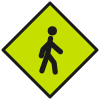
What does this sign warn you about?
Question 11 of 25Signals and pavement markings
The letters "RXR" painted on the road warn of:
Question 12 of 25Road signs
A five-sided sign shaped like a house warns of:
Question 13 of 25Signals and pavement markings
A crossing signal shows a white walking person. What does it mean for people on foot?
Question 14 of 25Speed and following distance (North Carolina)
A North Carolina work zone has a posted speed limit, but you see no workers. Where does that limit apply?
Question 15 of 25Turning, passing and lanes
What is the acceleration lane on a highway on-ramp for?
Question 16 of 25Parking and stopping (North Carolina)
In North Carolina, may you park on the shoulder of an interstate just to rest?
Question 17 of 25Right of way (North Carolina)
At a North Carolina intersection, you have a green arrow to make a U-turn. Facing traffic has a green arrow to turn right. Who should yield?
Question 18 of 25Sharing the road
A person in a wheelchair is crossing the street. What should you do?
Question 19 of 25Parking and stopping
How should you drive in a parking lot?
Question 20 of 25Signals and pavement markings
A flashing "DON'T WALK" or raised hand signal means people on foot should:
Question 21 of 25Alcohol, drugs and penalties (North Carolina)
A North Carolina driver is convicted of a second DWI, and the first offense was within three years. How long is the revocation?
Question 22 of 25Emergencies and equipment (North Carolina)
Under North Carolina rules, a tire is unsafe once its tread is less than how deep?
Question 23 of 25Right of way
You are coming up to a roundabout and someone is waiting at the crosswalk before it. What should you do?
Question 24 of 25Sharing the road
You are turning right and a cyclist is riding in the bike lane next to you. What should you do?
Question 25 of 25Speed and following distance
How can you check your following distance?
1 of 25
Answer each question to see the explanation. Keyboard: A–D or 1–4 to answer, N next, P previous.
Answers and explanations (text version)
The correct answer to each question above, why it is right, and where it comes from. Try the test first.
Question 1: B. Insurance costs go up
Insurance costs usually go up a lot after a conviction for driving under the influence.
Handbook: Chapter: Alcohol, drugs and penalties — Penalties
Question 2: A. A lane whose direction changes at set times
Double broken yellow lines usually mark a reversible lane, where the direction of travel changes at set times.
Handbook: Chapter: Traffic signals and pavement markings — Pavement markings
Question 3: A. Dirt and glare make it harder to see
A dirty windshield adds glare and makes it harder to see, most of all at night.
Handbook: Chapter: Safe driving and hazards — Night and weather
Question 4: B. Let it finish its turn before you go
Vehicles still in the intersection when the light changes must be allowed to clear it before you go.
Handbook: Chapter: Right of way — Signals and right of way
Question 5: D. Expect others to make mistakes and be ready
Defensive driving means you expect other drivers to make mistakes and are ready to avoid them.
Handbook: Chapter: Safe driving and hazards — Defensive driving
Question 6: B. You cannot see what is over the top
You cannot see past the top of a hill, so slow down in case a car or object is stopped on the other side.
Handbook: Chapter: Speed and following distance — Speed and road conditions
Question 7: D. Blind spots where the driver cannot see you
No zones are the large blind spots around a truck where the driver cannot see you.
Handbook: Chapter: Sharing the road — Large trucks and buses
Question 8: D. Stop and wait for the green light
A steady red ramp meter means stop and wait for the green light; on green you go down the ramp and merge onto the freeway.
Handbook: Chapter 5: Signals, Signs and Pavement Markings — Ramp Meter Traffic Signals
Question 9: C. Keep your speed low and watch for children
In neighborhoods children may run into the street, so keep your speed low and watch closely.
Handbook: Chapter: Speed and following distance — Special speed zones
Question 10: A. People may be crossing the road ahead
This pedestrian crossing sign warns that people may be crossing. Slow down and yield to anyone in the crosswalk.
Handbook: Chapter: Traffic signs — Warning signs
Question 11: B. A railroad crossing ahead
The letters RXR painted on the road warn of a railroad crossing ahead.
Handbook: Chapter: Traffic signals and pavement markings — Pavement markings
Question 12: B. A school zone or school crossing
The five-sided, house-shaped sign is used for a school zone or a school crossing.
Handbook: Chapter: Traffic signs — Sign shapes and colors
Question 13: B. They may start to cross, watching for turning cars
The walking person means people may start to cross, but they should still watch for cars that are turning.
Handbook: Chapter: Traffic signals and pavement markings — Traffic signals
Question 14: B. From the first work zone sign to the last
It is unlawful to exceed the posted work zone limit, and the work zone runs from the first sign that marks its start to the last sign that marks its end.
Handbook: Chapter 4: Your Driving — Hazardous Driving: Work Zones
Question 15: A. To speed up to match highway traffic
Use the acceleration lane to get up to the speed of highway traffic so you can merge smoothly.
Handbook: Chapter: Turning, passing and lane use — Highway driving
Question 16: D. No, only in an emergency
Parking anywhere in the right of way of an interstate is banned except in marked parking areas or in an emergency.
Handbook: Chapter 4: Your Driving — Parking
Question 17: D. You, the driver making the U-turn
The handbook says U-turning traffic "should yield to opposing right turning traffic" when both have a green arrow, so you yield.
Handbook: Chapter 5: Signals, Signs and Pavement Markings — Traffic Signals
Question 18: D. Wait until they have crossed
Treat a person in a wheelchair like any person walking. Stop and wait until they have crossed.
Handbook: Chapter: Sharing the road — Pedestrians
Question 19: D. Slowly, watching for people
Drive slowly in a parking lot and watch for people walking and cars backing out.
Handbook: Chapter: Parking and stopping — Parking lots
Question 20: D. Not start, but finish if already crossing
A flashing don't walk or raised hand means do not start to cross; those already crossing should finish.
Handbook: Chapter: Traffic signals and pavement markings — Traffic signals
Question 21: C. 4 years
A second DWI conviction with a prior offense within three years brings a mandatory revocation of 4 years.
Handbook: Chapter 2: Alcohol and the Law — Driving While Impaired
Question 22: A. 1/16 inch
A tire is unsafe if it is worn to the cord, has tread separation, or has less than 1/16 inch of tread depth.
Handbook: Chapter 4: Your Driving — Vehicle Equipment: Tires
Question 23: C. Stop and let them cross before entering
Crosswalks are often placed just before a roundabout entry. Yield to people crossing before you enter.
Handbook: Chapter: Right of way — Roundabouts
Question 24: A. Let the cyclist pass, then turn
Yield to the cyclist in the bike lane. Let them go by, then make your turn behind them.
Handbook: Chapter: Sharing the road — Bicycles
Question 25: B. Count the seconds to reach a point it passed
Pick a fixed point such as a sign. When the car ahead passes it, count the seconds until you reach it.
Handbook: Chapter: Speed and following distance — Following distance
Practice test 2 of 10 for the Written knowledge test and traffic signs test (Level 1 Limited Learner Permit) (NCDMV): 25 questions, 20 to pass — the commonly reported format; NCDMV does not publish the count. Official pass mark: 80% on the knowledge test and 9 of 12 road signs on the signs test. Our practice tests are untimed.