Question 1 of 18Safe driving and hazards
Practice test 1 of 10 — Pennsylvania permit test
Practice test 1 questions
Question 2 of 18Signals and pavement markings
What does a steady yellow light mean?
Question 3 of 18Parking and stopping
In many states, what does a curb painted red mean?
Question 4 of 18Signals and pavement markings (Pennsylvania)
You are on a Pennsylvania highway entrance ramp. Which line pattern shows you are going the right way?
Question 5 of 18Sharing the road
You are turning right and a cyclist is riding in the bike lane next to you. What should you do?
Question 6 of 18Sharing the road
Why should you stay well back from a snowplow?
Question 7 of 18Right of way (Pennsylvania)
You are inside a Pennsylvania roundabout when an emergency vehicle comes. What should you do?
Question 8 of 18Signals and pavement markings
A traffic light shows a steady red light and a green arrow pointing right. What may you do?
Question 9 of 18Parking and stopping
How should you start to parallel park?
Question 10 of 18Right of way
At an intersection with no signs, you want to turn left. An oncoming car is going straight. What should you do?
Question 11 of 18Alcohol, drugs and penalties (Pennsylvania)
According to the Pennsylvania manual, what is the chemical test refusal restoration fee for a first refusal?
Question 12 of 18Road signs
Orange signs are used for:
Question 13 of 18Right of way (Pennsylvania)
What is the Pennsylvania penalty for not stopping for a school bus with red lights flashing and stop arm out?
Question 14 of 18Speed and following distance
When should you leave more space between you and the car ahead?
Question 15 of 18Parking and stopping (Pennsylvania)
When you park along a curb in Pennsylvania, what is the farthest your car may be from it?
Question 16 of 18Safe driving and hazards
You are on a dark, empty road with no cars ahead or coming toward you. Which headlights help you see best?
Question 17 of 18Road signs
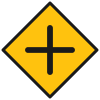
What does this sign tell you is ahead?
Question 18 of 18Road signs
A sign over a lane says "RIGHT LANE MUST TURN RIGHT". You are in that lane. What must you do?
1 of 18
Answer each question to see the explanation. Keyboard: A–D or 1–4 to answer, N next, P previous.
Answers and explanations (text version)
The correct answer to each question above, why it is right, and where it comes from. Try the test first.
Question 1: D. At least 10 inches
Sit at least 10 inches from the steering wheel so a deploying airbag does not hurt you.
Handbook: Chapter: Safe driving and hazards — Seat belts and airbags
Question 2: A. The light is about to turn red
A steady yellow light warns that the light is about to turn red. Stop if you can do so safely.
Handbook: Chapter: Traffic signals and pavement markings — Traffic signals
Question 3: B. No stopping or parking
In many states a red curb means no stopping or parking. Check your state for its curb colors.
Handbook: Chapter: Parking and stopping — Curb markings
Question 4: C. White line on your right, yellow on your left
The manual says a white line on your right and a yellow line on your left mean you are headed in the right direction.
Handbook: Chapter 3: Learning to Drive — Negotiating Highways and Interchanges
Question 5: A. Let the cyclist pass, then turn
Yield to the cyclist in the bike lane. Let them go by, then make your turn behind them.
Handbook: Chapter: Sharing the road — Bicycles
Question 6: B. It throws snow and may stop suddenly
Snowplows throw snow, move slowly and may stop or turn suddenly, so stay well back.
Handbook: Chapter: Sharing the road — Emergency and work vehicles
Question 7: A. Exit the circle, then pull over
If you are in the roundabout, exit right away and then pull to the side; the manual says never stop in the roundabout.
Handbook: Chapter 3: Learning to Drive — Negotiating Intersections
Question 8: A. Turn right with care, yielding to people crossing
A green arrow lets you turn right even while the red light is on, but you must still yield to people crossing and cars already in the intersection.
Handbook: Chapter: Traffic signals and pavement markings — Traffic signals
Question 9: A. Pull up beside the car in front of the space
Signal, then pull up alongside the car in front of the space before you start to back in.
Handbook: Chapter: Parking and stopping — Parallel parking
Question 10: D. Yield to the oncoming car
A driver turning left must yield to oncoming traffic that is close enough to be a hazard.
Handbook: Chapter: Right of way — Uncontrolled intersections
Question 11: B. $500
The manual states: "First offense is $500, second offense is $1,000," and $2,000 for a third or later.
Handbook: Chapter 4: Driving Record Information — Chemical Test Refusal Restoration Fee
Question 12: D. Work zones and road work
Orange signs mark work zones. Expect lower speeds, lane changes and workers on the road.
Handbook: Chapter: Traffic signs — Sign shapes and colors
Question 13: A. 60-day suspension, 5 points and a fine
Failing to stop for a school bus in Pennsylvania brings a 60-day license suspension, 5 points on your record and a fine.
Handbook: Chapter 3: Learning to Drive — School Buses
Question 14: D. In rain, fog, or at night
Leave more space when it is wet, foggy or dark, since you need more time to see hazards and to stop.
Handbook: Chapter: Speed and following distance — Following distance
Question 15: B. 12 inches
Pennsylvania drivers must park as close to the curb as they can, but no more than 12 inches away from it.
Handbook: Chapter 3: Learning to Drive — Parking
Question 16: C. High beams, until another car comes near
High beams let you see farther on a dark, empty road; switch back to low beams when another car comes near.
Handbook: Chapter: Safe driving and hazards — Night and weather
Question 17: B. Another road crosses yours
The cross symbol warns of a crossroad ahead. Watch for traffic coming from both sides.
Handbook: Chapter: Traffic signs — Warning signs
Question 18: B. Turn right at the intersection
This sign means every vehicle in the right lane must turn right at the intersection.
Handbook: Chapter: Traffic signs — Regulatory signs
Practice test 1 of 10 for the Knowledge Test (non-commercial learner's permit) (PennDOT): 18 questions · 15 of 18 (83%) to pass · no time limit.