Question 1 of 20Signs and markings
Australian Capital Territory road signs test: free practice with 20 sign questions.
Question 1 of 20Signs and markings
Question 2 of 20Signs and markings
Question 3 of 20Signs and markings
Question 4 of 20Signs and markings
Question 5 of 20Signs and markings
Question 6 of 20Signs and markings
Question 7 of 20Signs and markings

Question 8 of 20Signs and markings

Question 9 of 20Signs and markings
Question 10 of 20Signs and markings
Question 11 of 20Signs and markings
Question 12 of 20Signs and markings
Question 13 of 20Signs and markings
Question 14 of 20Signs and markings
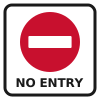
Question 15 of 20Signs and markings
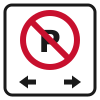
Question 16 of 20Signs and markings
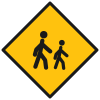
Question 17 of 20Signs and markings
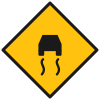
Question 18 of 20Signs and markings
Question 19 of 20Signs and markings
Question 20 of 20Signs and markings
Answer each question to see the explanation. Keyboard: A–D or 1–4 to answer, N next, P previous.
The correct answer to each question above, why it is right, and where it comes from. Try the test first.
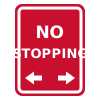
Question 1: D. Not at all, unless traffic or an emergency forces you
No stopping means a vehicle may not stop or park on that part of the street for any purpose.
Handbook: ACT Road Rules Handbook — Where not to park your vehicle (p. 63)
Question 2: B. Brake carefully and sound your horn
If an animal is dazzled by your lights, brake carefully and sound your horn; steer around it only if you cannot stop safely.
Handbook: ACT Road Rules Handbook — Night driving (p. 86)
Question 3: A. Pass to the left of the island
This sign means keep to the left of the island or divider ahead.
Handbook: ACT Road Rules Handbook — Regulatory signs (mandatory) (p. 35)
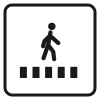
Question 4: B. Give way to the cyclist on the crossing
Drivers must give way to pedestrians and cyclists on a marked pedestrian crossing.
Handbook: ACT Road Rules Handbook — Pedestrian crossings (p. 60)
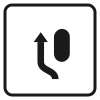
Question 5: C. As close as practical to the right edge
When turning right from a one-way road, approach and enter the intersection from as near as practicable to the right edge.
Handbook: ACT Road Rules Handbook — Right-hand turns (p. 56)
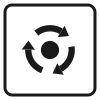
Question 6: B. Before you enter, and keep it on until you leave
When turning left at a roundabout, signal left before entering and keep signalling throughout the turn until you leave.
Handbook: ACT Road Rules Handbook — Roundabouts (p. 50)
Question 7: A. Stop and wait until the lights stop flashing
You must not enter a level crossing while its warning lights are operating, even if you cannot see a train.
Handbook: ACT Road Rules Handbook — Level crossings (p. 62)
Question 8: A. Stop fully behind the line, then go when safe
At a stop sign you must bring the vehicle to a complete stop behind the hold line, even if no traffic is coming, then give way.
Handbook: ACT Road Rules Handbook — Regulatory signs (mandatory) (p. 35)
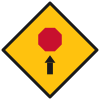
Question 9: D. A stop sign ahead that may be hard to see
This sign warns of a stop sign ahead, so slow down and prepare to stop.
Handbook: ACT Road Rules Handbook — Warning signs (advisory) (p. 36)
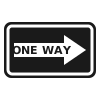
Question 10: C. Only in the direction of the arrow
This sign means traffic travels only in the direction the arrow points.
Handbook: ACT Road Rules Handbook — Regulatory signs (mandatory) (p. 35)
Question 11: A. The right lane
To drive all the way around a roundabout, or more than three quarters of the way, you must enter from the right lane.
Handbook: ACT Road Rules Handbook — Roundabouts (p. 52)
Question 12: B. If the load could come close to the overhead wires
You must not enter a level crossing if your vehicle or load is at risk of coming close to the overhead wires.
Handbook: ACT Road Rules Handbook — Level crossings (p. 62)
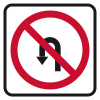
Question 13: C. From the sign to the next intersection
Away from an intersection, a no U-turn sign applies from the sign to the next intersection, or to the end of the road.
Handbook: ACT Road Rules Handbook — Making a U-turn contrary to a no U-turn sign (p. 58)
Question 14: C. Ignore that turn and take another route
Regulatory signs must be obeyed by law. This sign means no entry from this direction, so find another route.
Handbook: ACT Road Rules Handbook — Regulatory signs (mandatory) (p. 35)
Question 15: B. More than 3 metres away
In a no parking area the driver must stay with the vehicle; it counts as unattended if you are more than 3 metres from its closest point.
Handbook: ACT Road Rules Handbook — Where not to park your vehicle (p. 63)
Question 16: D. Children can act on impulse and step out
Children do not understand road rules and can be impulsive, so slow down near them, especially around parked cars.
Handbook: ACT Road Rules Handbook — Safe speed (p. 39)
Question 17: A. In shady spots under trees and on timber bridges
Watch for icy patches in areas shaded by trees, on timber bridges and on exposed windy stretches.
Handbook: ACT Road Rules Handbook — Winter and wet weather driving (p. 87)
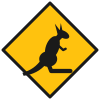
Question 18: D. Slow down and watch for animals on the road
This sign warns that kangaroos or other wildlife may be on the road, so slow down, especially at dawn and dusk.
Handbook: ACT Road Rules Handbook — Night driving (p. 86)
Question 19: A. People may be crossing using the island
ACT pedestrian refuge zones are yellow and red with Keep Left on them; slow down and watch for people crossing.
Handbook: ACT Road Rules Handbook — Pedestrian refuge zone (p. 61)
Question 20: A. Going straight ahead or turning right
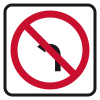
This sign bans only the left turn at this place, so going straight or turning right is still allowed if nothing else stops it.
Handbook: ACT Road Rules Handbook — Regulatory signs (mandatory) (p. 35)
Australian road signs and ACT road rules as set out in the ACT Road Rules Handbook ('guidance based on the Road Transport (Road Rules) Regulation 2017'); test categories: car general, alcohol and drugs, intersections, seat belts, driving general and vulnerable road users. 16 correct (80%) is our practice mark, not an official pass mark.
Our own simplified drawings of the signs learners meet most. The full list, with meanings, is in the Australia sign library; the official reference is the ACT Road Rules Handbook.
Stop completely at the stop line, then give way to all traffic before moving on.
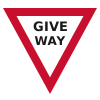
Slow down and stop if needed to let other traffic go first.
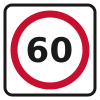
The maximum legal speed until another limit is shown.
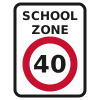
A lower speed limit applies during the school times shown on the sign.
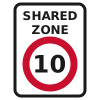
Pedestrians and vehicles share this space; give way to pedestrians and keep to the low limit shown.
You must not drive into this road from this direction.
Keep to the left of the island or divider ahead.
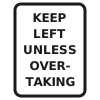
Stay in the left lane except when overtaking; the sign applies on roads where it is posted, which each state sets by speed limit.
Traffic travels only in the direction of the arrow.
You must not turn left here.
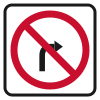
You must not turn right here.
You must not make a U-turn here.
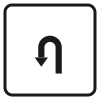
You may make a U-turn here, giving way to all other vehicles and pedestrians.
You are entering a roundabout; give way to vehicles already in it and travel clockwise.
You may stop for up to 2 minutes to drop off or pick up passengers or goods, but must stay within 3 m of the vehicle.
You must not stop at any point in the direction of the arrows unless forced to by traffic or an emergency.
Marks a pedestrian (zebra) crossing; give way to anyone on or entering it.
Marks the level crossing; give way to trains and stop if one is approaching.
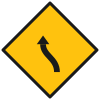
The road bends left ahead; slow to a safe speed before the curve.
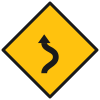
Several bends lie ahead; keep your speed down.
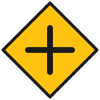
A road crosses ahead; watch for vehicles from both sides.
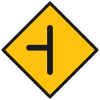
A side road joins from the left ahead.
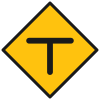
The road ends at a crossing road ahead; you will need to turn left or right.
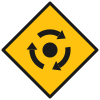
A roundabout is coming up; slow down and prepare to give way.
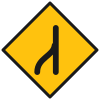
Two lanes become one ahead; merge smoothly and give way as required.
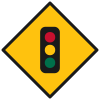
Traffic lights are ahead; be ready to stop.
A stop sign is ahead; slow down and prepare to stop.
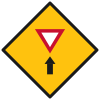
A give way sign is ahead; slow down and be ready to give way.
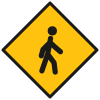
People may be walking on or crossing the road ahead.
Children may be crossing ahead, often near a school; slow down.
Kangaroos or other wildlife may be on the road; slow down, especially at dawn and dusk.
The road may be slippery when wet; slow down.
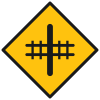
A railway level crossing is ahead; slow down and look for trains.
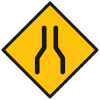
The road becomes narrower ahead; take care with oncoming traffic.
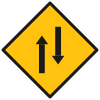
Oncoming traffic shares the road ahead.
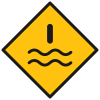
Water may cover the road here; never drive into floodwater.

An obstruction is ahead and all traffic must go around it in the direction the chevrons point, here to the left.

An obstruction is ahead and all traffic must go around it in the direction the chevrons point, here to the right.

Marks the nose of an island or obstruction that traffic may pass on either side.
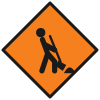
Roadwork is ahead; slow down and follow any temporary speed limit.
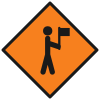
A person with a stop/slow bat is controlling traffic ahead; be ready to stop.