Question 1 of 30Road rules
Practice test 1 of 10 — Northern Territory theory test
Practice test 1 questions
Question 2 of 30Learner and P-plate rules
In the Northern Territory, four drivers have each held an NT P licence for two years and are now in its last six weeks. Who can get a free 10-year open car licence?
Question 3 of 30Hazards and sharing the road
You are first to arrive at a crash. A driver is awake but stuck in the car, and there is no sign of fire. What should you do?
Question 4 of 30Road rules
You turn into a shopping street where people on foot, cyclists and cars all share the road space. What speed limit do these zones often have?
Question 5 of 30Hazards and sharing the road
Two cyclists are riding side by side ahead of you on a two-lane road. How should you overtake them?
Question 6 of 30Signs and markings
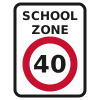
In the Northern Territory you pass this sign on a weekday in the school holidays, within the hours shown on it. What limit applies?
Question 7 of 30Signs and markings
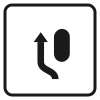
This sign is on a traffic island in the middle of the road ahead of you. How must you pass the island?
Question 8 of 30Hazards and sharing the road
You reach a flooded causeway with 'road closed' signs in place, but a local says the water is shallow. What should you do?
Question 9 of 30Signs and markings

You see this sign on a pole in front of a concrete barrier. How must you drive past?
Question 10 of 30Road rules
It is after sunset and you are driving on a town street with bright street lights. Must your headlights be on?
Question 11 of 30Alcohol, drugs and penalties
In the Northern Territory, a driver tests positive on a first roadside saliva test for drugs. What will police require next?
Question 12 of 30Road rules
You are on a country road with a 100 km/h limit and come up behind a cyclist. What is the least gap you must leave when you pass?
Question 13 of 30Hazards and sharing the road
You are overtaking a road train on an open highway. When is it safe to move back into the left lane?
Question 14 of 30Signs and markings
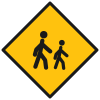
You see this sign at 8.15 am on a school day. Children are walking along the footpath. What should you do?
Question 15 of 30Road rules
The lane you are driving in is ending, and you must cross a lane line to join the lane beside you. Who must give way?
Question 16 of 30Safe driving
You are stopped in an intersection, waiting for a gap to turn right across oncoming traffic. Why should your front wheels stay straight?
Question 17 of 30Signs and markings
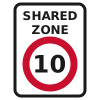
You turn into a narrow street past this sign. A group of people are walking down the middle of the road ahead. What must you do?
Question 18 of 30Signs and markings
A warning sign at the top of a long hill shows a steep descent ahead. How should you control your speed going down?
Question 19 of 30Road rules
You are driving in the left lane in a 60 km/h zone. A bus at a stop ahead shows a 'give way to buses' sign and its right indicator is flashing. What must you do?
Question 20 of 30Road rules
In the Northern Territory, it is a school day and you pass a school zone sign during the times it shows. What is the most you may drive?
Question 21 of 30Safe driving
You are driving through a busy shopping strip. What is the best way to use your eyes?
Question 22 of 30Hazards and sharing the road
In the Northern Territory, you clip the side mirror of a parked car in a narrow street and damage it. What must you do?
Question 23 of 30Signs and markings
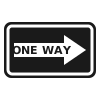
You turn right into a street marked with this sign. Where on the new road should your car be as you finish the turn?
Question 24 of 30Hazards and sharing the road
You are driving through a town centre on a busy evening. Which pedestrians are especially vulnerable?
Question 25 of 30Safe driving
You are about to drive to the beach wearing thongs. Why are they a poor choice for driving?
Question 26 of 30Safe driving
A driving instructor says that preventing skids is as easy as 'ABC'. What does this stand for?
Question 27 of 30Safe driving
You have hired a four-wheel drive for a holiday. Why might it handle differently from your normal car?
Question 28 of 30Road rules
You come to a stop sign with a stop line. The road you are joining looks clear both ways. What must you do?
Question 29 of 30Road rules
You drive an ordinary sedan and there is a free spot in a loading zone outside a shop. What may you do there?
Question 30 of 30Signs and markings
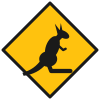
Under this sign is a plate that reads 'Next 40 km'. What does the plate tell you?
1 of 30
Answer each question to see the explanation. Keyboard: A–D or 1–4 to answer, N next, P previous.
Answers and explanations (text version)
The correct answer to each question above, why it is right, and where it comes from. Try the test first.
Question 1: D. Give way, but keep the intersection clear
You must give way to emergency vehicles, but blocking an intersection while you do so is dangerous.
Handbook: Road Users' Handbook — Emergency vehicles (p. 130)
Question 2: D. A driver with no traffic offences or suspensions
The free 10-year open licence is for P drivers with no traffic offences or suspensions who apply on time.
Official source: nt.gov.au — Get your driver licence
Question 3: B. Leave them in the car and call 000
Do not remove a person from a vehicle unless they are in immediate danger, such as from fire. Call 000 for help.
Handbook: Road Users' Handbook — If you witness or see a road crash (p. 29)
Question 4: A. 10 km/h
Shared zones often have a 10 km/h limit, and you must keep to it so everyone sharing the street stays safe.
Handbook: Road Users' Handbook — Shared traffic zone (p. 65)
Question 5: A. Pass them as you would pass a car, with care
Cyclists may ride two side by side, so when they do, overtake them the same way you would pass a car.
Handbook: Road Users' Handbook — Sharing the road with cyclists (p. 33)
Question 6: C. The road's normal limit, as the zone hours are over
The school zone limit only applies on school days, so on a school holiday the normal limit for that road applies.
Official source: nt.gov.au — Speed limits
Question 7: D. Pass on the left side of it
This sign tells you to keep to the left of the sign and the island it stands on.
Handbook: Road Users' Handbook — Regulatory signs (p. 99)
Question 8: D. Do not cross while the road is closed
Never try to cross a flooded road where 'road closed' signs or other controls show the road cannot be used.
Handbook: Road Users' Handbook — Water on the road (p. 56)
Question 9: B. Pass on the left side, where the arrows point
This hazard marker shows an obstruction; go around it the way the chevrons point, which is to the left.
Handbook: Road Users' Handbook — Traffic signs (p. 98)
Question 10: D. Yes, they must be on from sunset to sunrise
Your headlights must be on whenever you drive between sunset and sunrise, even where there are street lights.
Handbook: Road Users' Handbook — Headlights (p. 127)
Question 11: C. A second saliva test, there at the roadside
After a positive first saliva test, police require a second saliva test at the roadside to confirm drugs are present.
Official source: nt.gov.au — Alcohol, drugs and driving
Question 12: B. 1.5 metres
Where the speed limit is over 60 km/h, you must leave at least 1.5 metres when passing a cyclist.
Handbook: Road Users' Handbook — Overtaking cyclists (p. 115)
Question 13: C. When you can see both its headlights in your mirror
Do not move back until you can see both of the road train's headlights in your mirror, and do not slow down as you pull in.
Handbook: Road Users' Handbook — Driving with road trains and heavy vehicles (p. 50)
Question 14: D. Drive slowly and be ready to stop for children
This sign warns that children might be crossing. Near schools, drive slowly and be ready to stop, mostly as children arrive or leave.
Handbook: Road Users' Handbook — Sharing the road with pedestrians (p. 30)
Question 15: D. You must give way to traffic in that lane
When your lane ends and you cross lane lines to merge, you must give way to all traffic in the lane you are joining.
Handbook: Road Users' Handbook — Merging lanes (p. 111)
Question 16: D. So a hit from behind won't push you into oncoming cars
Keeping the wheels straight while you wait means that if a car hits you from behind, you will not be pushed into oncoming traffic.
Handbook: Road Users' Handbook — Crash avoidance space at intersections (p. 44)
Question 17: A. Give way to the people walking in the street
In this zone you must give way to all pedestrians, who share the road with cars and bikes.
Handbook: Road Users' Handbook — Shared traffic zone (p. 65)
Question 18: D. Slow down and change to a lower gear
This sign warns of a steep descent, so slow down and use a lower gear to help hold your speed.
Handbook: Road Users' Handbook — Warning signs (p. 101)
Question 19: A. Slow down or stop and let the bus pull out
In zones of 70 km/h or less, you must give way to a bus that shows a give way sign and signals to pull out.
Handbook: Road Users' Handbook — Giving way to a bus (p. 71)
Question 20: D. 40 km/h
On school days, during the times on the sign, you must drive at 40 km/h or less in an NT school zone.
Official source: nt.gov.au — Speed limits
Question 21: C. Keep your eyes moving, checking each area for a couple of seconds
Good observation means scanning: keep your eyes moving, look at one area for a couple of seconds, then check the next, including your mirrors.
Handbook: Road Users' Handbook — Observation skills (p. 41)
Question 22: D. Stop, give your details and report it to police
After a crash that damages property you must stop, give your name, address and vehicle details, and report the crash to police.
Handbook: Road Users' Handbook — If you are involved in a road crash (p. 28)
Question 23: B. As close as you can to its right side
When turning right into a one-way street, you must turn as close as possible to the right side of the road you enter.
Handbook: Road Users' Handbook — One-way streets (p. 81)
Question 24: B. Older people, children and anyone affected by alcohol
Older people, children and pedestrians affected by alcohol or drugs are especially at risk, so drive slowly and be ready to stop.
Handbook: Road Users' Handbook — Sharing the road with pedestrians (p. 30)
Question 25: D. They can get in the way when you work the pedals
Footwear without a closed heel, such as thongs, can get in the way of the pedals, so enclosed shoes are recommended.
Handbook: Road Users' Handbook — Footwear (p. 46)
Question 26: D. Accelerate, brake and corner smoothly
To prevent skids, accelerate, brake and corner smoothly. Harsh or sudden actions can make the tyres lose grip.
Handbook: Road Users' Handbook — Skidding (p. 52)
Question 27: A. It often has a higher centre of gravity
Four-wheel drives often have a higher centre of gravity and can be pushed about more by wind from other vehicles.
Handbook: Road Users' Handbook — Four-wheel drive vehicles (p. 49)
Question 28: B. Stop fully at the line, then go when safe
At a stop sign you must stop completely before the line and as close to it as you can, then go only when it is safe.
Handbook: Road Users' Handbook — Stop signs and stop lines (p. 73)
Question 29: C. Stop only to drop off or pick up passengers
Only goods vehicles may park in a loading zone; other vehicles may only stop there to pick up or drop off passengers.
Handbook: Road Users' Handbook — Loading zone (p. 126)
Question 30: A. Kangaroos are more likely near the road for about 40 km
A distance plate under a warning sign shows how far the hazard is likely, here kangaroos for about the next 40 km.
Handbook: Road Users' Handbook — Advisory signs (p. 103)
Practice test 1 of 10 for the Driver knowledge test (theory test, learner driver licence) (NT MVR): 30 questions · 26 of 30 (87%) to pass · no time limit.