Question 1 of 45General knowledge
Practice test 1 of 10 — NSW DKT test
Practice test 1 questions
Question 2 of 45General knowledge
You are in a crash. What details must you give the other driver?
Question 3 of 45General knowledge · Traffic signs
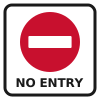
This sign faces you at the entrance to a side street. What may you do?
Question 4 of 45General knowledge
You want to park on a road that has a double centre line. How much space must be left between your car and that line?
Question 5 of 45General knowledge
At a pelican crossing, the light for vehicles is flashing yellow after the red. When may you drive through?
Question 6 of 45General knowledge · Traffic signs
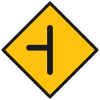
What does this sign show about the road you are on?
Question 7 of 45General knowledge
You have slowed down to pass a stopped ambulance with flashing lights. When may you speed up again?
Question 8 of 45General knowledge
Your road ends at a T-intersection with no signs. Who must you give way to?
Question 9 of 45General knowledge
You are on the continuing road of a T-intersection and want to turn right into the road that ends. Who must you give way to?
Question 10 of 45General knowledge · Traffic signs
An overhead signal above your motorway lane shows a red cross. What does it mean?
Question 11 of 45General knowledge · Traffic signs
You are first in line at a red signal. Where should the front of your car be?
Question 12 of 45General knowledge
You are on high beam behind another car. Within what distance of it must you switch to low beam?
Question 13 of 45General knowledge
Two lines of traffic merge into one and there are no lane markings. Which driver must give way?
Question 14 of 45General knowledge · Traffic signs
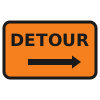
Works have closed your usual road and you see this sign. How should you continue your trip?
Question 15 of 45General knowledge · Traffic signs
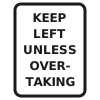
Even without this sign, the same right-lane rule applies when the speed limit is more than what?
Question 16 of 45Road safety
On a country drive, near which places should you expect wild animals to be more active?
Question 17 of 45Road safety
You hold a P1 licence in NSW and join a motorway signed at 110 km/h. What is the fastest you may drive?
Question 18 of 45Road safety
Late in a long drive, you notice a change in the way you steer. Which change warns you of fatigue?
Question 19 of 45Road safety
About how long does a fit, alert driver need to react to a hazard at normal speeds?
Question 20 of 45Road safety
Pedestrians are hardest for drivers to spot at which of these times?
Question 21 of 45Road safety
A child aged 5 is travelling in your car. Which restraint is allowed?
Question 22 of 45Road safety
You are driving at the speed limit at night in heavy rain. What should you do?
Question 23 of 45Road safety
You have a long drive tomorrow. About how much sleep does the average person need at night to work normally?
Question 24 of 45Road safety
What is the only real way to overcome tiredness when driving?
Question 25 of 45Road safety
In NSW, what is the legal alcohol limit for a driver who holds a full car licence?
Question 26 of 45Road safety
What is the best way to avoid running into the back of the car in front?
Question 27 of 45Road safety
Which of these is an example of hooning?
Question 28 of 45Road safety
Which of these is an early warning sign of fatigue while driving?
Question 29 of 45Road safety
The fog you were driving through has cleared and you can see well again. What must you do with your fog lights?
Question 30 of 45Road safety
Children must use an approved child restraint in a car until they reach what age?
Question 31 of 45Road safety
Up to what age must a baby travel in a rear-facing child car seat?
Question 32 of 45Road safety
What is the correct two-stage way to brake?
Question 33 of 45Road safety
A 3-year-old is travelling in a car with two rows of seats. Where may the child sit?
Question 34 of 45Road safety
In NSW, you pass a bicycle rider on a road with an 80 km/h limit. What is the smallest gap allowed?
Question 35 of 45Road safety
In NSW, what is the highest speed a learner driver may drive, even where a sign shows a higher limit?
Question 36 of 45Road safety
A driver with a full Victorian car licence is driving in NSW. What alcohol limit applies to them?
Question 37 of 45Road safety
Your passenger wants to rest their arm out of the open window while you drive. What is the rule?
Question 38 of 45Road safety
A P2 driver has a medical condition that makes wearing a seatbelt unsafe. When are they excused from wearing one?
Question 39 of 45Road safety
Bags and shopping are lying loose on the back seat before you set off. What is the best thing to do with them?
Question 40 of 45Road safety
What does it mean to wear your seatbelt 'low, flat and firm'?
Question 41 of 45Road safety
A NSW driver on a full licence has nowhere to mount their phone. What phone use is allowed on the move?
Question 42 of 45Road safety
After a breakdown, your 9-month-old baby must ride in a tow truck with two rows of seats and no child seat. How may the baby travel?
Question 43 of 45Road safety
Someone steps out in front of your car in the middle of a block, away from any crossing. How should you react?
Question 44 of 45Road safety
Light rain begins to fall during your drive. Which change makes you safer?
Question 45 of 45Road safety
You brake hard on a wet road and feel the brake pedal pulse under your foot. What is most likely happening?
1 of 45
Answer each question to see the explanation. Keyboard: A–D or 1–4 to answer, N next, P previous.
Answers and explanations (text version)
The correct answer to each question above, why it is right, and where it comes from. Try the test first.
Question 1: D. To warn others that you are approaching
You can only use your horn to warn others you are approaching or of your position, or to warn animals off the road.
Handbook: Warnings and road hazards — Lights and horns (p. 184)
Question 2: B. Your name, address and rego number
After a crash you must give your name and address, your registration number, and the owner's details if you are not the owner.
Handbook: Warnings and road hazards — Crashes (p. 174)
Question 3: C. Stay out of that street
A No entry sign means you must not turn into or enter the road beyond it, so stay out of that street.
Handbook: Stopping, giving way and turning — Turning left and right (p. 110)
Question 4: B. 3 metres
You must not park within 3 metres of any double dividing lines.
Handbook: Parking — No parking (p. 159)
Question 5: B. When no pedestrians are on the crossing
When the yellow light flashes at a pelican crossing, you can drive through if there are no pedestrians on the crossing.
Handbook: Stopping, giving way and turning — Pedestrian crossings (p. 117)
Question 6: B. It carries on past a road joining it
A side road sign shows that your road carries on while another road joins it from the side.
Handbook: Warnings and road hazards — Warning signs (p. 168)
Question 7: C. After passing all vehicles and people involved
When passing a stopped emergency vehicle, you must not speed up until you have passed all vehicles and people involved.
Handbook: Warnings and road hazards — Police and emergency vehicles (p. 179)
Question 8: C. All vehicles on the continuing road
On a road that ends at a T-intersection, you must give way to all vehicles on the continuing road, unless a sign says otherwise.
Handbook: Stopping, giving way and turning — Intersections (p. 103)
Question 9: C. Oncoming cars going straight or turning left
Turning right from the continuing road, you must give way to oncoming vehicles going straight ahead or turning left.
Handbook: Stopping, giving way and turning — Intersections (p. 103)
Question 10: B. The lane is closed; move out of it
A red cross is a closed-lane signal, so you must not drive in that lane and should move out of it.
Handbook: Overtaking and merging — Motorways and freeways (p. 137)
Question 11: D. Behind the stop line
A red light means you must stop, as close as possible behind the stop line.
Handbook: Stopping, giving way and turning — Traffic lights (p. 85)
Question 12: C. 200 metres
You must dip to low beam when driving 200 metres or less behind another vehicle.
Handbook: Warnings and road hazards — Lights and horns (p. 183)
Question 13: A. The driver behind gives way to the one ahead
In a zipper merge with no road markings, you must give way to the vehicle that is ahead of you.
Handbook: Overtaking and merging — Merging and changing lanes (p. 133)
Question 14: B. Follow the marked route around a closure
A Detour sign means the usual road is closed, so follow the marked route around the closure.
Handbook: Warnings and road hazards — Roadworks (p. 171)
Question 15: C. 80 km/h
You must keep out of the right lane, unless an exception such as overtaking applies, on roads with this sign or a limit over 80 km/h.
Handbook: Overtaking and merging — Overtaking (p. 128)
Question 16: D. Near waterholes and creeks
Animals are more active near waterholes and creeks, and are harder to see at sunrise and sunset. Slow down in these places.
Handbook: Warnings and road hazards — Wildlife and livestock (p. 173)
Question 17: B. 90 km/h
A P1 driver in NSW has a top speed of 90 km/h, whatever the sign shows.
Handbook: Safe driving behaviour — Speed limits (p. 33)
Question 18: B. Making fewer, larger steering corrections
Making fewer and larger steering corrections, or having trouble staying in your lane, are early signs of fatigue. Stop and rest.
Handbook: Safe driving behaviour — Fatigue (p. 59)
Question 19: C. 1.5 seconds
A fit and alert driver needs about 1.5 seconds to react to a hazard, and more at higher speeds.
Handbook: Safe driving behaviour — Safe stopping distance (p. 65)
Question 20: A. At night, at dusk, or in rain or fog
Pedestrians are hard to see at night, at dawn or dusk, and in rain or fog, so slow down and be ready to stop.
Handbook: Sharing with other road users — Pedestrians (p. 73)
Question 21: B. A forward-facing harness seat or a booster seat
Children aged 4 to 7 must use a forward-facing seat with a built-in harness or an approved booster seat.
Handbook: Safe driving behaviour — Child car seats (p. 49)
Question 22: A. Slow down to suit the conditions
A speed limit is the most you may drive in good conditions, so slow down when conditions are poor.
Handbook: Safe driving behaviour — Speed limits (p. 39)
Question 23: C. 8 hours
The average person needs about 8 hours of sleep a night. Getting less builds up a sleep debt that makes you tired at the wheel.
Handbook: Safe driving behaviour — Fatigue (p. 59)
Question 24: C. Getting some sleep
Sleep is the only way to beat tiredness, so pull over safely and have a nap when you notice fatigue.
Handbook: Safe driving behaviour — Fatigue (p. 60)
Question 25: C. A BAC under 0.05
A driver with a full (unrestricted) car licence in NSW must keep their BAC under 0.05.
Handbook: Safe driving behaviour — Alcohol limits (p. 39)
Question 26: D. Keep a safe gap from the car in front
Keeping a safe stopping gap from the car in front is one of the main ways to avoid rear-end crashes.
Handbook: Safe driving behaviour — Common crashes in NSW (p. 70)
Question 27: D. Doing burnouts or donuts
Hooning includes deliberately losing traction, such as doing burnouts or donuts, and racing other cars.
Handbook: Safe driving behaviour — Hooning and street racing (p. 62)
Question 28: B. Yawning and tired eyes
Yawning, tired or sore eyes, poor focus and drifting in the lane are warning signs that you need to rest.
Handbook: Safe driving behaviour — Fatigue (p. 59)
Question 29: D. Switch them off
Fog lights may only be used in fog, heavy rain, smoke or dust. You must switch them off once you can see clearly.
Handbook: Warnings and road hazards — Lights and horns (p. 184)
Question 30: B. 7 years
Children under 7 years must travel in an approved child restraint that suits their age and size.
Handbook: Safe driving behaviour — Child car seats (p. 49)
Question 31: C. 6 months
Children up to 6 months old must use an approved rear-facing child car seat.
Handbook: Safe driving behaviour — Child car seats (p. 49)
Question 32: B. Press lightly and pause, then squeeze harder
Two-stage braking means pressing lightly and pausing to set up the brakes, then squeezing to the pressure you need.
Handbook: Safe driving behaviour — Safe stopping distance (p. 68)
Question 33: D. Only in the back, in a suitable child seat
Children under 4 must not sit in the front of a car with two or more rows; they must ride in the back in a suitable child seat.
Handbook: Safe driving behaviour — Child car seats (p. 51)
Question 34: D. 1.5 metres
Where the limit is over 60 km/h, you must leave at least 1.5 metres when passing a bicycle rider.
Handbook: Sharing with other road users — Bicycle riders (p. 76)
Question 35: B. 90 km/h
Learner drivers in NSW must not go faster than 90 km/h, even if the posted limit is higher.
Handbook: Safe driving behaviour — Speed limits (p. 33)
Question 36: B. A BAC under 0.05
In NSW, a fully licensed driver from interstate or overseas has the same limit as a full NSW licence holder: a BAC under 0.05.
Handbook: Safe driving behaviour — Alcohol limits (p. 39)
Question 37: D. No part of their body may be outside the car
Drivers and passengers must not have any part of their body outside the vehicle while it is moving.
Handbook: Safe driving behaviour — Seatbelts (p. 46)
Question 38: D. When they carry a medical certificate
All drivers, including P1 and P2, may be exempt if they have a medical condition and carry a medical certificate. The reversing exemption is for full licence holders only.
Handbook: Safe driving behaviour — Seatbelts (p. 49)
Question 39: A. Put them in a box or in the boot
Loose items can distract you while driving. Put them in a bag, a box or the boot before you set off.
Handbook: Warnings and road hazards — Driving distractions (p. 182)
Question 40: D. On your hips, with no twists and no slack
A seatbelt should sit low on your hips, lie flat with no twists, and be pulled firm to remove slack.
Handbook: Safe driving behaviour — Seatbelts (p. 47)
Question 41: D. By Bluetooth for calls or audio, without touching it
Without a holder, a full licence holder may only use Bluetooth, without touching the phone, for calls or audio.
Handbook: Safe driving behaviour — Mobile phones (p. 55)
Question 42: A. On a passenger's lap in the back seat
After a crash or breakdown, a child under 12 months may ride in a tow truck on a passenger's lap if no child seat is available. With two rows, they must sit in the back seat.
Handbook: Safe driving behaviour — Child car seats (p. 52)
Question 43: A. Slow down and be ready to stop
Even if a pedestrian is jaywalking, slow down and be ready to stop if there is any risk of hitting them.
Handbook: Sharing with other road users — Pedestrians (p. 72)
Question 44: C. Turn on your headlights and widen your gap
When rain starts, turn on your headlights, slow down gently and widen the gap to the vehicle in front.
Handbook: Warnings and road hazards — Driving in poor conditions (p. 180)
Question 45: C. The ABS is stopping the tyres from skidding
ABS controls braking force to stop the tyres skidding. It may make the brake pedal pulse or shudder when it is working.
Handbook: Vehicle safety and compliance — Electronic driver assist systems (p. 191)
Practice test 1 of 10 for the Driver Knowledge Test (DKT) (Transport for NSW): 45 questions, 41 to pass (12 of 15 general knowledge and 29 of 30 road safety) — the commonly reported format; Transport for NSW does not publish the count or a pass mark. Our practice tests are untimed.