Question 1 of 30Giving way · Road rules
Practice test 2 of 10 — Queensland road rules test
Practice test 2 questions
Question 2 of 30Giving way · Road rules
You face a GIVE WAY sign and want to go straight. An oncoming car with no sign is turning right across your path. Who must give way?
Question 3 of 30Giving way · Road rules
You are turning left into a side street. A person is walking across the side street. What must you do?
Question 4 of 30Giving way · Road rules
A horse rider ahead raises a hand and points to the horse, which looks hard to control. What should you do?
Question 5 of 30Giving way · Road rules
The centre of the road has two continuous lines. A slow truck is ahead of you. May you cross the lines to overtake it?
Question 6 of 30Giving way · Road rules
In Queensland, you stop your car in a loading zone to drop off some boxes of goods. What is the longest you may stay?
Question 7 of 30Giving way · Road rules
You are in a built-up area with a 60 km/h limit. A bus ahead has a give way to buses sign and is signalling to leave a bus stop. What must you do?
Question 8 of 30Giving way · Road rules
You are driving on a road that ends at a T-intersection. A car is coming along the road that continues through. What must you do?
Question 9 of 30Giving way · Road rules
You are on a road with marked lanes. Your lane is ending, so you must move into the lane beside you. Who must give way?
Question 10 of 30Giving way · Road rules
You face a GIVE WAY sign at a railway level crossing. A train is coming towards the crossing. What must you do?
Question 11 of 30Road rules · Signs and markings
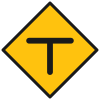
You see this sign as you drive along. What will you need to do soon?
Question 12 of 30Road rules · Signs and markings
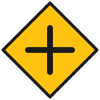
After this sign, you reach the crossing. It has no signs, lines or lights. A car is coming from your right. Who must give way?
Question 13 of 30Road rules · Safe driving
When may you drive with your fog lights switched on?
Question 14 of 30Road rules · Signs and markings
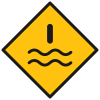
You see this sign and water is flowing over the road ahead. What should you do?
Question 15 of 30Road rules · Alcohol, drugs and penalties
You hold an open licence and drive a taxi for work in Queensland. What alcohol limit applies while on duty?
Question 16 of 30Road rules · Safe driving
You are involved in a crash. What must you do?
Question 17 of 30Road rules · Signs and markings
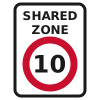
You drive past this sign into a narrow street with shops. A person walks out in front of you. What must you do?
Question 18 of 30Road rules · Safe driving
A front tyre blows out while you are on the highway. What should you do first?
Question 19 of 30Road rules · Safe driving
Why should you have your car radio on when driving through a tunnel?
Question 20 of 30Road rules · Alcohol, drugs and penalties
In Queensland, how much cannabis may be in your system when you drive?
Question 21 of 30Road rules · Learner and P-plate rules
In Queensland, how many hours of supervised driving must a learner under 25 record in a logbook?
Question 22 of 30Road rules · Safe driving
In Queensland, after a crash, when must you report it to police straight away?
Question 23 of 30Road rules · Safe driving
In Queensland, you hold an open licence and are stopped at a red light. May you pick up your phone to read a text?
Question 24 of 30Road rules · Alcohol, drugs and penalties
In Queensland, which drugs does a roadside saliva test look for?
Question 25 of 30Road rules · Alcohol, drugs and penalties
In Queensland, a driver is convicted with a BAC of 0.10 or more. Once the ban ends, what is the shortest time they must spend in the interlock program?
Question 26 of 30Road rules · Signs and markings
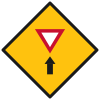
You see this sign as you near an intersection. What is the best response?
Question 27 of 30Road rules · Signs and markings
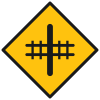
After this sign, you reach the crossing. No train is in sight, but traffic is banked up past the tracks and your car would not fit. What must you do?
Question 28 of 30Road rules · Learner and P-plate rules
You have just moved up to a P2 licence in Queensland. Which plates must you now show on your car?
Question 29 of 30Road rules · Hazards and sharing the road
You are driving on the Gold Coast. Traffic is queued ahead and you are about to cross the tram tracks. What should you do?
Question 30 of 30Road rules · Alcohol, drugs and penalties
In Queensland, what is the lowest BAC at which a driver is over the middle alcohol limit?
1 of 30
Answer each question to see the explanation. Keyboard: A–D or 1–4 to answer, N next, P previous.
Answers and explanations (text version)
The correct answer to each question above, why it is right, and where it comes from. Try the test first.
Question 1: C. Up to 100 m
You may drive on or over a continuous edge line for up to 100 m to stop at the side of the road, turn, or enter or leave the road.
Handbook: Your keys — Edge lines (p. 92)
Question 2: D. You must, because you face the GIVE WAY sign
At a GIVE WAY sign you must give way to vehicles approaching, entering or on the intersection, even one turning right across you.
Handbook: Your keys — GIVE WAY signs (p. 82)
Question 3: A. Give way to the person before you turn
When you turn at an intersection, you must give way to pedestrians crossing the road you are turning into.
Handbook: Your keys — Giving way to pedestrians, bicycle and personal mobility device riders (p. 87)
Question 4: D. Pull over, stop and turn off your engine
When a rider signals like this you must give way; pull to the side, stop and turn off your engine until the horse is no longer upset.
Handbook: Your keys — Giving way to horses (p. 88)
Question 5: B. No, you must stay behind the truck
You must stay behind the truck, because two continuous dividing lines must not be crossed to overtake; the only exception is passing a bicycle rider.
Handbook: Your keys — Dividing lines or centre lines (p. 91)
Question 6: C. 20 minutes
In Queensland any vehicle may stop in a loading zone to drop off or pick up goods for no longer than 20 minutes.
Handbook: Your keys — Loading zones (p. 120)
Question 7: A. Give way and let the bus pull out
In a built-up area with a limit of 70 km/h or less, you must give way to a signalling bus with this sign as it pulls out.
Handbook: Your keys — Giving way to buses (p. 84)
Question 8: B. Give way to the car on the continuing road
If your road ends at a T-intersection, you must give way to all vehicles on the continuing road that are approaching, entering or on the intersection.
Handbook: Your keys — Giving way at a T-intersection (p. 85)
Question 9: A. You must give way to traffic in that lane
If your marked lane ends, you must give way to traffic already in the lane you are moving into, just like any lane change.
Handbook: Your keys — Giving way when merging (p. 84)
Question 10: A. Give way and let the train pass first
At a GIVE WAY sign or line at a level crossing, you must give way to any train approaching the crossing.
Handbook: Your keys — Giving way at a railway level crossing (p. 88)
Question 11: A. Turn left or right, because your road ends
This sign warns of a T-intersection, where your road ends at a crossing road and you must turn left or right.
Handbook: Your keys — Warning signs (p. 65)
Question 12: B. You must give way to the car on your right
At a crossroad with no signs or lines, you must give way to vehicles on your right that are approaching, entering or on the intersection.
Handbook: Your keys — Giving way to the right (p. 83)
Question 13: D. When fog or bad weather makes it hard to see
You may only use fog lights in fog or other bad weather that makes it hard to see. You can be fined otherwise.
Handbook: Your keys — Use of lights (p. 116)
Question 14: C. Do not drive in; turn back or wait
Flood water can be fast moving, so never drive into water over the road. If it's flooded, turn back or wait.
Handbook: Your keys — Road closures due to flooding and wet weather (p. 151)
Question 15: D. Zero, so no alcohol at all
Drivers of taxis, buses, trucks and other set vehicles must have zero alcohol, even on an open licence.
Handbook: Your keys — Alcohol and drugs (p. 103)
Question 16: C. Stop at the scene
You must stop if you are involved in a crash, even if it seems minor or no one looks hurt.
Handbook: Your keys — What to do at a crash (p. 157)
Question 17: C. Give way, as walkers have priority here
In this zone people on foot have full priority, so you must give way to the person who walks out.
Handbook: Your keys — Signs and signals (p. 64)
Question 18: B. Grip the wheel firmly and do not brake yet
After a blowout, hold the wheel firmly and do not brake at once. Let the car slow down gradually, then pull over.
Handbook: Your keys — Tyre blowouts (p. 152)
Question 19: C. To hear safety and traffic messages
Tunnels re-broadcast safety and traffic messages over the radio, so having it on keeps you informed.
Handbook: Your keys — Driving safely in tunnels (p. 146)
Question 20: A. None, as any trace can be penalised
There is no legal limit for cannabis, so any trace found in your system when you drive can be penalised.
Handbook: Your keys — Alcohol and drugs (p. 106)
Question 21: C. 100 hours, with at least 10 at night
Learners under 25 must log 100 hours of supervised driving, and at least 10 of those hours must be at night.
Handbook: Your keys — The compulsory Queensland learner logbook (p. 26)
Question 22: D. When someone is hurt or a car must be towed
You must report a crash to police at once if anyone is hurt or killed, a vehicle must be towed, or a driver does not give their details.
Handbook: Your keys — What to do at a crash (p. 157)
Question 23: C. No, it is illegal even while stopped
Holding a phone while driving is illegal even when you are stopped at lights. Pull over and park safely first.
Handbook: Your keys — Mobile phones (p. 125)
Question 24: C. Ice, ecstasy, cannabis and cocaine
The saliva test looks for ice, ecstasy (MDMA), cannabis (THC) and cocaine, and any trace can be penalised.
Official source: qld.gov.au — Drugs and driving
Question 25: D. 12 months
Drivers convicted of a high-risk drink driving offence must stay in the interlock program for at least 12 months.
Handbook: Your keys — Alcohol ignition interlock program (p. 171)
Question 26: D. Slow down and be ready to give way
This sign warns that a give way sign is ahead, so slow down and be ready to give way when you reach it.
Handbook: Your keys — Warning signs; GIVE WAY signs (pp. 65, 82)
Question 27: B. Wait before the crossing until there is room
You must not enter a level crossing unless your whole vehicle can clear it straight away, so wait before the crossing.
Handbook: Your keys — Entering or leaving a level crossing (p. 102)
Question 28: B. Green P plates at the front and back
P2 drivers must show green P plates at the front and back of the car, and only on the back of a motorbike.
Handbook: Your keys — Provisional licences (p. 36)
Question 29: B. Wait so you do not stop on the tracks
You must not stop on tram tracks or the yellow cross hatching, and you must never queue across the tracks.
Handbook: Your keys — Trams (p. 144)
Question 30: C. 0.10
Queensland has 4 alcohol limits, and a driver is over the middle alcohol limit at 0.10 or more.
Handbook: Your keys — Alcohol and drugs (p. 103)
Practice test 2 of 10 for the Class C (car) PrepL and written road rules test (TMR): 30 questions · 27 of 30 (9 of 10 giving way and 18 of 20 road rules) to pass · no time limit.