Question 1 of 30Signs and markings
Practice test 1 of 10 — South Australia theory test
Practice test 1 questions
Question 2 of 30Hazards and sharing the road
A kangaroo is standing on the road in front of you at night. What should you do?
Question 3 of 30Signs and markings
A painted island ahead is edged by one continuous line. A turning lane begins right after it. How far may you drive on the island to enter that lane?
Question 4 of 30Safe driving
Your car has electronic stability control (ESC). What does it do when it senses the car starting to slide?
Question 5 of 30Road rules
You want to make a U-turn at an intersection with traffic lights. There is no sign about U-turns. What does the rule say?
Question 6 of 30Signs and markings
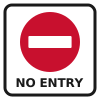
Your GPS tells you to turn into a street, but this sign faces you at its entrance. What should you do?
Question 7 of 30Signs and markings
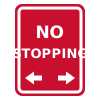
Your car breaks down on a street where this sign applies. What does the rule allow?
Question 8 of 30Learner and P-plate rules
You are 22 and hold a P2 licence in South Australia. A friend offers to lend you his high-powered car. What applies?
Question 9 of 30Road rules
You are on the entry road to a freeway and there is a safe gap in traffic. How should you join the freeway?
Question 10 of 30Road rules
You want to stop near a zebra crossing. Unless a sign allows it, which stretch of road must you keep clear?
Question 11 of 30Road rules
At a children's crossing, a school crossing monitor holds up a STOP sign towards you. When may you drive on?
Question 12 of 30Learner and P-plate rules
You have met the learner hours and passed your driving test. In South Australia, what is the youngest age at which you can get a P1 licence?
Question 13 of 30Signs and markings

You are driving toward this sign at a side street. A stop line is marked across your lane. Where must you bring your car to a halt?
Question 14 of 30Road rules
In South Australia, a school bus has stopped on the other side of the road to let children off. What is the most you may drive as you pass it?
Question 15 of 30Signs and markings
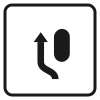
A traffic island in the middle of the road has this sign on it. Which way must you pass the island?
Question 16 of 30Signs and markings
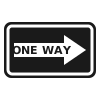
You are on a road marked with this sign and want to turn right at the next corner. Where should your car be as you turn?
Question 17 of 30Signs and markings

At an intersection with traffic lights, you see this sign. You want to turn around and go back. What applies?
Question 18 of 30Safe driving
In South Australia, you have a crash where no one is hurt, but repairs to the other driver's car will cost well over $3000. When must the crash be reported to police?
Question 19 of 30Alcohol, drugs and penalties
Research has looked at how a driver's BAC affects the risk of a crash in which someone is hurt. What happens to that risk for each rise of 0.05 above zero?
Question 20 of 30Hazards and sharing the road
You turn off the bitumen onto a long gravel road. How should you change your driving?
Question 21 of 30Safe driving
After a crash, you swap details with the other driver. Which details should you give them?
Question 22 of 30Safe driving
Your child has a medical condition and cannot use an approved child restraint. What allows the child to travel in a non-approved restraint?
Question 23 of 30Hazards and sharing the road
An ambulance with its siren on is coming up behind you. What must you do?
Question 24 of 30Signs and markings
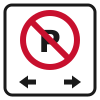
You stop where this sign applies to drop off a parcel at a door 10 metres away. May you leave the car to do this?
Question 25 of 30Safe driving
You are waiting to turn out of a side street onto a busy road. The driver behind you keeps sounding their horn. What should you do?
Question 26 of 30Hazards and sharing the road
You are in the left lane of a road in a built-up area. A bus at the kerb ahead has a 'Give way to buses' sign and is signalling to pull out. What must you do?
Question 27 of 30Signs and markings
Your passenger asks you to pull over for a moment where this sign applies, so they can hop out. What should you do?
Question 28 of 30Signs and markings

This sign is fixed to a barrier that blocks part of the road ahead where the road shifts across. Which way should you go?
Question 29 of 30Learner and P-plate rules
You are 27 and have just got your P1 licence in South Australia. Can you drive home from a late shift at 1 am on your own?
Question 30 of 30Signs and markings
On a country road, you pass a warning sign for stock, such as cattle or sheep. What should you expect on the road ahead?
1 of 30
Answer each question to see the explanation. Keyboard: A–D or 1–4 to answer, N next, P previous.
Answers and explanations (text version)
The correct answer to each question above, why it is right, and where it comes from. Try the test first.
Question 1: D. Go straight ahead or turn right
When the arrows in your lane give a choice, you may go in either of the directions they show, here straight ahead or right.
Handbook: Driver's Handbook — Driving Signals (p. 63)
Question 2: B. Brake slowly, sound the horn and flash your headlights
For an animal on the road, brake slowly, sound your horn and flash your headlights, and do not swerve.
Handbook: Driver's Handbook — Hazardous Driving Situations (p. 40)
Question 3: C. 50 metres
You may drive on a painted island edged by a single continuous line for up to 50 metres to enter a turning lane that starts just after it.
Handbook: Driver's Handbook — Driving on the Road (p. 53)
Question 4: A. It brakes individual wheels to steady the car
ESC senses when the car is unstable and steadies it by applying the brakes on individual wheels.
Handbook: Driver's Handbook — Understand Different Types of Crashes and How to Avoid Them (p. 11)
Question 5: C. You must not make a U-turn there
A U-turn at an intersection with traffic lights is not allowed unless a U-turn Permitted sign is shown.
Handbook: Driver's Handbook — U-turns (p. 64)
Question 6: D. Do not enter, and find another route
This sign means you must not drive into the road from this direction, so you must not enter and need another route.
Handbook: Driver's Handbook — Signs (p. 58)
Question 7: D. You may stop, but must move the car as soon as you can
Stopping rules do not apply when your car is disabled, but you must not stay longer than needed and should move the car as soon as you can.
Handbook: Driver's Handbook — Parking (p. 102)
Question 8: A. You must not drive it unless you hold an exemption
Provisional licence holders under 25 must not drive a high-powered vehicle unless they hold an exemption certificate.
Handbook: Driver's Handbook — High-powered vehicles (p. 126)
Question 9: A. Speed up along the entry road and merge at traffic speed
Speed up along the entry road so that you merge with freeway traffic at the same speed as it.
Handbook: Driver's Handbook — Freeways and Expressways (p. 81)
Question 10: C. 20 metres before and 10 metres after the crossing
You must not stop on a pedestrian crossing, within 20 metres before it or within 10 metres after the crossing.
Handbook: Driver's Handbook — Parking (p. 99)
Question 11: B. Only when the sign is no longer shown to you
If a crossing monitor shows a STOP sign, you must stop at the stop line and wait until the sign is no longer shown to you.
Handbook: Driver's Handbook — Crossings (p. 69)
Question 12: B. 17 years
You must be at least 17 years old before you can apply for a P1 provisional licence in South Australia.
Handbook: Driver's Handbook — Obtaining a P1 Provisional Licence (p. 124)
Question 13: B. At the stop line, before entering the intersection
At this sign you must stop at the stop line, or as close as you can before the intersection if there is no line.
Handbook: Driver's Handbook — Signs (p. 58)
Question 14: B. 25 km/h
In South Australia you must not go faster than 25 km/h when passing, in either direction, a school bus stopped to drop off or pick up children.
Handbook: Driver's Handbook — Speed Limits (p. 47)
Question 15: C. Pass on its left side
This sign tells you to keep to the left of the island, and you must never drive on a traffic island, so you pass on its left side.
Handbook: Driver's Handbook — Driving on the Road (p. 53)
Question 16: A. As near as you can to the far right side
On a one-way road you must make a right turn from as near as you can to the far right side of the road.
Handbook: Driver's Handbook — Driving Signals (p. 62)
Question 17: C. You may U-turn here, giving way to everyone
U-turns at traffic lights are banned unless this sign is shown, and you must still give way to everyone, including pedestrians.
Handbook: Driver's Handbook — Traffic Lights (p. 67)
Question 18: C. As soon as possible, and no later than 24 hours
A crash with no injuries but damage to someone else's property must be reported as soon as possible and within 24 hours.
Handbook: Driver's Handbook — In Case of a Crash (p. 15)
Question 19: D. It doubles
The risk of a casualty crash doubles for every 0.05 rise in BAC above zero, and is even higher for new drivers.
Handbook: Driver's Handbook — Alcohol (p. 21)
Question 20: C. Slow down, as braking and control are harder
Gravel is more hazardous than bitumen because control and braking are harder, so slow down to keep safe control.
Handbook: Driver's Handbook — Hazardous Driving Situations (p. 38)
Question 21: C. Name and address of the driver and owner, plus the registration number
You should give the driver's and owner's names and addresses and the vehicle's registration number, plus anything police need to identify it.
Handbook: Driver's Handbook — In Case of a Crash (p. 14)
Question 22: B. You carry a medical certificate for the child
Children with a disability or medical condition may use a non-approved restraint if the driver carries a medical certificate for them.
Handbook: Driver's Handbook — Seatbelts and Restraints (p. 43)
Question 23: B. Move out of its path to give it a clear way
You must give way to an emergency vehicle with a siren or flashing lights and move out of its path so it has a clear way through.
Handbook: Driver's Handbook — Giving Way (p. 78)
Question 24: C. No, you must stay within 3 metres of the car
Under this sign you may drop off goods only if you do not leave the car unattended, which means going no more than 3 metres from it.
Handbook: Driver's Handbook — Parking (p. 99)
Question 25: B. Wait for a larger gap in the traffic
Many intersection crashes come from picking gaps that are too small, so wait for a larger gap even if the driver behind is impatient.
Handbook: Driver's Handbook — Understand Different Types of Crashes and How to Avoid Them (p. 11)
Question 26: D. Give way and let the bus pull out
In a built-up area, drivers in the left lane must give way to a bus showing this sign that is signalling to move out from the kerb.
Handbook: Driver's Handbook — Giving Way (p. 72)
Question 27: D. Drive on to a place where stopping is allowed
You must not stop where this sign applies, even to set down a passenger, so drive on to a place where stopping is allowed.
Handbook: Driver's Handbook — Parking (p. 98)
Question 28: D. To the left, the way the chevrons point
Hazard markers warn of an obstruction, and the chevrons show the side to pass. Here they point left, so pass on the left.
Handbook: Driver's Handbook — Warning Signs (p. 58)
Question 29: A. Yes, the late-night limit is only for P1 drivers under 25
The midnight to 5 am limit applies only to P1 drivers under 25, so a 27-year-old P1 driver may drive then.
Handbook: Driver's Handbook — Provisional Licence Laws and Conditions (P1 and P2) (p. 125)
Question 30: D. Farm animals crossing or walking beside the road
A stock sign warns that farm animals may be crossing the road or walking beside it, so slow down and be ready to stop.
Handbook: Driver's Handbook — Animals on the road (p. 40)
Practice test 1 of 10 for the Learner's theory test (car learner's permit); myLs online course test or in-office test at Service SA (DIT): 30 questions · 27 of 30 (90%) to pass · no time limit.