Question 1 of 30Safe driving
Practice test 2 of 10 — Tasmania knowledge test
Practice test 2 questions
Question 2 of 30Signs and markings
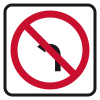
You reach an intersection with this sign. The address you want is down the street on your left. What should you do?
Question 3 of 30Learner and P-plate rules
In Tasmania, you passed your P1 assessment last week and are now on a freeway signed 110 km/h. What is your top speed?
Question 4 of 30Hazards and sharing the road
At a pedestrian crossing with lights, your signal is flashing yellow and people are still crossing. What must you do?
Question 5 of 30Road rules
You are about to turn left from a two-way road into a side street. Where should your car be as you turn?
Question 6 of 30Road rules
Twin red lights start flashing as you approach a fire station on your route. What must you do?
Question 7 of 30Safe driving
You are following another car on a dry, open road. What time gap is recommended between you and that car?
Question 8 of 30Hazards and sharing the road
A bicycle rider is riding in the middle of your lane on a road with marked lanes. Is this allowed?
Question 9 of 30Hazards and sharing the road
Which of these people counts as a pedestrian under the road rules?
Question 10 of 30Alcohol, drugs and penalties
In Tasmania, police pull over a driver they suspect has taken drugs. What are the police allowed to do?
Question 11 of 30Safe driving
You need to reverse along a quiet street to reach a parking space. Which is a rule for reversing?
Question 12 of 30Signs and markings
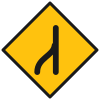
You see this sign on a city road with two lanes going your way. What is about to happen?
Question 13 of 30Learner and P-plate rules
In Tasmania, a P1 driver wants GPS directions from their phone on a long trip. When is this allowed?
Question 14 of 30Learner and P-plate rules
In Tasmania, a P2 driver hopes to earn the safer driver reward. What must they avoid over their P1 and P2 years?
Question 15 of 30Road rules
You are driving on a road with one lane each way, split by a painted dividing line. Where should your car be?
Question 16 of 30Safe driving
After a crash, you should switch off the ignition of the crashed cars. Why?
Question 17 of 30Safe driving
A friend is walking on the footpath as you drive past. When are you allowed to use your horn?
Question 18 of 30Signs and markings
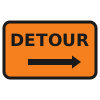
The road you planned to take is closed for repairs, and you see this sign. What should you do?
Question 19 of 30Signs and markings
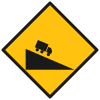
You are driving through hilly country and see this sign. What is the safest way to drive the next part?
Question 20 of 30Safe driving
At night you catch up to another car on a country road. You may keep high beam on only while you are more than how far behind it?
Question 21 of 30Learner and P-plate rules
In Tasmania, you are 30 years old when you move up to your P2 licence. How long must you hold it?
Question 22 of 30Signs and markings
In Australia, you see a clearway sign on a main road. It is now within the times shown on the sign. Can you stop at the kerb to buy a coffee?
Question 23 of 30Road rules
At a T-intersection, the continuing road curves to the left. You want to leave it and drive straight on into the terminating road. Should you indicate?
Question 24 of 30Signs and markings
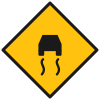
It has just started to rain on a hilly road, and you see this sign. What should you do?
Question 25 of 30Learner and P-plate rules
In Tasmania, a learner has logged plenty of daytime hours. How many of the required logbook hours must be at night?
Question 26 of 30Signs and markings
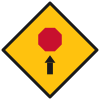
After this sign, you reach the Stop sign. Bushes on the corner hide most of the cross road. Where must your car first come to a stop?
Question 27 of 30Signs and markings

After this sign you enter a roundabout with two lanes. Once inside, you need to move into the other lane. What is the rule?
Question 28 of 30Road rules
You realise you are going the wrong way. The road has a single continuous dividing line and no other traffic in sight. May you make a U-turn across the line?
Question 29 of 30Signs and markings
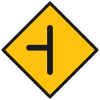
You see this sign and want to turn into the road it warns you about. What should you do before the turn?
Question 30 of 30Signs and markings

You see this sign fixed to an object on the road ahead. Which way must you go around it?
1 of 30
Answer each question to see the explanation. Keyboard: A–D or 1–4 to answer, N next, P previous.
Answers and explanations (text version)
The correct answer to each question above, why it is right, and where it comes from. Try the test first.
Question 1: B. Stop at once and stay at the scene
After any crash that causes damage, injury or death, you must stop at once and stay at the scene.
Handbook: Tasmanian Road Rules — 18. Car crashes (p. 72)
Question 2: B. Do not turn left; find another route
A no left turn sign means you must not turn left at that street or entrance, so plan another route.
Handbook: Tasmanian Road Rules — 14. Traffic signs (p. 62)
Question 3: C. 100 km/h
Your top speed is 100 km/h: the handbook says "P1 provisional (first year) licence holders must not drive faster than 100km/h", even where a sign allows more.
Official source: platesplus.tas.gov.au — Summary of novice car licensing pathway
Question 4: C. Give way until all have left the crossing
On a flashing yellow light at a crossing, you must give way to pedestrians and wait until they have all left the crossing.
Handbook: Tasmanian Road Rules — 7. Giving way (p. 25)
Question 5: A. As close as you can to the left
When turning left from a two-way or one-way road, keep as close as you can to the left side of the road.
Handbook: Tasmanian Road Rules — 8. Making turns (p. 30)
Question 6: B. Stop, and wait until they stop showing
Twin red lights have the same rules as a red light. Stop at the line and wait until the lights stop showing.
Handbook: Tasmanian Road Rules — 10. Traffic lights (p. 38)
Question 7: C. 3 seconds
A gap of 3 seconds behind the vehicle ahead is recommended, so you have time to avoid a crash if something happens suddenly.
Handbook: Tasmanian Road Rules — 3. General safety (p. 6)
Question 8: C. Yes, riders may use the whole lane
Bicycle riders are allowed to use the whole lane on roads with lane markings, so be patient behind them.
Handbook: Tasmanian Road Rules — 1. Introduction to the Tasmanian Road Rules (p. 3)
Question 9: B. A person pushing a bicycle
A person pushing a bicycle is treated as a pedestrian, while e-bikes, ridden horses and tractors on a road are vehicles.
Handbook: Tasmanian Road Rules — 1. Introduction to the Tasmanian Road Rules (p. 2)
Question 10: B. Stop the driver and test them
Tasmania Police can stop and test any driver they suspect of driving under the influence of drugs or alcohol.
Handbook: Tasmanian Road Rules — 20. Enforcing the Road Rules (p. 74)
Question 11: C. Never reverse further than you need to
Only reverse when it is safe, and never reverse further than you need to or than is reasonable.
Handbook: Tasmanian Road Rules — 3. General safety (p. 8)
Question 12: B. The two lanes will join to form one lane
This sign means two lanes join into one lane ahead, so be ready to merge smoothly and give way as the rules require.
Handbook: Tasmanian Road Rules — 7. Giving way (p. 24)
Question 13: C. If set up before the trip and not touched or looked at
P1 drivers may hear GPS directions from a phone only if it is set up before the trip and they do not touch or look at it while driving.
Handbook: Tasmanian Road Rules — 3. General safety (p. 7)
Question 14: C. Demerit points and certain offences
You may be eligible for the safer driver reward if you reach your full licence without demerit points or certain offences.
Official source: platesplus.tas.gov.au — Summary of novice car licensing pathway
Question 15: A. To the left of the dividing line
On a road with only one lane in each direction, you must keep to the left of the dividing line.
Handbook: Tasmanian Road Rules — 4. Keeping left (p. 9)
Question 16: B. To lower the risk of fire
Turning off the ignition of crashed vehicles helps to lower the risk of a fire starting.
Handbook: Tasmanian Road Rules — 18. Car crashes (p. 72)
Question 17: B. Only to warn of danger, or as an alarm
Use the horn only in an emergency to warn others where your car is, or as an anti-theft alarm.
Handbook: Tasmanian Road Rules — 15. Headlights, hazard lights and warning devices (p. 67)
Question 18: A. Follow the marked route around the closed road
This sign shows a detour: the road ahead is closed, so follow the marked route around it.
Handbook: Tasmanian Road Rules — 14. Traffic signs (p. 65)
Question 19: B. Slow down and use a lower gear going down
This sign warns of a steep downhill ahead. Slow down and use a lower gear so the car does not run away from you.
Handbook: Tasmanian Road Rules — 14. Traffic signs (p. 65)
Question 20: D. 200 metres
High beam may only be used when you are more than 200 metres behind another vehicle, so you do not dazzle its driver.
Handbook: Tasmanian Road Rules — 15. Headlights, hazard lights and warning devices (p. 66)
Question 21: D. 12 months
Drivers aged 25 or older at the start of P2 must hold the P2 licence for 12 months.
Official source: platesplus.tas.gov.au — Summary of novice car licensing pathway
Question 22: A. No, you must not stop there during those times
You must not stop on a clearway during the times and days shown on its sign.
Handbook: Tasmanian Road Rules — 13. Stopping and parking (p. 60)
Question 23: D. Yes, as you are leaving the continuing road
You must indicate before you leave the continuing road at a T-intersection where that road curves.
Handbook: Tasmanian Road Rules — 9. Indicators (p. 36)
Question 24: A. Slow down, as the road may lose its grip
This sign warns that the surface may be slippery. On wet roads you should slow down and drive below the speed limit.
Handbook: Tasmanian Road Rules — 14. Traffic signs (p. 65)
Question 25: B. 15 hours
Of the 80 logbook hours a learner must complete, 15 hours must be driven at night.
Official source: platesplus.tas.gov.au — Summary of novice car licensing pathway
Question 26: A. Before the stop line, as close to it as you can
At a Stop sign you must stop as near as you can to the stop line, but before it. Then give way and move on only when it is safe.
Handbook: Tasmanian Road Rules — 11. Intersections (p. 45)
Question 27: B. You may, when safe, but you must indicate first
You may change lanes in a multi-lane roundabout when it is safe, but you must indicate before you change lanes.
Handbook: Tasmanian Road Rules — 11. Intersections (p. 51)
Question 28: D. No, you must not U-turn across it
A U-turn across a single continuous dividing line is not allowed, even when the road is clear.
Handbook: Tasmanian Road Rules — 8. Making turns (p. 33)
Question 29: B. Indicate left, slow down and keep close to the left
This sign warns of a side road on the left. To turn into it, indicate left, slow down and turn from as close to the left as you can.
Handbook: Tasmanian Road Rules — 8. Making turns (p. 30)
Question 30: A. To the left, the way the stripes point
This hazard marker shows an obstruction ahead. All traffic must go around it to the left, the way the chevrons point.
Handbook: Tasmanian Road Rules — 14. Traffic signs (p. 65)
Practice test 2 of 10 for the Driver knowledge test (learner driver licence); Plates Plus online course and test or standalone test at a Service Tasmania shop (Transport Tasmania): 30 questions · 27 of 30 (90%) to pass · no time limit.