Question 1 of 30Safe driving
Practice test 1 of 10 — Western Australia theory test
Practice test 1 questions
Question 2 of 30Alcohol, drugs and penalties
In Western Australia, you are driving and a text message arrives. Your phone sits in a cradle fixed to the car. What may you do?
Question 3 of 30Signs and markings
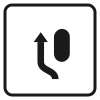
You see this sign on a traffic island in the middle of the road ahead. What must you do?
Question 4 of 30Road rules
There are no parking signs near a railway crossing. How close to the nearest rail may you stop or park, on either side of the crossing?
Question 5 of 30Signs and markings
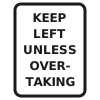
You are on a road with two lanes each way, a 100 km/h limit and this sign. You are in the right lane, not overtaking, and the left lane is clear. What should you do?
Question 6 of 30Signs and markings
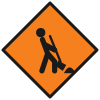
Orange cones line the edge of a highway you use every day, and this sign stands beside them. How should you treat it?
Question 7 of 30Signs and markings

At traffic lights, you see this sign and want to turn back the way you came. What does the sign allow?
Question 8 of 30Learner and P-plate rules
In Western Australia, you are on red P plates. Two school friends ask for a lift. Neither is family. How many of them may you take?
Question 9 of 30Learner and P-plate rules
In Western Australia, you are on red P plates. Which trip between midnight and 5 am is allowed?
Question 10 of 30Safe driving
At night, a car coming towards you has its high beam on and you are dazzled. What should you do?
Question 11 of 30Hazards and sharing the road
You turn left at an intersection. A person is crossing the road you are turning into. What must you do?
Question 12 of 30Signs and markings
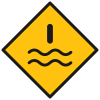
You see this sign and water is flowing over the road ahead. What should you do?
Question 13 of 30Signs and markings
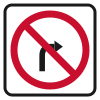
Your phone's map app tells you to turn right at a corner where this sign is shown. What should you do?
Question 14 of 30Road rules
At a T-intersection with no signs or signals, you are on the road that ends. A car is coming along the through road from your left. What must you do?
Question 15 of 30Hazards and sharing the road
In Western Australia, a highway has a 90 km/h limit and a bike rider is ahead on the shoulder. What is the smallest side gap the law requires at this speed limit?
Question 16 of 30Hazards and sharing the road
You turn left using a slip lane with a traffic island. A person is walking across the slip lane. Who must give way?
Question 17 of 30Safe driving
You stop at a roadside parking bay on a country highway. Where in the bay should you park?
Question 18 of 30Learner and P-plate rules
In Western Australia, you are applying for your first learner's permit. What kind of identity papers must you bring?
Question 19 of 30Hazards and sharing the road
You have parked on a busy street and are about to open your door. What should you check first?
Question 20 of 30Signs and markings

This sign stands in front of an obstruction on the road ahead. Which way must you go around it?
Question 21 of 30Safe driving
The sign on a road says 80 km/h. What does that number tell you?
Question 22 of 30Learner and P-plate rules
In Western Australia, a first-time learner's permit holder gets 4 demerit points. What happens?
Question 23 of 30Alcohol, drugs and penalties
In Western Australia, under anti-hoon laws, how far over the speed limit can lead to a reckless driving charge?
Question 24 of 30Road rules
A car ahead has stopped at a pedestrian crossing. You are in the next lane going the same way. What must you do?
Question 25 of 30Safe driving
Your car has two rows of seats. When may a 5-year-old ride in the front seat?
Question 26 of 30Learner and P-plate rules
In Western Australia, a P plate driver goes over the novice demerit point limit. What is the result?
Question 27 of 30Road rules
On a road with one lane each way, when may you overtake a car on its left?
Question 28 of 30Safe driving
You are driving into thick fog. Which headlights should you use?
Question 29 of 30Road rules
The car ahead is going 5 km/h under the speed limit. You want to overtake it. How fast may you go?
Question 30 of 30Signs and markings
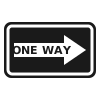
You see this sign on a pole at the corner of a street. What does it tell you about that street?
1 of 30
Answer each question to see the explanation. Keyboard: A–D or 1–4 to answer, N next, P previous.
Answers and explanations (text version)
The correct answer to each question above, why it is right, and where it comes from. Try the test first.
Question 1: D. Your speed goes up or down without you meaning it to
Fatigue signs include yawning, heavy eyes, wandering over the road and your speed changing without you meaning it to.
Handbook: Drive Safe 1.5.3 What are the warning signs of driver fatigue? (p. 17)
Question 2: D. Leave it, as reading it is illegal
It is illegal to create, send or look at a text message while driving, even when the phone is in a cradle.
Handbook: Drive Safe 1.7 Mobile Phones (p. 18)
Question 3: B. Pass the island on its left side
This sign tells you to keep to the left of the island or divider it stands on, so pass on its left side.
Handbook: Drive Safe 3.8 Traffic Signs (p. 51)
Question 4: B. No closer than 20 metres
You must not stop or park within 20 metres of the nearest rail, before or after a crossing, unless signs allow it.
Handbook: Drive Safe 3.5.1 When you must stop (p. 50)
Question 5: C. Move back into the left lane when it is safe
On a road with this sign and a high speed limit, you may use the right lane only to overtake, so move back into the left lane.
Handbook: Drive Safe 3.4.2 Roads with 2 or more lanes (p. 48)
Question 6: B. Slow down and obey any lower speed limit
Roadwork is ahead. Slow down and obey any temporary speed limit, as these signs are enforced by law.
Handbook: Drive Safe 3.8 Traffic Signs (p. 53)
Question 7: C. A U-turn, giving way to all vehicles and people
This sign lets you make a U-turn here, but you must give way to all other vehicles and pedestrians.
Handbook: Drive Safe 3.10 Traffic Control Signals (p. 59)
Question 8: A. Only one of them
In your first 6 months on P plates you may carry only one passenger, unless an exemption applies.
Handbook: Drive Safe 2.1.1 The Graduated Driver Training and Licensing System (p. 33)
Question 9: D. Driving home from your late shift at work
The red P plate night rule does not apply when you drive to or from work. It is wise to carry a letter from your employer.
Handbook: Drive Safe 2.1.1 The Graduated Driver Training and Licensing System (p. 33)
Question 10: C. Slow down and look to the left side of the road
Slow down, look to the left of the road and keep left. If you cannot see at all, stop.
Handbook: Drive Safe 3.3.1 Driving at night (p. 46)
Question 11: C. Give way to the person crossing
Drivers must give way to pedestrians crossing the road at an intersection in front of a turning vehicle.
Handbook: Drive Safe 1.8.1 Pedestrians (p. 19)
Question 12: C. Do not drive in; find another route
Never drive into floodwater. Fast flowing water can sweep a car away, so find another route.
Handbook: Drive Safe 3.7 Crossing Water on Roadways (p. 50)
Question 13: A. Obey the sign and take a different route
You must obey regulatory signs like this one, which bans right turns here. Ignore the map and take a different route.
Handbook: Drive Safe 3.8 Traffic Signs (p. 51)
Question 14: D. Give way, as it is on the road that goes on
At an uncontrolled T-intersection, drivers on the road that ends give way to all vehicles on or turning from the continuing road.
Handbook: Drive Safe 3.13.2 Uncontrolled intersections (p. 69)
Question 15: D. At least 1.5 metres
When the speed limit is over 60 km/h, you must leave a gap of at least 1.5 metres when passing a bicycle rider.
Handbook: Drive Safe 6.1 Cyclists (p. 108)
Question 16: B. You must give way to the person
A driver turning in a slip lane must give way to a pedestrian crossing that slip lane.
Handbook: Drive Safe 1.8.1 Pedestrians (p. 19)
Question 17: C. At the front end, so others can get in and out
Park at the forward end of a roadside bay. This leaves room for other vehicles to enter and leave.
Handbook: Drive Safe 3.3.4 Country driving (p. 48)
Question 18: A. Original documents, not copies
All identity documents must be originals, and certified photocopies are not accepted. A set of five documents is needed.
Handbook: Drive Safe Appendix 3 Getting Your First Licence (p. 117)
Question 19: D. That no bike is coming up from behind
Check behind for bicycles before you open your door. If your door hits a rider, they can be badly hurt and you may be to blame.
Handbook: Drive Safe 6.1 Cyclists (p. 108)
Question 20: D. To the right, the way the arrows point
An obstruction is ahead and all traffic must go around it in the direction the chevrons point, here to the right.
Handbook: Drive Safe 3.8 Traffic Signs (p. 51)
Question 21: C. The most you may drive there, and only in ideal conditions
A speed limit is the maximum legal speed in ideal conditions. You must drive slower when the road, traffic or weather is poor.
Handbook: Drive Safe 1.2.2 Choosing what speed to travel (p. 3)
Question 22: B. They are disqualified from driving for at least 3 months
First-time learners are Type 1 novice drivers, so 4 or more demerit points means disqualification from driving for at least 3 months.
Handbook: Drive Safe 5.3.4 Graduated Demerit Point System (Novice Drivers) (p. 101)
Question 23: C. 45 km/h or more
Under anti-hoon laws, driving 45 km/h or more over the speed limit can lead to a reckless driving charge.
Handbook: Drive Safe 1.2 Speed (p. 2)
Question 24: A. Do not overtake it while it is stopped there
You must not overtake a vehicle that has slowed or stopped at a pedestrian, children's or railway crossing, as it may hide someone crossing.
Handbook: Drive Safe 3.16.2 When you must not overtake (p. 73)
Question 25: A. Only if every back seat is taken by a child under 7
Children aged 4 to under 7 may not sit in the front unless all rear seats are taken by children under 7, and they must be suitably restrained.
Handbook: Drive Safe 1.4.4 Who must wear a seat belt? (p. 12)
Question 26: A. Licence cancelled, banned for at least 3 months, then reapply
A provisional licence is cancelled and the driver is disqualified for at least 3 months. They must reapply and may need to redo the tests.
Handbook: Drive Safe 5.3.4 Graduated Demerit Point System (Novice Drivers) (p. 101)
Question 27: B. When it is signalling to turn right
You may pass on the left of a vehicle that is signalling to turn right, and you may also pass stopped vehicles behind it.
Handbook: Drive Safe 3.16.1 When can you overtake? (p. 73)
Question 28: D. Low beam, as high beam lights up the fog
High beam lights up the fog or smoke and makes the road harder to see. Dip to low beam and drive slowly.
Handbook: Drive Safe 3.3.3 Driving in fog or smoke (p. 47)
Question 29: A. No faster than the speed limit
You must not go over the speed limit to overtake, so only pass if you can do it within the limit.
Handbook: Drive Safe 3.16 Overtaking (p. 73)
Question 30: A. Traffic may only travel in the arrow's direction
This sign shows a one-way street, where all traffic may only travel in the direction of the arrow.
Handbook: Drive Safe 3.8 Traffic Signs (p. 51)
Practice test 1 of 10 for the Learner's Permit Computerised Theory Test (CTT) (DTMI): 30 questions · 24 of 30 (80%) to pass · no time limit.