Question 1 of 40Rules of the road
Practice test 1 of 10 — Nova Scotia class 7 test
Practice test 1 questions
Question 2 of 40Rules of the road · Alcohol, drugs and penalties
You are convicted of impaired driving under the Criminal Code of Canada. Where are you banned from driving?
Question 3 of 40Rules of the road · Right-of-way
At an intersection with no painted crosswalk, a pedestrian is crossing. What must you do?
Question 4 of 40Rules of the road · Right-of-way
In Nova Scotia, a stopped city transit bus signals that it wants to pull back into traffic. The posted limit is 50 km/h. What should you do?
Question 5 of 40Rules of the road · Parking and stopping
In Nova Scotia, when you park at a curb, how close must your curbside wheels be?
Question 6 of 40Rules of the road · Right-of-way
In Nova Scotia, an emergency vehicle has stopped to help at a collision. How close may you drive or park?
Question 7 of 40Rules of the road · Speed and following distance
You use the two-second rule and reach the landmark before you finish counting. What does that tell you?
Question 8 of 40Rules of the road · Alcohol, drugs and penalties
In Nova Scotia, how many demerit points lead to a six-month suspension for a fully licensed driver who is not in the GDL program?
Question 9 of 40Rules of the road · Parking and stopping
You leave your car parked and unattended. What must you do?
Question 10 of 40Rules of the road · Right-of-way
You want to turn left. An oncoming car at the same intersection is going straight. Who must yield?
Question 11 of 40Rules of the road
In Nova Scotia, what does sounding your horn before you pass do to the driver ahead?
Question 12 of 40Rules of the road · Speed and following distance
How do you use the two-second rule?
Question 13 of 40Rules of the road · Licensing and insurance
In Nova Scotia, at which GDL stage may you first upgrade to a higher licence class (1 to 4)?
Question 14 of 40Rules of the road · Licensing and insurance
How much time do you have to finish each part of the Nova Scotia Class 7 knowledge test?
Question 15 of 40Rules of the road
While backing up, you take off your seat belt so you can turn to see. What must you remember?
Question 16 of 40Rules of the road · Licensing and insurance
In Nova Scotia, you fail your road test. How long must you wait before trying again?
Question 17 of 40Rules of the road · Safe driving and hazards
In Nova Scotia, a child weighs more than 18 kg but is under 145 cm tall and under 9 years old. What must they ride in?
Question 18 of 40Rules of the road · Safe driving and hazards
A seat has a front airbag. Which child seat must never be used in it?
Question 19 of 40Rules of the road
In Nova Scotia, when must you use your signal lights instead of hand signals?
Question 20 of 40Rules of the road · Licensing and insurance
In Nova Scotia, during which hours may a newly licensed (Class 5N) driver NOT drive alone, without an exemption?
Question 21 of 40Road signs · Signs, signals and road markings
In Nova Scotia, a warning sign tells you that a bridge opening is ahead. What does it mean?
Question 22 of 40Road signs · Signs, signals and road markings

What must you do when you come to this sign?
Question 23 of 40Road signs · Signs, signals and road markings
In Nova Scotia, you reach a corner where the traffic lights are not working. How should you treat it?
Question 24 of 40Road signs · Signs, signals and road markings

Signs like this one are often posted in a group. What are they for?
Question 25 of 40Road signs · Signs, signals and road markings
In Nova Scotia, you are stopped at a red light and want to turn right. No sign forbids it. What may you do?
Question 26 of 40Road signs · Signs, signals and road markings
In Nova Scotia, on a highway with a climbing lane, a posted sign can tell slow vehicles to use four-way flashers. Below what speed does this apply?
Question 27 of 40Road signs · Signs, signals and road markings
You waited at a railway crossing while a train passed. What should you do before you cross?
Question 28 of 40Road signs · Signs, signals and road markings
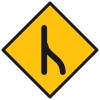
You see this sign where two lanes are about to join. Who is responsible for a smooth merge?
Question 29 of 40Road signs · Signs, signals and road markings
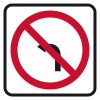
What does this sign mean?
Question 30 of 40Road signs · Signs, signals and road markings
The centre line is made of two solid yellow lines side by side. May you cross them to pass?
Question 31 of 40Road signs · Signs, signals and road markings
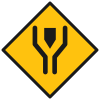
What change in the road does this sign warn you about?
Question 32 of 40Road signs · Signs, signals and road markings
In Nova Scotia, what do most warning signs look like?
Question 33 of 40Road signs · Signs, signals and road markings
On a multi-lane road, one lane is closed ahead for road work. When should you merge?
Question 34 of 40Road signs · Signs, signals and road markings
In Nova Scotia, work zone signs that show a symbol of a person are used only when what is true?
Question 35 of 40Road signs · Signs, signals and road markings
In a work zone, an orange sign warns that the road will narrow. What does this tell you about the lanes?
Question 36 of 40Road signs · Signs, signals and road markings
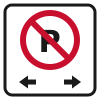
In Nova Scotia, what does this sign with arrows pointing both ways mean?
Question 37 of 40Road signs · Signs, signals and road markings
In Nova Scotia, what causes the most crashes in work zones?
Question 38 of 40Road signs · Signs, signals and road markings
In Nova Scotia, you see someone driving carelessly through a work zone. What should you do?
Question 39 of 40Road signs · Signs, signals and road markings
In Nova Scotia, a white square sign shows an arrow pointing straight up inside a green circle. What does it mean?
Question 40 of 40Road signs · Signs, signals and road markings
Near a school, a crosswalk guard holds up a stop paddle facing your car. What must you do?
1 of 40
Answer each question to see the explanation. Keyboard: A–D or 1–4 to answer, N next, P previous.
Answers and explanations (text version)
The correct answer to each question above, why it is right, and where it comes from. Try the test first.
Question 1: B. Faster cars may not see you in time to slow down
A slow vehicle just beyond the crest of a hill or a curve is often hidden. Faster vehicles may hit it before they can slow down.
Handbook: NS Driver's Handbook, Ch. 2 Rules of the Road — Driving too slowly (p. 48)
Question 2: B. Anywhere in Canada
A Criminal Code conviction brings a court order that prohibits you from driving a motor vehicle anywhere in Canada.
Handbook: NS Driver's Handbook, Ch. 1 Your Driver's Licence — Mandatory revocation (p. 25)
Question 3: A. Yield, since every intersection has a crosswalk
Every intersection has a crosswalk, even if it is unmarked. Drivers must yield to pedestrians at all intersections.
Handbook: NS Driver's Handbook, Ch. 2 Rules of the Road — Unmarked crosswalks (p. 42)
Question 4: C. Yield and let the bus move back into traffic
When a stopped transit bus signals to re-enter traffic and the posted limit is 60 km/h or less, yield the right of way if it is safe.
Handbook: NS Driver's Handbook, Introduction — Changes since publication: Yield to transit buses (p. VIII)
Question 5: B. Within 15 cm
The handbook says: "Curbside wheels must be within 15 centimetres of the curb or edge of the road."
Handbook: NS Driver's Handbook, Ch. 2 Rules of the Road — Parking and stopping (p. 61)
Question 6: B. No closer than 150 metres
Never drive or park within 150 metres of an emergency vehicle that has stopped to investigate a collision or give assistance.
Handbook: NS Driver's Handbook, Ch. 2 Rules of the Road — Emergency vehicles (p. 45)
Question 7: A. You are following too closely
If you reach the landmark before you count 'one thousand and two', you are following too close to the vehicle in front.
Handbook: NS Driver's Handbook, Ch. 2 Rules of the Road — Two-second rule (p. 49)
Question 8: B. 10 points
The points table shows that drivers who are not learners or newly licensed are suspended for six months at 10 points.
Handbook: NS Driver's Handbook, Ch. 1 Your Driver's Licence — Demerit Points (p. 30)
Question 9: D. Set the parking brake and turn off the engine
Whenever your vehicle is left standing unattended, apply the parking brake and turn off the engine.
Handbook: NS Driver's Handbook, Ch. 2 Rules of the Road — Parking and stopping (p. 61)
Question 10: C. You, the driver turning left
If one driver is going straight and the other wants to turn left, the driver turning left must yield and wait until it is safe.
Handbook: NS Driver's Handbook, Ch. 2 Rules of the Road — Right of way (p. 44)
Question 11: A. It puts them under a legal duty to help you pass
You must signal and sound your horn before passing. The horn places the driver being passed under a legal obligation to help you pass.
Handbook: NS Driver's Handbook, Ch. 2 Rules of the Road — Overtaking and passing (p. 57)
Question 12: C. When the car ahead passes a landmark, count two seconds
Pick a landmark. When the vehicle ahead passes it, count 'one thousand and one, one thousand and two' before you reach it.
Handbook: NS Driver's Handbook, Ch. 2 Rules of the Road — Two-second rule (p. 49)
Question 13: C. The restricted individual stage
Upgrading to Class 1-4 is not allowed while you are a learner or newly licensed driver, but you can upgrade in the restricted individual stage.
Handbook: NS Driver's Handbook, Introduction — Changes since publication: No upgrade while a learner or Newly Licensed Driver (p. V)
Question 14: B. 30 minutes
You need to complete each part of the knowledge test within 30 minutes, and you should get your results right away.
Official source: novascotia.ca, Take a driver knowledge test: Learner's Licence (class 7)
Question 15: A. Fasten it again before moving forward
You may remove your seat belt to turn and see properly when backing, but fasten it again before you move forward.
Handbook: NS Driver's Handbook, Ch. 2 Rules of the Road — Backing (p. 60)
Question 16: C. At least one week
If you do not pass the road test, you must wait at least one week, pay another fee and book a new appointment.
Handbook: NS Driver's Handbook, Ch. 1 Your Driver's Licence — Road Test (p. 15)
Question 17: B. A booster seat
Children over 18 kg who are under 145 cm tall must ride in a booster seat if they are younger than 9, unless they reach 145 cm.
Handbook: NS Driver's Handbook, Ch. 4 Safety — Seat belts, child restraints, and the law (p. 117)
Question 18: D. A rear-facing child seat
A rear-facing child restraint must never be used where there is an airbag, because a deploying airbag hits it with too much force.
Handbook: NS Driver's Handbook, Ch. 4 Safety — Airbags (p. 120)
Question 19: D. When your vehicle or load blocks the view of your arm
If the vehicle or its load limits how well hand-and-arm signals can be seen, you must use signal lights.
Handbook: NS Driver's Handbook, Ch. 2 Rules of the Road — Using your signal lights and horn (p. 53)
Question 20: C. Between midnight and 5:00 a.m.
Newly licensed drivers have a curfew from midnight to 5:00 a.m. unless an experienced driver is in the front seat or they have an exemption.
Handbook: NS Driver's Handbook, Ch. 1 Your Driver's Licence — Restrictions (p. 16)
Question 21: B. The bridge can be opened to let boats pass
A bridge opening sign tells you that you are nearing a bridge that can be opened so boats can pass through.
Handbook: NS Driver's Handbook, Ch. 3 Signs, Pavement Markings, and Work Zones — Warning signs (p. 92)
Question 22: B. Come to a complete stop, then go only when the way is clear
This is a stop sign. You must bring your vehicle to a complete stop and make sure the way is clear before you go.
Handbook: NS Driver's Handbook, Ch. 3 Signs, Pavement Markings, and Work Zones — Stop sign (p. 80)
Question 23: A. As a multi-stop: stop fully, then go when it is your turn
When the signal lights are out, treat the intersection as a multi-stop. Come to a full stop and go only when you have the right of way and it is safe.
Handbook: NS Driver's Handbook, Ch. 2 Rules of the Road — Traffic signal lights (p. 39)
Question 24: A. To guide drivers around a sharp curve
Chevron signs are posted in groups to guide drivers around sharp curves in the road.
Handbook: NS Driver's Handbook, Ch. 3 Signs, Pavement Markings, and Work Zones — Warning signs (p. 93)
Question 25: D. Turn right after a full stop, once you are sure it is safe
Unless a sign says no turn on red, you may turn right on a red light after you stop and make sure the turn is safe.
Handbook: NS Driver's Handbook, Ch. 2 Rules of the Road — Traffic signal lights (p. 40)
Question 26: C. 70 km/h
Where a sign on the right side says so, vehicles going less than 70 km/h in a climbing lane area must use their four-way flashers.
Handbook: NS Driver's Handbook, Ch. 3 Signs, Pavement Markings, and Work Zones — Two-laned highway with climbing lane (p. 86)
Question 27: C. Check that no other train is coming
Do not move right after a train passes. First check that there is not another train coming.
Handbook: NS Driver's Handbook, Ch. 3 Signs, Pavement Markings, and Work Zones — Railway crossings (p. 81)
Question 28: B. Drivers in both lanes share that duty
At a merge, drivers coming from both lanes are equally responsible for making traffic merge smoothly and safely.
Handbook: NS Driver's Handbook, Ch. 3 Signs, Pavement Markings, and Work Zones — Warning Signs (p. 83)
Question 29: A. Left turns are not permitted here
A red circle with a slash denies permission. This sign means a left turn is not permitted.
Handbook: NS Driver's Handbook, Ch. 3 Signs, Pavement Markings, and Work Zones — Regulatory signs (p. 89)
Question 30: A. No, not in either direction
When the centre line is a double solid yellow line, you may not cross it to pass in either direction.
Handbook: NS Driver's Handbook, Ch. 3 Signs, Pavement Markings, and Work Zones — Rules about solid and broken lines (p. 84)
Question 31: A. The road is about to become a divided highway
This sign means a divided highway is ahead. The road changes from undivided to divided.
Handbook: NS Driver's Handbook, Ch. 3 Signs, Pavement Markings, and Work Zones — Warning signs (p. 92)
Question 32: B. A yellow diamond with black letters or symbols
Most warning signs are diamond-shaped, with black letters or symbols on a yellow background.
Handbook: NS Driver's Handbook, Ch. 3 Signs, Pavement Markings, and Work Zones — Warning Signs (p. 83)
Question 33: A. As soon as you can do it safely
Merge as soon as it is safe. Racing to the merge point in the closing lane and pushing in at the last moment causes collisions.
Handbook: NS Driver's Handbook, Ch. 3 Signs, Pavement Markings, and Work Zones — Lane closures (p. 96)
Question 34: B. Workers are on site and could be hit
Human activity signs show a person. They are only used when workers are on site and at risk of being hit, so take extra care.
Handbook: NS Driver's Handbook, Ch. 3 Signs, Pavement Markings, and Work Zones — Work zone signs (p. 97)
Question 35: D. Lanes get narrower, but there are just as many
The road narrows sign means the lanes will be narrower but their number will not change. You may need to slow down for the smaller lane width.
Handbook: NS Driver's Handbook, Ch. 3 Signs, Pavement Markings, and Work Zones — Specific Signs (p. 99)
Question 36: A. No parking on either side of where the sign stands
This sign means no parking in either direction of the sign. The arrows show that the rule applies on both sides of it.
Handbook: NS Driver's Handbook, Ch. 3 Signs, Pavement Markings, and Work Zones — Regulatory signs (p. 88)
Question 37: A. Vehicles going at different speeds
The biggest hazard in a work zone is the difference in speed between vehicles. Travel at the same safe speed as the traffic around you.
Handbook: NS Driver's Handbook, Ch. 3 Signs, Pavement Markings, and Work Zones — Travelling safely through a work zone (p. 95)
Question 38: D. Report the driver to the police
If you see someone driving irresponsibly through a work zone, report the driver to the police.
Handbook: NS Driver's Handbook, Ch. 3 Signs, Pavement Markings, and Work Zones — Work zone signs (p. 97)
Question 39: C. No turns; you may only go straight ahead
This sign means no turns. The green circle permits only the action shown, which is going straight ahead.
Handbook: NS Driver's Handbook, Ch. 3 Signs, Pavement Markings, and Work Zones — Regulatory signs (p. 88)
Question 40: B. Stop and obey the guard's signal
Drivers must obey crosswalk guards who hold up a stop paddle. Failing to stop and obey could mean demerit points on your record.
Handbook: NS Driver's Handbook, Ch. 2 Rules of the Road — Crosswalk guards (p. 42)
Practice test 1 of 10 for the Knowledge Test (Learner's Licence, class 7) (Nova Scotia RMV): 40 questions · 16 of 20 in each section to pass · no time limit.