Question 1 of 40Rules of the road · Right-of-way
Practice test 1 of 10 — Saskatchewan class 7 test
Practice test 1 questions
Question 2 of 40Rules of the road · Turning, passing and lanes
In Saskatchewan, when driving under 60 km/h, at least how far before a turn should you signal?
Question 3 of 40Rules of the road · Licensing and insurance
Two sober Saskatchewan drivers have a collision. Which fact means they must report it to police right away?
Question 4 of 40Rules of the road · Safe driving and hazards
In Saskatchewan, which drivers may hold and use a hand-held cellphone while driving?
Question 5 of 40Rules of the road · Safe driving and hazards
You are stranded in your vehicle during a winter blizzard. What should you do?
Question 6 of 40Rules of the road · Safe driving and hazards
Four-wheel lock braking gives the shortest stop on every surface except one. Which one?
Question 7 of 40Rules of the road · Sharing the road
In Saskatchewan, where may you drive across a city street?
Question 8 of 40Rules of the road · Turning, passing and lanes
On a two-lane road, on which side should you normally pass another vehicle?
Question 9 of 40Rules of the road · Speed and following distance
Is it ever a problem to drive far below the speed of other traffic?
Question 10 of 40Rules of the road · Speed and following distance
In Saskatchewan, what happens to speeding fines when you pass highway workers in a work zone?
Question 11 of 40Rules of the road
In Saskatchewan, a police officer signals you to stop. What must you do?
Question 12 of 40Rules of the road · Turning, passing and lanes
On a divided highway, which lane should you normally travel in?
Question 13 of 40Rules of the road · Right-of-way
You have the right of way at an intersection, but another driver does not yield to you. What should you do?
Question 14 of 40Rules of the road · Right-of-way
A highway maintenance vehicle ahead has its warning lights flashing. What must you do?
Question 15 of 40Rules of the road · Safe driving and hazards
What are you trying to do when you use threshold braking?
Question 16 of 40Rules of the road · Licensing and insurance
In Saskatchewan, how long must you hold a Class 7 learner's licence before you can take a Class 5 road test?
Question 17 of 40Rules of the road · Sharing the road
In Saskatchewan, a school bus ahead is stopped with only its four-way hazard lamps flashing. What should you do?
Question 18 of 40Rules of the road · Parking and stopping
Some parking spaces are at about a 60-degree angle to the road. How are you meant to use them?
Question 19 of 40Rules of the road
A road is split by a grassy median. Where may you cross the median?
Question 20 of 40Rules of the road · Licensing and insurance
In Saskatchewan, a driver with Tort Coverage sues for pain and suffering after a crash they did not fully cause. What deductible applies?
Question 21 of 40Road signs · Signs, signals and road markings
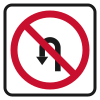
What does this sign mean?
Question 22 of 40Road signs · Signs, signals and road markings
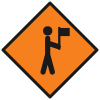
In Saskatchewan, for the tripled speeding fine, anyone within what distance of this sign counts as a worker?
Question 23 of 40Road signs · Signs, signals and road markings

What does this sign tell you to do?
Question 24 of 40Road signs · Signs, signals and road markings
Which signs use a fluorescent yellow-green colour?
Question 25 of 40Road signs · Signs, signals and road markings
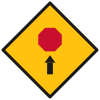
What does this sign warn you of?
Question 26 of 40Road signs · Signs, signals and road markings
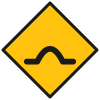
What does this sign warn you of?
Question 27 of 40Road signs · Signs, signals and road markings
A black lane sign shows an arrow pointing up with a second arrow branching off to the right. What does it mean?
Question 28 of 40Road signs · Signs, signals and road markings
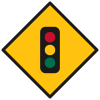
What should you be ready to do when you see this sign?
Question 29 of 40Road signs · Signs, signals and road markings
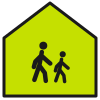
What does this sign warn you about?
Question 30 of 40Road signs · Signs, signals and road markings
White lines between lanes keep apart which traffic?
Question 31 of 40Road signs · Signs, signals and road markings

What is the purpose of this sign?
Question 32 of 40Road signs · Signs, signals and road markings
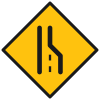
What does this sign mean?
Question 33 of 40Road signs · Signs, signals and road markings
An orange diamond sign shows an up arrow over the word CONSTRUCTION. What does it tell you?
Question 34 of 40Road signs · Signs, signals and road markings
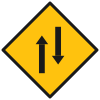
What does this sign warn you of?
Question 35 of 40Road signs · Signs, signals and road markings
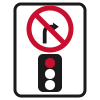
You are stopped at a red light where this sign is posted. You want to turn right. What must you do?
Question 36 of 40Road signs · Signs, signals and road markings
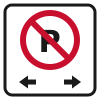
What does this sign mean?
Question 37 of 40Road signs · Signs, signals and road markings
In Saskatchewan, an older version of this sign is still being replaced. What does the old version look like?
Question 38 of 40Road signs · Signs, signals and road markings
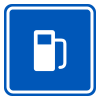
Sometimes a sign like this one also shows the letter D. What does the D tell you?
Question 39 of 40Road signs · Signs, signals and road markings
What does this sign tell you?
Question 40 of 40Road signs · Signs, signals and road markings
After a green left-turn arrow ends, an amber (yellow) arrow appears. What does the amber arrow tell you?
1 of 40
Answer each question to see the explanation. Keyboard: A–D or 1–4 to answer, N next, P previous.
Answers and explanations (text version)
The correct answer to each question above, why it is right, and where it comes from. Try the test first.
Question 1: D. Traffic already in the roundabout
Traffic entering a roundabout must yield to the traffic that is already in the roundabout.
Handbook: SGI Driver's Handbook, 3.19 Interchanges (p. 64)
Question 2: B. 30 m
Under 60 km/h, signal at least 30 m before turning; at higher speeds, signal at least 150 m ahead.
Handbook: SGI Driver's Handbook, 3.11 Signalling (p. 47)
Question 3: D. A passenger was injured
Crashes where someone is injured or killed must be reported to police at once, as must hit and runs, impaired drivers, out-of-province vehicles and tows.
Handbook: SGI Driver's Handbook, 6.12 What to do if you're in a collision (p. 160)
Question 4: B. None; it is banned for all drivers
Holding, viewing or using a hand-held cellphone while driving is banned for all drivers in Saskatchewan.
Handbook: SGI Driver's Handbook, 3.2 Distracted driving (p. 31)
Question 5: B. Stay with your vehicle and keep calm
Many people die after leaving their vehicle in a blizzard; staying with the vehicle gives you a better chance of being found.
Handbook: SGI Driver's Handbook, 6.8 Winter driving (p. 146)
Question 6: C. Glare ice
Locking all four wheels gives the shortest stopping distance on all surfaces except glare ice.
Handbook: SGI Driver's Handbook, 6.9 Braking (p. 148)
Question 7: A. Only at an intersection, lane or alley
You may drive across a street only at an intersection, lane or alley, and some cities also ban crossing at lanes or alleys.
Handbook: SGI Driver's Handbook, 3.22 Crossing urban streets (p. 69)
Question 8: B. On the left
You must normally pass on the left, except in the few cases where the law lets you pass on the right.
Handbook: SGI Driver's Handbook, 3.13 Passing (p. 49)
Question 9: C. Yes, it can block traffic and be unsafe
Driving too slowly can be a hazard, so never go so slow that you block traffic without taking proper safety steps.
Handbook: SGI Driver's Handbook, 3.1 Speeding, stunting and racing (p. 30)
Question 10: A. They are tripled
Speeding fines are tripled when you pass highway workers, or equipment with a worker in it, in a work zone.
Handbook: SGI Driver's Handbook, 3.1 Speeding, stunting and racing (p. 30)
Question 11: C. Pull close to the right edge and stop before the next intersection
When police signal you, pull over as near to the right edge as you can and stop before you reach the next intersection.
Handbook: SGI Driver's Handbook, 8.1 The Traffic Safety Act (p. 176)
Question 12: A. The right-hand lane
Travel in the right-hand lane and use the left lane only for passing, turning left or emergencies.
Handbook: SGI Driver's Handbook, 3.20 Highways (p. 68)
Question 13: C. Give up your right of way to avoid a crash
Every driver must try to avoid a collision, so give up your right of way rather than insist on it.
Handbook: SGI Driver's Handbook, 3.17 Right of way (p. 62)
Question 14: D. Yield the right of way to it
You must always yield the right of way to highway construction or maintenance vehicles with warning lights flashing.
Handbook: SGI Driver's Handbook, 3.17 Right of way (p. 62)
Question 15: B. Brake as hard as you can without locking the wheels
Threshold braking uses all the braking force available while stopping just short of the point where the wheels lock.
Handbook: SGI Driver's Handbook, 6.9 Braking (p. 148)
Question 16: C. 9 months
The handbook says a Class 7 driver "must retain that classification for at least nine months (9 months) before becoming eligible for any examinations" for another class.
Handbook: SGI Driver's Handbook, 2.11 Your test (p. 24)
Question 17: B. Go slowly with care, watching for children
You are not required to stop for a bus showing four-way hazard lamps, but go slowly and watch for children crossing.
Handbook: SGI Driver's Handbook, 3.4 Sharing the road with school buses (p. 37)
Question 18: D. Drive in forward and back out to leave
Spaces at about 60 degrees are meant to be entered by driving in forward and left by backing out with care.
Handbook: SGI Driver's Handbook, 6.1 Parking (p. 129)
Question 19: B. Only at an intersection or a cross-over
You may cross a median, boulevard or ditch only at an intersection or where a cross-over has been built.
Handbook: SGI Driver's Handbook, 3.25 Medians (p. 70)
Question 20: D. $5,000
The handbook says Tort Coverage drivers not totally at fault can sue for pain and suffering, "subject to a $5,000 deductible".
Handbook: SGI Driver's Handbook, 2.2 Vehicle registration (p. 8)
Question 21: C. You must not turn around to go the other way
This is a no U-turn sign: you must not turn around in the roadway to travel the opposite way.
Handbook: SGI Driver's Handbook, 4.4 Regulatory signs (p. 79)
Question 22: B. 3 km
The handbook says: "Workers are identified as anyone within 3 km of a traffic control person, survey crew or highway workers sign."
Handbook: SGI Driver's Handbook, 4.4 Regulatory signs (p. 78)
Question 23: C. Give the right of way to trains and stop if needed
The crossbuck marks a railway crossing and means give the right of way and stop if necessary.
Handbook: SGI Driver's Handbook, 4.2 Six basic sign shapes every driver must know (p. 77)
Question 24: C. School zone and school crosswalk ahead signs
Fluorescent yellow-green is used for school zone and school crosswalk ahead signs.
Handbook: SGI Driver's Handbook, 4.3 Standard sign colours (p. 78)
Question 25: D. A stop sign is ahead
This warning sign shows a stop sign is ahead, so be ready to stop.
Handbook: SGI Driver's Handbook, 4.9 Warning signs (p. 83)
Question 26: A. A bump or rough road ahead
This warning sign shows there is a bump or rough road ahead.
Handbook: SGI Driver's Handbook, 4.9 Warning signs (p. 83)
Question 27: C. This lane may turn right or go through
That lane designation sign means this lane may turn right or go straight through.
Handbook: SGI Driver's Handbook, 4.7 Regulatory lane designation signs (p. 81)
Question 28: B. Stop at the traffic lights ahead
This sign warns of traffic signals ahead, so be prepared to stop at the lights.
Handbook: SGI Driver's Handbook, 4.9 Warning signs (p. 83)
Question 29: B. You are in or near a school zone
The fluorescent yellow-green pentagon with children on it is the school zone sign.
Handbook: SGI Driver's Handbook, 4.2 Six basic sign shapes every driver must know (p. 77)
Question 30: A. Traffic going the same way
White line markings separate traffic travelling the same way, in the same direction.
Handbook: SGI Driver's Handbook, 3.7 Directional dividing lines (p. 44)
Question 31: A. To guide you around a sharp curve
Chevron signs guide drivers around sharp curves in the road.
Handbook: SGI Driver's Handbook, 4.9 Warning signs (p. 85)
Question 32: C. The right lane ends ahead
This warning sign means a lane ends; the right lane ends ahead.
Handbook: SGI Driver's Handbook, 4.9 Warning signs (p. 84)
Question 33: D. You are entering a construction zone, so expect speed changes
The construction ahead sign means you are entering a construction zone, so drive with extra care and expect speed limit changes.
Handbook: SGI Driver's Handbook, 4.10 Construction signs (p. 86)
Question 34: D. Traffic ahead moves in both directions
This warning sign means two-way traffic ahead, so expect traffic moving in both directions.
Handbook: SGI Driver's Handbook, 4.9 Warning signs (p. 83)
Question 35: B. Wait for the green light, then turn
This sign means no right turn on red, so you must wait for the green light before turning right.
Handbook: SGI Driver's Handbook, 4.8 Regulatory turn control signs (p. 82)
Question 36: C. Parking is not allowed in the area shown
This sign means parking is prohibited as the sign indicates.
Handbook: SGI Driver's Handbook, 4.5 Regulatory parking signs (p. 80)
Question 37: B. A blue pentagon with white children
The handbook says: "The old school zone sign has a pentagon shape, but with a blue background and shows a white silhouette of children."
Handbook: SGI Driver's Handbook, 4.2 Six basic sign shapes every driver must know (p. 77)
Question 38: C. Diesel fuel is sold here
On the fuel information sign, the letter D means diesel fuel is available.
Handbook: SGI Driver's Handbook, 4.14 Information signs (p. 90)
Question 39: C. Gas for cars is sold nearby
This blue information sign shows gas (gasoline fuel) is available nearby.
Handbook: SGI Driver's Handbook, 4.14 Information signs (p. 90)
Question 40: A. A green light will soon show for both directions
The amber arrow after a left-turn arrow means the green light is about to appear for traffic in both directions.
Handbook: SGI Driver's Handbook, 4.15 Traffic signals (p. 92)
Practice test 1 of 10 for the Basic knowledge exam and sign exam (Class 7 learner's licence) (SGI): Our practice tests use 40 questions, 16 of 20 in each section to pass (SGI does not publish a fixed format). Official pass mark: 80% in each section. Our practice tests are untimed.