Question 1 of 40Rules of the road · Sharing the road
Practice test 2 of 10 — Saskatchewan class 7 test
Practice test 2 questions
Question 2 of 40Rules of the road · Right-of-way
At a two-way stop, you and a driver across from you stop at about the same time. You want to turn left and they are going straight. Who goes first?
Question 3 of 40Rules of the road · Alcohol, drugs and penalties
In Saskatchewan, a driver has an indefinite suspension for an alcohol-related Criminal Code charge. How many days must they serve before an interlock can let them drive again?
Question 4 of 40Rules of the road · Sharing the road
How should you treat a funeral procession on the road?
Question 5 of 40Rules of the road · Safe driving and hazards
Which of these is a potential hazard rather than a real hazard?
Question 6 of 40Rules of the road · Speed and following distance
In Saskatchewan, what is the speed limit on a road where no speed limit signs are posted?
Question 7 of 40Rules of the road · Right-of-way
On a one-way street, an emergency vehicle with its siren on comes up behind you. Where should you pull over?
Question 8 of 40Rules of the road · Turning, passing and lanes
You want to use a two-way centre turning lane to reach a business in the middle of a block. Where should you enter that lane?
Question 9 of 40Rules of the road · Sharing the road
What is a large truck's "no-zone"?
Question 10 of 40Rules of the road · Safe driving and hazards
Your gas pedal sticks down while you are driving. What should you do?
Question 11 of 40Rules of the road · Right-of-way
An emergency vehicle is coming toward you with its lights flashing but no siren. What should you do?
Question 12 of 40Rules of the road · Alcohol, drugs and penalties
A person drank heavily last night. What is the only thing that removes the alcohol from their body?
Question 13 of 40Rules of the road · Speed and following distance
At night, you see something on the road ahead but cannot yet tell what it is. What should you do?
Question 14 of 40Rules of the road · Safe driving and hazards
Except in traffic, after about how long does idling waste more fuel than restarting the engine?
Question 15 of 40Rules of the road · Safe driving and hazards
You are driving in thick fog. Which headlight setting helps you see better?
Question 16 of 40Rules of the road · Alcohol, drugs and penalties
In Saskatchewan, a new driver gets a first roadside suspension for alcohol or drugs. How long is the licence suspended?
Question 17 of 40Rules of the road · Licensing and insurance
In Saskatchewan's Safe Driver Recognition program, what is the largest discount a driver can earn on vehicle insurance?
Question 18 of 40Rules of the road · Safe driving and hazards
Your car starts to skid on a slippery road. Where should you look?
Question 19 of 40Rules of the road
In Saskatchewan, you are using high beams and a vehicle is coming toward you. At least how far away must you be when you dim them?
Question 20 of 40Rules of the road · Alcohol, drugs and penalties
In Saskatchewan, how do the penalties for drug-impaired driving compare with those for alcohol-impaired driving?
Question 21 of 40Road signs · Signs, signals and road markings
In some Saskatchewan cities, diamond shapes are painted on the pavement of a curb lane. What do they show?
Question 22 of 40Road signs · Signs, signals and road markings
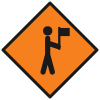
An orange sign like this is ahead. What should you be ready to do?
Question 23 of 40Road signs · Signs, signals and road markings

What must you do when you come to this sign?
Question 24 of 40Road signs · Signs, signals and road markings
A yellow warning sign shows a car skidding next to a thermometer and 0 C. What does it warn?
Question 25 of 40Road signs · Signs, signals and road markings
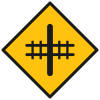
On this sign, the tracks cross the road at a slant. What does the slant show?
Question 26 of 40Road signs · Signs, signals and road markings
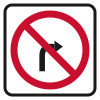
What does this sign mean?
Question 27 of 40Road signs · Signs, signals and road markings
What does a flashing amber (yellow) light tell you to do?
Question 28 of 40Road signs · Signs, signals and road markings
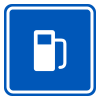
Signs with this background colour give you what kind of message?
Question 29 of 40Road signs · Signs, signals and road markings
What must you do at a flashing red light?
Question 30 of 40Road signs · Signs, signals and road markings
You face a green light at an intersection and no sign limits your moves. What may you do once it is safe?
Question 31 of 40Road signs · Signs, signals and road markings
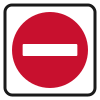
On signs like this one, what does the colour red stand for?
Question 32 of 40Road signs · Signs, signals and road markings
A sign uses the colour green. What does green tell you?
Question 33 of 40Road signs · Signs, signals and road markings
What does an orange pavement drop-off sign warn you of?
Question 34 of 40Road signs · Signs, signals and road markings
A bicycle symbol with a chevron above it is painted in a traffic lane. What does it mean?
Question 35 of 40Road signs · Signs, signals and road markings
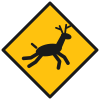
What does this sign tell you?
Question 36 of 40Road signs · Signs, signals and road markings
What does this sign mean?
Question 37 of 40Road signs · Signs, signals and road markings

In Saskatchewan, at a crossing marked with this sign, red lights are flashing but there are no gates. No train is close. What may you do?
Question 38 of 40Road signs · Signs, signals and road markings
In Saskatchewan, what does this sign mark the start of?
Question 39 of 40Road signs · Signs, signals and road markings
In Saskatchewan, a rural stop sign post has just one reflective triangle on it. What kind of road are you about to cross?
Question 40 of 40Road signs · Signs, signals and road markings
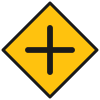
What does this sign warn you of?
1 of 40
Answer each question to see the explanation. Keyboard: A–D or 1–4 to answer, N next, P previous.
Answers and explanations (text version)
The correct answer to each question above, why it is right, and where it comes from. Try the test first.
Question 1: C. It may startle them into your path
Honking needlessly as you pass may frighten a cyclist and make them steer into your path.
Handbook: SGI Driver's Handbook, 3.4 Sharing the road with bicycles (p. 40)
Question 2: C. The driver going straight
When opposite drivers stop together and one is turning left, the left-turning driver yields to the driver going straight.
Handbook: SGI Driver's Handbook, 3.17 Right of way (p. 61)
Question 3: C. 90 days
Early reinstatement with a voluntary ignition interlock needs an alcohol-related charge and at least 90 days of the indefinite suspension served.
Handbook: SGI Driver's Handbook, 8.1 The Traffic Safety Act (p. 181)
Question 4: B. Do not cut into it or interrupt it
Funeral processions have special privileges, so other drivers should not interfere with them or interrupt them.
Handbook: SGI Driver's Handbook, 3.4 Sharing the road with funeral processions (p. 41)
Question 5: A. A car on the shoulder that might pull out
A potential hazard is something that might happen, like a car on the shoulder that could pull out into your path.
Handbook: SGI Driver's Handbook, 5.1 Hazards (p. 94)
Question 6: B. 80 km/h
In Saskatchewan, when there are no speed signs, the speed limit is 80 km/h.
Handbook: SGI Driver's Handbook, 3.1 Speeding, stunting and racing (p. 29)
Question 7: C. To the nearest curb, left or right
On one-way streets, pull over to the nearest curb, whether it is on the right or the left.
Handbook: SGI Driver's Handbook, 3.4 Sharing the road (p. 35)
Question 8: B. Only beside the spot where you will turn
Enter a two-way centre turning lane only next to the property you plan to turn into; it is not a driving or passing lane.
Handbook: SGI Driver's Handbook, 3.16 Centre turning lanes (p. 58)
Question 9: D. The blind spot areas around the truck
The no-zone is the set of large blind spot areas around a big truck, where crashes are most likely.
Handbook: SGI Driver's Handbook, 3.4 Sharing the road with large trucks (p. 33)
Question 10: A. Shift to neutral, slow down, pull over and stop
If the accelerator sticks, shift to neutral, slow down and stop at the side; only then turn off the key and free the pedal.
Handbook: SGI Driver's Handbook, 6.10 Emergency driving (p. 156)
Question 11: B. Yield to it as if the siren were on
With lights flashing but no siren, drivers should still yield to the emergency vehicle in the same way.
Handbook: SGI Driver's Handbook, 3.4 Sharing the road (p. 36)
Question 12: B. Enough time passing
Only time clears alcohol from the body. Coffee, a shower or a short sleep will not lower your blood alcohol level.
Handbook: SGI Driver's Handbook, 7.1 Alcohol (p. 170)
Question 13: B. Start braking right away while you work out what it is
Start braking as soon as you see something, so you slow down while you work out what it is and have more time to react.
Handbook: SGI Driver's Handbook, 3.29 Choosing the right speed (p. 74)
Question 14: A. 10 seconds
Idling for more than 10 seconds, except in traffic, uses more fuel than turning the engine off and restarting it.
Handbook: SGI Driver's Handbook, Fuel-efficient driving techniques (p. 193)
Question 15: D. Low beams
In fog, blowing snow or heavy rain, you will see better with your headlights on low beams.
Handbook: SGI Driver's Handbook, 6.13 Impairing factors (other than drugs and alcohol) (p. 165)
Question 16: B. 60 days
A new driver's first roadside suspension takes the licence for 60 days, along with a 3-day vehicle impoundment.
Handbook: SGI Driver's Handbook, 8.1 The Traffic Safety Act (p. 179)
Question 17: A. 25%
The handbook says each Safety Zone point gives a discount on your vehicle plate insurance, "to a maximum of 25%".
Handbook: SGI Driver's Handbook, 8.5 Safe Driver Recognition (p. 190)
Question 18: A. Where you want the car to go
You steer where you look, so in a skid look where you want the car to go and steer there.
Handbook: SGI Driver's Handbook, 6.10 Emergency driving (p. 151)
Question 19: B. 200 m
The handbook says: "When using high beams, you must dim your headlights at least 200 m (650 ft.) in advance of oncoming vehicles."
Handbook: SGI Driver's Handbook, 3.27 Headlights (p. 72)
Question 20: C. They are the same penalties
Drug-impaired driving is treated as seriously as alcohol-impaired driving and carries the same penalties.
Handbook: SGI Driver's Handbook, 7.2 Drugs (p. 174)
Question 21: D. The lane is a bus lane
In some centres, a bus lane has diamond markings in the pavement.
Handbook: SGI Driver's Handbook, 3.14 Bus lanes and bicycle lanes (p. 51)
Question 22: B. Stop and follow a flag person's directions
This construction sign means a traffic control person is ahead, so be prepared to stop for directions.
Handbook: SGI Driver's Handbook, 4.10 Construction signs (p. 86)
Question 23: B. Come to a full stop and make sure the way is clear
A stop sign means a full stop every time, and you go only once the way is clear.
Handbook: SGI Driver's Handbook, 4.2 Six basic sign shapes every driver must know (p. 76)
Question 24: A. The bridge or road may be slippery at zero degrees
This sign means the surface is subject to icing, and a bridge or road may be slippery at zero degrees Celsius.
Handbook: SGI Driver's Handbook, 4.9 Warning signs (p. 85)
Question 25: D. The angle at which the road meets the rail tracks
The railway ahead sign shows the road meets the rail tracks ahead at the angle drawn.
Handbook: SGI Driver's Handbook, 4.9 Warning signs (p. 83)
Question 26: B. Right turns are not allowed
The red circle and slash over a right arrow means no right turn is allowed.
Handbook: SGI Driver's Handbook, 4.8 Regulatory turn control signs (p. 82)
Question 27: B. Go on with caution
When you come to a flashing amber light, go on with caution.
Handbook: SGI Driver's Handbook, 4.15 Traffic signals (p. 92)
Question 28: B. General or service information
Blue signs give general information or service road information, such as where to find fuel.
Handbook: SGI Driver's Handbook, 4.3 Standard sign colours (p. 78)
Question 29: D. Stop, then go when it is safe
A flashing red light means you must stop, but you may go on once it is safe.
Handbook: SGI Driver's Handbook, 4.15 Traffic signals (p. 93)
Question 30: A. Go straight, turn left or turn right
A green light means you may turn left, turn right or go straight once the intersection is clear and it is safe.
Handbook: SGI Driver's Handbook, 4.15 Traffic signals (p. 91)
Question 31: A. Stop or prohibition
Red on a sign stands for stop or prohibition, as on the do not enter sign.
Handbook: SGI Driver's Handbook, 4.3 Standard sign colours (p. 78)
Question 32: C. A movement is permitted, or it gives direction
Green shows traffic movements that are permitted, such as turns, or gives directional guidance.
Handbook: SGI Driver's Handbook, 4.3 Standard sign colours (p. 78)
Question 33: D. The next lane or shoulder is higher or lower than yours
The pavement drop-off sign warns that the next lane, the shoulder or both are lower or higher than your lane.
Handbook: SGI Driver's Handbook, 4.10 Construction signs (p. 87)
Question 34: C. Cyclists and drivers share the lane
A chevron and bicycle symbol mark a shared lane, or sharrow, that cyclists and drivers share.
Handbook: SGI Driver's Handbook, 3.14 Bus lanes and bicycle lanes (p. 52)
Question 35: B. Deer often cross this part of the road
This warning sign marks a section of road that deer cross often.
Handbook: SGI Driver's Handbook, 4.9 Warning signs (p. 83)
Question 36: D. You must not enter this road
This regulatory sign means do not enter, so you must not drive into that road.
Handbook: SGI Driver's Handbook, 4.4 Regulatory signs (p. 78)
Question 37: A. Stop, then cross when it is safe to do so
At a crossing without gates you may cross after stopping while the red lights flash, if it is safe and no train is close.
Handbook: SGI Driver's Handbook, 4.11 Railway crossings (p. 88)
Question 38: A. A work zone
The traffic control person, survey crew and highway workers signs each mark the start of a work zone.
Handbook: SGI Driver's Handbook, 4.10 Construction signs (p. 87)
Question 39: A. A minor rural road or local street
One crossroad delineator marks all other minor rural roads and local urban streets.
Handbook: SGI Driver's Handbook, 4.12 Crossroad delineators (p. 89)
Question 40: D. A hidden intersection with roads from the side
This sign warns of a concealed or hidden intersection ahead, with a road from the right and/or left.
Handbook: SGI Driver's Handbook, 4.9 Warning signs (p. 84)
Practice test 2 of 10 for the Basic knowledge exam and sign exam (Class 7 learner's licence) (SGI): Our practice tests use 40 questions, 16 of 20 in each section to pass (SGI does not publish a fixed format). Official pass mark: 80% in each section. Our practice tests are untimed.