Question 1 of 36Speed and following distance (California)
Practice test 1 of 10 — California permit test
Practice test 1 questions
Question 2 of 36Signals and pavement markings
The light is green, but traffic is backed up on the far side of the intersection. What should you do?
Question 3 of 36Safe driving and hazards
How can you let other drivers know what you plan to do?
Question 4 of 36Road signs
In most states, how are exit numbers on an Interstate chosen?
Question 5 of 36Safe driving and hazards
You are on a dark, empty road with no cars ahead or coming toward you. Which headlights help you see best?
Question 6 of 36Turning, passing and lanes
You need to turn at the next intersection. When should you get into the correct lane?
Question 7 of 36Parking and stopping (California)
What does a white curb mean in California?
Question 8 of 36Emergencies and equipment (California)
Someone is injured in your California collision. Within how long must it be reported to law enforcement?
Question 9 of 36Signals and pavement markings
What does a flashing yellow arrow pointing left mean?
Question 10 of 36Right of way (California)
In California, a blind person at a corner pulls in their cane and steps back. What does it usually mean?
Question 11 of 36Alcohol, drugs and penalties
Can an energy drink make up for the effects of alcohol?
Question 12 of 36Speed and following distance
You are following a car in heavy traffic. What should you do?
Question 13 of 36Emergencies and equipment
Your hood flies up while you are driving. What should you do?
Question 14 of 36Road signs
Which sign is the only one with eight sides?
Question 15 of 36Safe driving and hazards
Why is driving at night riskier than in the day?
Question 16 of 36Emergencies and equipment
Your gas pedal sticks down. What should you do?
Question 17 of 36Turning, passing and lanes
On a highway with several lanes, which lane should slower traffic use?
Question 18 of 36Safe driving and hazards (California)
In California, cargo sticks out more than 4 feet past your rear bumper. What must you show in daylight?
Question 19 of 36Alcohol, drugs and penalties
How do the laws treat driving under the influence of illegal drugs?
Question 20 of 36Emergencies and equipment
How should you set your head restraint?
Question 21 of 36Signals and pavement markings
You reach an intersection where the traffic lights are not working at all. In general, what should you do?
Question 22 of 36Parking and stopping
You park on a hill with no curb, facing up or down. Which way should you turn your wheels?
Question 23 of 36Emergencies and equipment
Your headlights suddenly go out at night. What should you do?
Question 24 of 36Signals and pavement markings
A solid white line runs along the right edge of the road. What does it mark?
Question 25 of 36Right of way
Your road ends at a T-intersection with no signs. A car is coming on the through road. Who has the right-of-way?
Question 26 of 36Alcohol, drugs and penalties
In nearly every state, what is the legal blood alcohol limit for drivers 21 and over?
Question 27 of 36Signals and pavement markings
What do two solid yellow lines down the center of the road mean?
Question 28 of 36Alcohol, drugs and penalties (California)
In California, where must an opened container of alcohol be kept in a car?
Question 29 of 36Speed and following distance (California)
The California handbook names two kinds of double-fine areas. One is a Safety Enhanced-Double Fine Zone. What is the other?
Question 30 of 36Parking and stopping
May you park in a disability space without a valid placard or plate?
Question 31 of 36Sharing the road
Where should you take extra care to watch for children?
Question 32 of 36Road signs
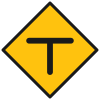
What does this sign tell you about the road ahead?
Question 33 of 36Parking and stopping
Why should you not park next to a fire hydrant?
Question 34 of 36Parking and stopping (California)
In California, how close to a fire hydrant may you park?
Question 35 of 36Turning, passing and lanes (California)
You tow a trailer on a California road with four lanes your way and no lanes marked for slow traffic. Which lanes may you use?
Question 36 of 36Sharing the road
An orange triangle with a red border on the back of a vehicle means:
1 of 36
Answer each question to see the explanation. Keyboard: A–D or 1–4 to answer, N next, P previous.
Answers and explanations (text version)
The correct answer to each question above, why it is right, and where it comes from. Try the test first.
Question 1: B. At least three seconds
Use the three-second rule to keep a safe following distance behind the vehicle in front.
Handbook: Section 8: Safe Driving — Tailgating (Following Too Closely)
Question 2: B. Wait until there is room to clear the intersection
Do not enter an intersection unless there is room to clear it, even on green. Blocking it holds up cross traffic.
Handbook: Chapter: Traffic signals and pavement markings — Traffic signals
Question 3: D. Use your signals and brake lights
Signals, brake lights and eye contact tell other drivers and people walking what you plan to do.
Handbook: Chapter: Safe driving and hazards — Defensive driving
Question 4: A. By the mile marker nearest the exit
In most states, exit numbers match the nearest mile marker, so you can tell how far apart two exits are.
Handbook: Chapter: Traffic signs — Guide and service signs
Question 5: C. High beams, until another car comes near
High beams let you see farther on a dark, empty road; switch back to low beams when another car comes near.
Handbook: Chapter: Safe driving and hazards — Night and weather
Question 6: C. Well before the intersection
Move into the correct lane well before the intersection so you do not swerve at the last moment.
Handbook: Chapter: Turning, passing and lane use — Turns
Question 7: A. Stop only to pick up or drop off riders
At a white curb, stop only long enough to pick up or drop off passengers.
Handbook: Section 6: Navigating the Roads — Parking at Colored Curbs
Question 8: B. Within 24 hours
You must report to law enforcement within 24 hours if anyone is injured or killed.
Handbook: Section 10: Financial Responsibility, Insurance Requirements, and Collisions — What to Do if You Are in a Collision
Question 9: A. You may turn left after yielding
A flashing yellow arrow means turns are allowed, but you must first yield to oncoming traffic and pedestrians.
Handbook: Chapter: Traffic signals and pavement markings — Traffic signals
Question 10: B. You may go
California's handbook says pulling in the cane and stepping away usually means you may go; still drive past with care.
Handbook: Section 7: Laws and Rules of the Road — Pedestrians Who Are Blind
Question 11: C. No, you are still impaired
Energy drinks may make you feel alert, but you are still impaired by the alcohol in your body.
Handbook: Chapter: Alcohol, drugs and penalties — How alcohol affects you
Question 12: D. Keep a steady gap and watch for brake lights
In heavy traffic keep a steady gap and watch for brake lights ahead so you can slow down smoothly.
Handbook: Chapter: Speed and following distance — Following distance
Question 13: B. Look through the gap and pull over
Look through the gap under the hood or out the side window, slow down and pull off the road.
Handbook: Chapter: Emergencies and vehicle equipment — Vehicle failures
Question 14: D. Stop
Only the stop sign has eight sides, so you can know it by shape alone.
Handbook: Chapter: Traffic signs — Sign shapes and colors
Question 15: B. You cannot see as far or as clearly
At night you cannot see as far or as clearly, so it is harder to spot hazards in time.
Handbook: Chapter: Safe driving and hazards — Night and weather
Question 16: C. Shift to neutral and brake
Shift to neutral to cut power to the wheels, brake, and pull off the road when safe.
Handbook: Chapter: Emergencies and vehicle equipment — Stuck gas pedal
Question 17: B. The right lane
Slower traffic should keep to the right lane so faster cars can pass on the left.
Handbook: Chapter: Turning, passing and lane use — Lane use
Question 18: D. A 12-inch red or orange flag
Cargo extending more than 4 feet from the rear bumper must display a 12-inch red or fluorescent orange square flag.
Handbook: Section 7: Laws and Rules of the Road — Other Important Roadway Information
Question 19: C. It is as illegal as driving drunk
Driving under the influence of drugs is treated as seriously as driving under the influence of alcohol.
Handbook: Chapter: Alcohol, drugs and penalties — Drugs and medicine
Question 20: D. Level with the back of your head
Set the head restraint level with the back of your head to protect your neck in a crash.
Handbook: Chapter: Emergencies and vehicle equipment — Vehicle equipment
Question 21: B. Treat it as an all-way stop
In general, when signals are dark, treat the intersection as an all-way stop and take turns going.
Handbook: Chapter: Traffic signals and pavement markings — Traffic signals
Question 22: A. Toward the edge of the road
With no curb, turn the wheels toward the edge of the road so the car rolls off the road, not into traffic.
Handbook: Chapter: Parking and stopping — Parking on hills
Question 23: D. Turn on hazards and pull off the road
Try your hazard lights or high beams, then pull off the road as soon as you safely can.
Handbook: Chapter: Emergencies and vehicle equipment — Lights failure
Question 24: A. The edge of the road
A solid white edge line marks the right edge of the road and helps you stay on it at night and in fog.
Handbook: Chapter: Traffic signals and pavement markings — Pavement markings
Question 25: D. The car on the through road
At a T-intersection with no signs, traffic on the ending road yields to traffic on the through road.
Handbook: Chapter: Right of way — Uncontrolled intersections
Question 26: A. 0.08 percent
In nearly every state the limit for drivers 21 and over is 0.08 percent; a state may set it lower.
Handbook: Chapter: Alcohol, drugs and penalties — Legal limits
Question 27: D. No passing from either side
Two solid yellow lines down the center of the road mean no passing from either side.
Handbook: Chapter: Traffic signals and pavement markings — Pavement markings
Question 28: D. In the trunk or where no passenger sits
An open container must be kept in the trunk or a place where passengers do not sit; the glove box is not allowed.
Handbook: Section 9: Alcohol and Drugs — Use or Possession of Alcohol or Cannabis Products in a Vehicle
Question 29: D. A work zone while workers are present
Fines are doubled in Safety Enhanced-Double Fine Zones, and also in highway construction or maintenance zones when workers are present.
Handbook: Section 7: Laws and Rules of the Road — Fines and Double Fine Zones
Question 30: C. No, it is not allowed
Disability spaces are only for vehicles with a valid placard or plate. Others may not park there.
Handbook: Chapter: Parking and stopping — Where not to park
Question 31: C. Near schools, parks, and playgrounds
Children near schools, parks and playgrounds may run into the road without looking.
Handbook: Chapter: Sharing the road — Pedestrians
Question 32: B. It ends, and you must turn left or right
The T-shaped symbol warns that your road ends at a crossing road, so you must turn left or right.
Handbook: Chapter: Traffic signs — Warning signs
Question 33: D. Fire crews need to reach it quickly
Fire crews need fast access to a hydrant, so do not park next to one; check your state for the exact distance.
Handbook: Chapter: Parking and stopping — Where not to park
Question 34: B. No closer than 15 feet
Never park within 15 feet of a fire hydrant or a fire station driveway.
Handbook: Section 6: Navigating the Roads — Illegal Parking
Question 35: B. Only the two lanes nearest the right edge
When towing, use the far-right lane or a lane for slower vehicles; with four or more lanes and none marked, use only the two right lanes.
Handbook: Section 7: Laws and Rules of the Road — Towing
Question 36: B. It is a slow-moving vehicle
An orange triangle with a red border marks a slow-moving vehicle, such as a tractor.
Handbook: Chapter: Sharing the road — Slow-moving vehicles
Practice test 1 of 10 for the Driver's license knowledge test (Class C) (the California DMV): 36 questions, 29 to pass — the commonly reported format; the California DMV does not publish the count. Official pass mark: 80%. Our practice tests are untimed.