Question 1 of 50Signals and pavement markings
Practice test 2 of 10 — Florida permit test
Practice test 2 questions
Question 2 of 50Alcohol, drugs and penalties (Florida)
A Florida driver under 18 gets 6 points within 12 months. What happens?
Question 3 of 50Right of way
In the US, which way do cars travel in a roundabout?
Question 4 of 50Road signs
Why do stop and yield signs have shapes no other sign uses?
Question 5 of 50Speed and following distance (Florida)
In Florida, where are fines for speeding doubled?
Question 6 of 50Turning, passing and lanes
You turn left from a two-way street onto another two-way street. Which lane should you end in?
Question 7 of 50Safe driving and hazards (Florida)
In Florida, when you turn on your windshield wipers for rain, what else should you turn on?
Question 8 of 50Speed and following distance (Florida)
Unless posted otherwise, what is the Florida speed limit in a business or residential area?
Question 9 of 50Right of way
When must you yield the right-of-way?
Question 10 of 50Right of way (Florida)
In Florida, a funeral procession led by a lead vehicle enters an intersection. What should you do?
Question 11 of 50Parking and stopping (Florida)

How close to a railroad crossing may you park in Florida?
Question 12 of 50Road signs
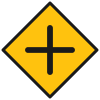
What does this sign tell you is ahead?
Question 13 of 50Speed and following distance
The road is wet from rain. What should you do?
Question 14 of 50Road signs

What does this round yellow sign warn you about?
Question 15 of 50Signals and pavement markings
Yellow center lines on a road separate:
Question 16 of 50Alcohol, drugs and penalties
A medicine label says "Do not operate heavy machinery." What should you do?
Question 17 of 50Signals and pavement markings (Florida)
The Florida handbook allows a left turn on a steady red light in one case, after stopping. Which?
Question 18 of 50Road signs
Blue signs along a highway point out:
Question 19 of 50Sharing the road
A person in a wheelchair is crossing the street. What should you do?
Question 20 of 50Road signs
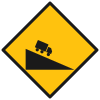
This sign shows a truck on a downward slope. What does it warn you about?
Question 21 of 50Signals and pavement markings
The light turns yellow just as you reach the stop line at speed and cannot stop safely. What should you do?
Question 22 of 50Signals and pavement markings
A center lane is marked with a solid yellow line and a broken yellow line on each side. What is it for?
Question 23 of 50Turning, passing and lanes
How should you turn left from a one-way street onto another one-way street?
Question 24 of 50Emergencies and equipment
Your brakes suddenly stop working. What should you do first?
Question 25 of 50Signals and pavement markings
Generally, when may you turn right on a steady red light?
Question 26 of 50Safe driving and hazards (Florida)
In Florida, when must you switch from high beams for an oncoming car?
Question 27 of 50Right of way
Why must drivers always yield to trains at a crossing?
Question 28 of 50Safe driving and hazards
What is an "escape route" when driving?
Question 29 of 50Road signs

When you reach this sign, what must you do?
Question 30 of 50Safe driving and hazards
The back of your car starts to skid. What should you do?
Question 31 of 50Safe driving and hazards
Why is texting while driving so dangerous?
Question 32 of 50Right of way (Florida)
In Florida the minimum fine for passing a stopped school bus is $265. What is the minimum if you pass on the side where children get on and off?
Question 33 of 50Safe driving and hazards (Florida)
Where does Florida ban using a phone in your hand while driving, even just to talk?
Question 34 of 50Road signs
A school zone sign has a plaque that says "WHEN FLASHING". What does it mean?
Question 35 of 50Speed and following distance
When you are stopped behind another car, how much space should you leave?
Question 36 of 50Parking and stopping
When you leave your car parked, what should you do?
Question 37 of 50Right of way
At a four-way stop, you and an oncoming car stop at the same time. You want to turn left; they are going straight. Who goes first?
Question 38 of 50Right of way
At an intersection with no signs, you want to turn left. An oncoming car is going straight. What should you do?
Question 39 of 50Road signs
A sign shaped like a triangle with one point facing down means:
Question 40 of 50Turning, passing and lanes (Florida)
In Florida, you may not pass on a hill or curve unless you can see how far ahead?
Question 41 of 50Turning, passing and lanes
Why should you avoid changing lanes in an intersection?
Question 42 of 50Speed and following distance
Why is it unsafe to drive faster than your lights can show at night?
Question 43 of 50Right of way
You want to make a U-turn where it is legal. Who must you yield to?
Question 44 of 50Speed and following distance
Why does the risk of hydroplaning go up as you drive faster?
Question 45 of 50Speed and following distance (Florida)
Unless posted otherwise, what is the Florida speed limit on other streets and highways?
Question 46 of 50Speed and following distance (Florida)
On a Florida highway with a 70 mph limit, what is the minimum speed?
Question 47 of 50Emergencies and equipment
When should you use your hazard warning lights?
Question 48 of 50Speed and following distance
You are driving in a neighborhood with homes and parks. What should you do?
Question 49 of 50Turning, passing and lanes
Before you change lanes, how should you check your blind spot?
Question 50 of 50Alcohol, drugs and penalties
What does "implied consent" mean?
1 of 50
The timer starts when you answer the first question. Keyboard: A–D or 1–4 to answer, N next, P previous.
Answers and explanations (text version)
The correct answer to each question above, why it is right, and where it comes from. Try the test first.
Question 1: C. Which way traffic in that lane may go
Lane arrows show which way traffic in that lane may go, such as straight or left only.
Handbook: Chapter: Traffic signals and pavement markings — Pavement markings
Question 2: D. Driving is limited to business purposes for a year
A driver under 18 with 6 or more points in 12 months is restricted to business purposes only for one year.
Handbook: Section 3: Your Driving Privilege — Mandatory Restriction for Minors
Question 3: D. Counterclockwise, to the right
In the US, traffic in a roundabout moves counterclockwise, so you go around to the right.
Handbook: Chapter: Right of way — Roundabouts
Question 4: A. So drivers can tell them apart even from behind
Their unique shapes let drivers tell what they are even when the front is covered by snow or seen from behind.
Handbook: Chapter: Traffic signs — Sign shapes and colors
Question 5: A. In school zones and construction zones
Florida doubles speeding fines in school zones and construction or work zones, and may require a driving course.
Handbook: Section 3: Your Driving Privilege — Speeding
Question 6: C. The lane just right of the center line
When turning left onto a two-way street, finish in the lane just to the right of the center line.
Handbook: Chapter: Turning, passing and lane use — Turns
Question 7: D. Your headlights
When you turn on your windshield wipers, turn on your headlights.
Handbook: Section 8: Special Driving Situations — Rain
Question 8: A. 30 mph
The maximum in a municipal, business or residential area is 30 mph unless otherwise posted.
Handbook: Section 7: Driving Safety — Speed Limits
Question 9: A. Whenever it helps prevent a crash
Even when you have the right-of-way, yield if it will help prevent a crash.
Handbook: Chapter: Right of way — Right-of-way basics
Question 10: D. Yield and let the procession go through
Drivers must yield to funeral processions; once the lead vehicle enters, the rest may follow through regardless of signals.
Handbook: Section 10: Sharing the Road — Funeral Processions
Question 11: A. No closer than 50 feet
It is against the law to park within 50 feet of a railroad crossing.
Handbook: Section 7: Driving Safety — Parking
Question 12: B. Another road crosses yours
The cross symbol warns of a crossroad ahead. Watch for traffic coming from both sides.
Handbook: Chapter: Traffic signs — Warning signs
Question 13: B. Slow down and leave more space
Wet roads give your tires less grip, so slow down and leave more space ahead.
Handbook: Chapter: Speed and following distance — Speed and road conditions
Question 14: D. A railroad crossing is ahead
The round yellow sign with an X warns of a railroad crossing ahead. Slow down, look and listen for trains.
Handbook: Chapter: Traffic signs — Warning signs
Question 15: A. Traffic moving in opposite directions
Yellow lines separate traffic moving in opposite directions.
Handbook: Chapter: Traffic signals and pavement markings — Pavement markings
Question 16: D. Do not drive until you know how it affects you
A car counts as heavy machinery. Do not drive until you know how the medicine affects you.
Handbook: Chapter: Alcohol, drugs and penalties — Drugs and medicine
Question 17: D. From a one-way street onto a one-way street going left
The Florida handbook says at a red light "you may turn left from a one-way street onto a one-way street" with traffic moving left.
Handbook: Section 6: Traffic Controls — Traffic Signals
Question 18: A. Services such as gas, food and lodging
Blue signs show services for drivers, such as gas, food, lodging and hospitals.
Handbook: Chapter: Traffic signs — Sign shapes and colors
Question 19: D. Wait until they have crossed
Treat a person in a wheelchair like any person walking. Stop and wait until they have crossed.
Handbook: Chapter: Sharing the road — Pedestrians
Question 20: C. A steep downhill grade ahead
The truck on a downward slope warns of a steep downhill grade. Check your speed and use a lower gear.
Handbook: Chapter: Traffic signs — Warning signs
Question 21: D. Go on through the intersection with care
Stop for a yellow light if you safely can. If you are too close to stop safely, go on through the intersection with care.
Handbook: Chapter: Traffic signals and pavement markings — Traffic signals
Question 22: C. Left turns by traffic from both directions
This is a two-way left-turn lane. Drivers from both directions use it only to make left turns.
Handbook: Chapter: Traffic signals and pavement markings — Pavement markings
Question 23: B. From the far left lane into the far left lane
Turning left from one one-way street onto another, start in the far left lane and end in the far left lane.
Handbook: Chapter: Turning, passing and lane use — Turns
Question 24: C. Pump the brakes and shift to a lower gear
Pump the brake pedal to build pressure and shift to a lower gear, then use the parking brake slowly if needed.
Handbook: Chapter: Emergencies and vehicle equipment — Brake failure
Question 25: A. After a full stop, unless a sign forbids it
Generally you may turn right on red after a full stop if no sign forbids it and you yield to people and traffic.
Handbook: Chapter: Traffic signals and pavement markings — Traffic signals
Question 26: D. When it is within 500 feet
Florida law bans high beams within 500 feet of an oncoming vehicle; use low beams.
Handbook: Section 8: Special Driving Situations — Night Driving
Question 27: B. Trains cannot stop quickly or steer away
A train cannot steer and may need a mile or more to stop, so you must always yield to it.
Handbook: Chapter: Right of way — Railroad crossings
Question 28: A. Open space you can steer into
An escape route is open space you can steer into if you suddenly need to avoid a crash.
Handbook: Chapter: Safe driving and hazards — Defensive driving
Question 29: C. Stop completely, then go when it is safe
This is a stop sign. You must come to a full stop and move on only when the way is clear.
Handbook: Chapter: Traffic signs — Regulatory signs
Question 30: A. Ease off the gas and steer where you want to go
In a skid, ease off the gas and steer gently where you want the car to go.
Handbook: Chapter: Safe driving and hazards — Skids and slippery roads
Question 31: D. It takes your eyes and mind off the road
Texting takes your eyes, hands and mind off driving, which makes a crash much more likely.
Handbook: Chapter: Safe driving and hazards — Distracted driving
Question 32: C. $465
The Florida handbook gives a $265 minimum, but passing "on the side where children enter and exit" brings a minimum of $465.
Handbook: Section 3: Your Driving Privilege — Passing a Stopped School Bus
Question 33: C. In school zones, school crossings and work zones
Florida prohibits using a wireless device in a handheld manner in a school crossing, school zone or work zone.
Handbook: Section 4: Before You Drive—You the Driver — Distracted Driving
Question 34: C. The lower limit applies while lights flash
With a "when flashing" plaque, the lower school speed limit applies while the yellow lights are flashing.
Handbook: Chapter: Traffic signs — Regulatory signs
Question 35: A. Enough to see its rear tires touch the road
If you can see the rear tires of the car ahead touching the road, you have room to steer around it.
Handbook: Chapter: Speed and following distance — Managing space
Question 36: B. Turn off the engine, take the keys, and lock it
Turn off the engine, take the keys and lock the car so no one can drive it away and it cannot roll.
Handbook: Chapter: Parking and stopping — Leaving a parked car
Question 37: B. The car going straight
A driver turning left yields to an oncoming car going straight, so let it go first.
Handbook: Chapter: Right of way — Stop signs and intersections
Question 38: D. Yield to the oncoming car
A driver turning left must yield to oncoming traffic that is close enough to be a hazard.
Handbook: Chapter: Right of way — Uncontrolled intersections
Question 39: C. Yield
The downward-pointing triangle is used only for the yield sign.
Handbook: Chapter: Traffic signs — Sign shapes and colors
Question 40: D. At least 500 feet
Do not pass on hills or curves where you cannot see at least 500 feet ahead.
Handbook: Section 7: Driving Safety — Passing
Question 41: B. Others may not expect it, and it can cause a crash
Changing lanes in an intersection surprises other drivers and people crossing, so it often causes crashes.
Handbook: Chapter: Turning, passing and lane use — Changing lanes
Question 42: A. You may not see a hazard in time to stop
If you drive faster than your lights reach, you may not see a hazard in time to stop.
Handbook: Chapter: Speed and following distance — Speed and road conditions
Question 43: D. All other traffic and pedestrians
A driver making a U-turn must yield to all other traffic and to pedestrians.
Handbook: Chapter: Right of way — Turning at intersections
Question 44: D. Your tires cannot push water away fast enough
At higher speed, tires cannot clear the water fast enough and can ride up on a thin layer of it.
Handbook: Chapter: Speed and following distance — Speed and road conditions
Question 45: D. 55 mph
On streets and highways where no other limit is posted, the Florida maximum is 55 mph.
Handbook: Section 7: Driving Safety — Speed Limits
Question 46: C. 50 mph
When the posted limit is 70 mph, the minimum speed limit is 50 mph.
Handbook: Section 7: Driving Safety — Speed Limits
Question 47: B. When your stopped car could be a hazard
Use hazard lights when your car is stopped or very slow and could be a hazard to others.
Handbook: Chapter: Emergencies and vehicle equipment — Breakdowns
Question 48: C. Keep your speed low and watch for children
In neighborhoods children may run into the street, so keep your speed low and watch closely.
Handbook: Chapter: Speed and following distance — Special speed zones
Question 49: B. Turn your head and look over your shoulder
Mirrors do not show everything. A quick look over your shoulder checks the blind spot before you move.
Handbook: Chapter: Turning, passing and lane use — Changing lanes
Question 50: C. By driving, you agree to alcohol or drug tests
Implied consent means that by driving, you have agreed to a test for alcohol or drugs if lawfully asked.
Handbook: Chapter: Alcohol, drugs and penalties — Testing and implied consent
Practice test 2 of 10 for the Class E Knowledge Exam (FLHSMV): 50 questions · 40 of 50 (80%) to pass · 60 minutes.