Question 1 of 35Road signs
Practice test 1 of 10 — Illinois permit test
Practice test 1 questions
Question 2 of 35Sharing the road (Illinois)
When you pass a bicyclist on an Illinois road, how much space must you leave?
Question 3 of 35Right of way
At a four-way stop, you and an oncoming car stop at the same time. You want to turn left; they are going straight. Who goes first?
Question 4 of 35Emergencies and equipment
You are in a crash and someone is hurt. What should you do?
Question 5 of 35Road signs
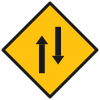
You are on a one-way street and see this sign. What does it mean?
Question 6 of 35Sharing the road
Where should you take extra care to watch for children?
Question 7 of 35Right of way
Your light turns green, but people are still in the crosswalk. What should you do?
Question 8 of 35Signals and pavement markings
What should you do at a flashing red light?
Question 9 of 35Signals and pavement markings
A crossing signal shows a number counting down. What does the number show?
Question 10 of 35Parking and stopping (Illinois)
In Illinois, how close to a fire hydrant may you stand or park?
Question 11 of 35Emergencies and equipment
Your car breaks down on the highway. What should you do?
Question 12 of 35Turning, passing and lanes
Where should you slow down when leaving a highway?
Question 13 of 35Road signs
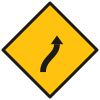
What does this sign warn you about?
Question 14 of 35Speed and following distance
Why should you slow down as you near the top of a hill?
Question 15 of 35Emergencies and equipment
Your car stalls on the railroad tracks and a train is coming. What should you do?
Question 16 of 35Sharing the road
An orange triangle with a red border on the back of a vehicle means:
Question 17 of 35Parking and stopping (Illinois)
A striped area is painted next to an Illinois accessible parking space. May a car with a disability placard park on it?
Question 18 of 35Parking and stopping (Illinois)
In Illinois, how close to a fire station driveway may you stand or park?
Question 19 of 35Road signs
Green signs on a highway show:
Question 20 of 35Turning, passing and lanes (Illinois)
What does Illinois law say about passing other vehicles in construction zones?
Question 21 of 35Signals and pavement markings
A lane is marked with a white diamond symbol. What does it usually mean?
Question 22 of 35Emergencies and equipment
A front tire blows out. What should you do?
Question 23 of 35Safe driving and hazards
Why is driving at night riskier than in the day?
Question 24 of 35Signals and pavement markings
Generally, when may you turn right on a steady red light?
Question 25 of 35Turning, passing and lanes (Illinois)
Outside business and residential areas in Illinois, at least how far before a turn must you signal?
Question 26 of 35Right of way
At a corner with no painted lines, is there a crosswalk?
Question 27 of 35Speed and following distance
How does higher speed affect what you can see?
Question 28 of 35Speed and following distance (Illinois)
The Illinois three-second rule table lists a following distance for 55 mph. About how far back is it?
Question 29 of 35Sharing the road
Why is it dangerous to cut in front of a large truck?
Question 30 of 35Signals and pavement markings (Illinois)
In an Illinois city, a white stop line is usually painted how far before the crosswalk?
Question 31 of 35Parking and stopping
You park facing uphill next to a curb. Which way should you turn your front wheels?
Question 32 of 35Signals and pavement markings (Illinois)
An Illinois traffic signal is not working at all. How must you treat the intersection?
Question 33 of 35Speed and following distance
Why does the risk of hydroplaning go up as you drive faster?
Question 34 of 35Safe driving and hazards
What is the main danger of driving when angry or upset?
Question 35 of 35Road signs
A school zone sign has a plaque that says "WHEN FLASHING". What does it mean?
1 of 35
Answer each question to see the explanation. Keyboard: A–D or 1–4 to answer, N next, P previous.
Answers and explanations (text version)
The correct answer to each question above, why it is right, and where it comes from. Try the test first.
Question 1: B. Get ready to slow down to a lower limit
This sign means a lower speed limit is coming up. Get ready to slow down to the new limit.
Handbook: Chapter: Traffic signs — Regulatory signs
Question 2: D. At least 3 feet
Pass slowly and "leave at least 3 feet of passing space from the edge of the vehicle's side mirror."
Handbook: Chapter 5: Sharing the Road — Bicycles
Question 3: B. The car going straight
A driver turning left yields to an oncoming car going straight, so let it go first.
Handbook: Chapter: Right of way — Stop signs and intersections
Question 4: D. Stop, call 911, and help if you can
Stop, call 911, and give help you are able to give. Do not move injured people unless they are in danger.
Handbook: Chapter: Emergencies and vehicle equipment — Crashes
Question 5: C. Traffic will soon come toward you on this road
The two-way traffic sign warns that oncoming traffic will soon use the same road as you.
Handbook: Chapter: Traffic signs — Warning signs
Question 6: C. Near schools, parks, and playgrounds
Children near schools, parks and playgrounds may run into the road without looking.
Handbook: Chapter: Sharing the road — Pedestrians
Question 7: A. Wait until they have crossed
People who are still in the crosswalk when your light turns green have the right-of-way. Wait for them to cross.
Handbook: Chapter: Right of way — Pedestrians
Question 8: C. Stop fully, then go when it is safe
Treat a flashing red light like a stop sign. Stop fully, then go when it is safe.
Handbook: Chapter: Traffic signals and pavement markings — Traffic signals
Question 9: C. The seconds left to finish crossing
A countdown signal shows how many seconds are left for people to finish crossing before the signal changes.
Handbook: Chapter: Traffic signals and pavement markings — Traffic signals
Question 10: A. No closer than 15 feet
Standing or parking is prohibited "Within 15 feet of a fire hydrant" in Illinois.
Handbook: Chapter 4: Traffic Laws — Prohibited Stopping, Standing or Parking
Question 11: D. Pull off the road and turn on hazards
Pull off the road as far as you can and turn on your hazard lights so others can see you.
Handbook: Chapter: Emergencies and vehicle equipment — Breakdowns
Question 12: A. In the exit lane, after leaving the main lanes
Keep your speed in the main lanes and slow down once you are in the exit lane.
Handbook: Chapter: Turning, passing and lane use — Highway driving
Question 13: B. The road curves to the right ahead
This curve sign means the road bends to the right ahead. Slow down before you reach the curve.
Handbook: Chapter: Traffic signs — Warning signs
Question 14: B. You cannot see what is over the top
You cannot see past the top of a hill, so slow down in case a car or object is stopped on the other side.
Handbook: Chapter: Speed and following distance — Speed and road conditions
Question 15: A. Get out and walk away at an angle toward the train
Get out at once and walk away from the tracks at an angle toward the train, so debris thrown forward in the crash will not hit you.
Handbook: Chapter: Emergencies and vehicle equipment — Railroad emergencies
Question 16: B. It is a slow-moving vehicle
An orange triangle with a red border marks a slow-moving vehicle, such as a tractor.
Handbook: Chapter: Sharing the road — Slow-moving vehicles
Question 17: D. No, no vehicle may park there
The striped area is part of the reserved space, and vehicles "may not use this striped area for parking, even if they have a parking placard."
Handbook: Chapter 4: Traffic Laws — Parking
Question 18: A. No closer than 20 feet
Standing or parking is prohibited "Within 20 feet of a fire station driveway or crosswalk at an intersection."
Handbook: Chapter 4: Traffic Laws — Prohibited Stopping, Standing or Parking
Question 19: D. Directions, exits and distances
Green guide signs show directions, exits and how far it is to places ahead.
Handbook: Chapter: Traffic signs — Sign shapes and colors
Question 20: A. All construction zones are no-passing zones
Passing is not allowed in a construction zone: "All construction zones in Illinois are no passing zones."
Handbook: Chapter 4: Traffic Laws — Passing
Question 21: C. The lane is reserved, such as for carpools
A white diamond marks a reserved lane, such as a carpool (HOV) lane, that only some vehicles may use.
Handbook: Chapter: Traffic signals and pavement markings — Pavement markings
Question 22: B. Hold the wheel firmly and ease off the gas
Hold the wheel firmly, ease off the gas and let the car slow down before you brake gently.
Handbook: Chapter: Emergencies and vehicle equipment — Tire failure
Question 23: B. You cannot see as far or as clearly
At night you cannot see as far or as clearly, so it is harder to spot hazards in time.
Handbook: Chapter: Safe driving and hazards — Night and weather
Question 24: A. After a full stop, unless a sign forbids it
Generally you may turn right on red after a full stop if no sign forbids it and you yield to people and traffic.
Handbook: Chapter: Traffic signals and pavement markings — Traffic signals
Question 25: C. 200 feet
Signal for at least 100 feet in a business or residential area; "In other areas, the signal must be given at least 200 feet before turning."
Handbook: Chapter 4: Traffic Laws — Signaling
Question 26: A. Yes, there is usually an unmarked crosswalk
At most intersections there is an unmarked crosswalk even with no painted lines, and you must yield to people using it.
Handbook: Chapter: Right of way — Pedestrians
Question 27: A. Your side vision narrows
The faster you go, the more your field of view narrows, so you may miss hazards to the side.
Handbook: Chapter: Speed and following distance — Speed and road conditions
Question 28: C. 243 feet
At 55 mph a car travels about 81 feet each second, so the table gives "243 feet back" for three seconds.
Handbook: Chapter 11: Safe Driving Tips — Following Distances
Question 29: C. It needs much more distance to stop
A loaded truck needs much more distance to stop than a car, so it may not be able to stop for you.
Handbook: Chapter: Sharing the road — Large trucks and buses
Question 30: D. About 4 feet
A white stop line "is usually 4 feet before the crosswalk in an urban area" and shows where you must stop.
Handbook: Chapter 10: Traffic Signals and Pavement Markings — Pavement Markings
Question 31: C. Away from the curb
Facing uphill with a curb, turn the wheels away from the curb so the tire rests against it if the car rolls back.
Handbook: Chapter: Parking and stopping — Parking on hills
Question 32: C. As an all-way stop
When traffic signals are not working, "you must always treat the intersection as an all-way stop by coming to a complete stop."
Handbook: Chapter 10: Traffic Signals and Pavement Markings — Traffic Signals
Question 33: D. Your tires cannot push water away fast enough
At higher speed, tires cannot clear the water fast enough and can ride up on a thin layer of it.
Handbook: Chapter: Speed and following distance — Speed and road conditions
Question 34: D. You may take more risks
Strong feelings make you take more risks and pay less attention, so wait until you are calm before you drive.
Handbook: Chapter: Safe driving and hazards — Defensive driving
Question 35: C. The lower limit applies while lights flash
With a "when flashing" plaque, the lower school speed limit applies while the yellow lights are flashing.
Handbook: Chapter: Traffic signs — Regulatory signs
Practice test 1 of 10 for the Basic written exam (written test for the instruction permit) (ILSOS): 35 questions, 28 to pass — the commonly reported format; ILSOS does not publish the exact count. Official pass mark: 80%. Our practice tests are untimed.