Question 1 of 25Safe driving and hazards
Practice test 2 of 10 — Iowa permit test
Practice test 2 questions
Question 2 of 25Safe driving and hazards
You drive into thick smoke or fog and can barely see. What is the safest choice?
Question 3 of 25Safe driving and hazards
You feel very sleepy while driving. What should you do?
Question 4 of 25Right of way
At a four-way stop, another driver waves you on, but it is their turn. What is the safest thing to do?
Question 5 of 25Speed and following distance
When should you leave more space between you and the car ahead?
Question 6 of 25Right of way
Your light turns green, but an ambulance with flashing lights and a siren is coming. What should you do?
Question 7 of 25Sharing the road (Iowa)
On an Iowa street, the car ahead in the next lane has stopped for a pedestrian. What should you do?
Question 8 of 25Sharing the road
A car is stopped ahead with people getting out of it near a crosswalk. What should you do?
Question 9 of 25Emergencies and equipment
When should you use your hazard warning lights?
Question 10 of 25Alcohol, drugs and penalties (Iowa)
Does Iowa’s implied consent law apply to drivers from other states?
Question 11 of 25Signals and pavement markings
A row of white triangles across your lane points toward you. What does it mean?
Question 12 of 25Road signs
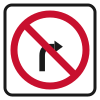
This sign is posted at a crossroad. Which move may you not make?
Question 13 of 25Speed and following distance
The road is wet from rain. What should you do?
Question 14 of 25Right of way
You have stopped at a stop line, but your view of the cross street is blocked. What should you do?
Question 15 of 25Turning, passing and lanes
You need to turn at the next intersection. When should you get into the correct lane?
Question 16 of 25Road signs
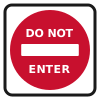
What does this sign mean?
Question 17 of 25Speed and following distance (Iowa)
Unless a sign says otherwise, what is the speed limit in an Iowa business district?
Question 18 of 25Safe driving and hazards
You see children playing near the road ahead. What is a good step to take?
Question 19 of 25Emergencies and equipment (Iowa)
Your brakes stop working while driving in Iowa. What does the manual say to try first?
Question 20 of 25Road signs
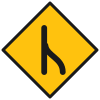
You are on the main road and see this sign. What is the best thing to do?
Question 21 of 25Speed and following distance (Iowa)
According to the Iowa manual, how fast do snowplows typically drive?
Question 22 of 25Right of way
At a corner with no painted lines, is there a crosswalk?
Question 23 of 25Speed and following distance
Driving well over the limit on a short trip usually:
Question 24 of 25Road signs (Iowa)
An Iowa Hill warning sign says the road ahead goes down a hill. What does the manual say to do first?
Question 25 of 25Signals and pavement markings
A crossing signal shows a white walking person. What does it mean for people on foot?
1 of 25
Answer each question to see the explanation. Keyboard: A–D or 1–4 to answer, N next, P previous.
Answers and explanations (text version)
The correct answer to each question above, why it is right, and where it comes from. Try the test first.
Question 1: A. Slow down and grip the wheel firmly
Strong crosswinds can push your car. Slow down and keep a firm grip on the wheel.
Handbook: Chapter: Safe driving and hazards — Night and weather
Question 2: B. Slow down, and pull off the road to stop
Slow down with low beams on. If you must stop, pull fully off the road so cars behind do not hit you.
Handbook: Chapter: Safe driving and hazards — Night and weather
Question 3: B. Stop in a safe place and rest
The only cure for being drowsy is rest. Stop in a safe place and sleep or switch drivers.
Handbook: Chapter: Safe driving and hazards — Fatigue
Question 4: C. Look for other traffic, then go
A wave is not a promise that the way is clear. Look for other traffic and people before you go.
Handbook: Chapter: Right of way — Stop signs and intersections
Question 5: D. In rain, fog, or at night
Leave more space when it is wet, foggy or dark, since you need more time to see hazards and to stop.
Handbook: Chapter: Speed and following distance — Following distance
Question 6: A. Stay stopped and let it go by
A green light does not let you go when an emergency vehicle with a siren is coming. Stay where you are and let it pass.
Handbook: Chapter: Right of way — Emergency vehicles
Question 7: D. Do not pass it
"Never pass another vehicle that has stopped or is slowing down for a pedestrian."
Handbook: Chapter 5: Applying Your Driving Skills — 5.11 Sharing the Road with Bicyclists and Pedestrians
Question 8: C. Slow down and watch for people
People getting out of a car may step into the road, so slow down and watch for them.
Handbook: Chapter: Sharing the road — Pedestrians
Question 9: B. When your stopped car could be a hazard
Use hazard lights when your car is stopped or very slow and could be a hazard to others.
Handbook: Chapter: Emergencies and vehicle equipment — Breakdowns
Question 10: D. Yes, it applies to non-residents too
The consent law "also applies to any non-resident drivers traveling in the state."
Handbook: Chapter 3: Preparing to Drive — 3.8 Alcohol and Drugs
Question 11: B. Yield at that line
A row of white triangles, called a yield line, shows where you must yield.
Handbook: Chapter: Traffic signals and pavement markings — Pavement markings
Question 12: B. A right turn
This sign bans right turns at that spot, so you must go straight or turn left if allowed.
Handbook: Chapter: Traffic signs — Regulatory signs
Question 13: B. Slow down and leave more space
Wet roads give your tires less grip, so slow down and leave more space ahead.
Handbook: Chapter: Speed and following distance — Speed and road conditions
Question 14: D. Edge forward until you can see, then go
After stopping, edge forward slowly until you can see cross traffic, then go only when it is clear.
Handbook: Chapter: Right of way — Stop signs and intersections
Question 15: C. Well before the intersection
Move into the correct lane well before the intersection so you do not swerve at the last moment.
Handbook: Chapter: Turning, passing and lane use — Turns
Question 16: B. You must not drive onto this road from here
This sign means do not enter. You must not drive onto the road or ramp from this direction.
Handbook: Chapter: Traffic signs — Regulatory signs
Question 17: C. 20 mph
Where no limit is posted, the limit is "20 mph in any business district."
Handbook: Chapter 4: Basic Driving Skills — 4.5 Appropriate Speed
Question 18: D. Cover the brake so you can stop fast
Taking your foot off the gas and covering the brake cuts the time it takes to stop if a child runs out.
Handbook: Chapter: Safe driving and hazards — Defensive driving
Question 19: A. Pump the brake pedal several times
If your brakes fail, "Pump the brake pedal several times" to build pressure; then use the parking brake slowly.
Handbook: Chapter 5: Applying Your Driving Skills — 5.14 Equipment Failure Emergencies
Question 20: A. Watch for cars joining and adjust your speed
At a merge, both drivers share the job. Watch for cars joining and adjust your speed or lane to help them merge.
Handbook: Chapter: Traffic signs — Warning signs
Question 21: C. 25-35 mph
"Snowplows typically operate at 25-35 mph," and many drivers hit them from behind.
Handbook: Chapter 5: Applying Your Driving Skills — 5.13 Inclement Weather Driving
Question 22: A. Yes, there is usually an unmarked crosswalk
At most intersections there is an unmarked crosswalk even with no painted lines, and you must yield to people using it.
Handbook: Chapter: Right of way — Pedestrians
Question 23: A. Saves very little time and adds a lot of risk
Speeding on most trips saves only a few minutes but raises the chance and harm of a crash.
Handbook: Chapter: Speed and following distance — Basic speed rule
Question 24: C. Check your brakes
The Hill sign warns that the road goes down a hill, and "You should check your brakes before going down the hill."
Handbook: Chapter 2: Traffic Signs & Rules of the Road — 2.3 Warning Signs
Question 25: B. They may start to cross, watching for turning cars
The walking person means people may start to cross, but they should still watch for cars that are turning.
Handbook: Chapter: Traffic signals and pavement markings — Traffic signals
Practice test 2 of 10 for the Knowledge test (instruction permit) (the Iowa DOT): Our practice tests use 25 questions, 20 of 25 (80%) to pass (the Iowa DOT does not publish a fixed format). Our practice tests are untimed.