Question 1 of 25Road signs
Practice test 1 of 10 — Maryland permit test
Practice test 1 questions
Question 2 of 25Safe driving and hazards (Maryland)
The fog is too thick to drive safely on a Maryland road. What does the manual say to do?
Question 3 of 25Signals and pavement markings (Maryland)
In Maryland, may you make a left turn across double solid yellow center lines?
Question 4 of 25Turning, passing and lanes
You miss your exit on the highway. What should you do?
Question 5 of 25Emergencies and equipment
Your brakes suddenly stop working. What should you do first?
Question 6 of 25Road signs
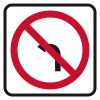
What is not allowed where this sign is posted?
Question 7 of 25Road signs
A stop sign has a small plaque below it that says "ALL WAY". What does this mean?
Question 8 of 25Right of way
A person is crossing the middle of a block, not at a crosswalk. What is true?
Question 9 of 25Signals and pavement markings
A bicycle symbol with two V-shaped chevrons above it is painted in the middle of a traffic lane. What does it tell you?
Question 10 of 25Emergencies and equipment
You see smoke coming from under the hood. What should you do?
Question 11 of 25Road signs (Maryland)
In Maryland, what does a trapezoid-shaped sign mark?
Question 12 of 25Sharing the road
Many states require at least 3 feet of space when passing a cyclist. What is the main reason?
Question 13 of 25Signals and pavement markings (Maryland)
You want to turn in the direction of a steady red arrow at a Maryland light. What must you do?
Question 14 of 25Signals and pavement markings (Maryland)
On a Maryland road, what do side-by-side broken yellow lines mark?
Question 15 of 25Emergencies and equipment
When should you adjust your seat and mirrors?
Question 16 of 25Sharing the road
A large truck passes you in the rain. What should you expect?
Question 17 of 25Turning, passing and lanes
When should you signal a turn?
Question 18 of 25Sharing the road
How should you pass a person riding a horse?
Question 19 of 25Signals and pavement markings
What does a steady yellow light mean?
Question 20 of 25Signals and pavement markings
You reach an intersection where the traffic lights are not working at all. In general, what should you do?
Question 21 of 25Speed and following distance
The road is wet from rain. What should you do?
Question 22 of 25Emergencies and equipment (Maryland)
Under Maryland law, a child under 8 must ride in a child safety seat unless the child is at least how tall?
Question 23 of 25Sharing the road
Why should you stay well back from a snowplow?
Question 24 of 25Speed and following distance
When should you leave more space between you and the car ahead?
Question 25 of 25Road signs
Blue signs along a highway point out:
1 of 25
The timer starts when you answer the first question. Keyboard: A–D or 1–4 to answer, N next, P previous.
Answers and explanations (text version)
The correct answer to each question above, why it is right, and where it comes from. Try the test first.
Question 1: A. Avoid driving on the edge of the road
A soft shoulder sign means the edge of the road is loose or soft. Avoid driving onto the shoulder.
Handbook: Chapter: Traffic signs — Warning signs
Question 2: A. Pull fully off the road and turn on flashers
If fog is too thick, "pull completely off the road to a safe location and turn on your emergency flashers."
Handbook: Section 5: Driving Situations and Conditions — C. Driving in Fog
Question 3: D. Yes, for example into a driveway
Double solid yellow means no passing either way, but "You may make a left turn across a double solid yellow line. For example, when turning into a driveway."
Handbook: Section 4: Signs, Signals and Pavement Markings — C. Pavement Markings
Question 4: C. Go on to the next exit
Never back up or turn around on a highway. Drive on to the next exit.
Handbook: Chapter: Turning, passing and lane use — Highway driving
Question 5: C. Pump the brakes and shift to a lower gear
Pump the brake pedal to build pressure and shift to a lower gear, then use the parking brake slowly if needed.
Handbook: Chapter: Emergencies and vehicle equipment — Brake failure
Question 6: D. Turning left
This sign bans left turns. You may go straight or turn right if those moves are allowed.
Handbook: Chapter: Traffic signs — Regulatory signs
Question 7: A. Traffic from every direction must stop
An all-way plaque means traffic from every direction must stop at the intersection.
Handbook: Chapter: Traffic signs — Regulatory signs
Question 8: B. They should yield, but you must still avoid them
Pedestrians outside a crosswalk should yield to cars, but drivers must still take care not to hit anyone.
Handbook: Chapter: Right of way — Pedestrians
Question 9: B. Bikes may use the full lane, so expect them in it
This shared-lane marking means bikes may use the full lane, so expect cyclists in it and pass only when safe.
Handbook: Chapter: Traffic signals and pavement markings — Pavement markings
Question 10: A. Pull over, get out, and move away
Pull over, turn off the engine, get everyone out and move away. Call for help.
Handbook: Chapter: Emergencies and vehicle equipment — Vehicle fires
Question 11: D. Recreation areas and National Forest routes
The trapezoid marks "Recreation and cultural interest areas and National Forest Routes."
Handbook: Section 4: Signs, Signals and Pavement Markings — B. Traffic Signs
Question 12: B. A cyclist may swerve to avoid a hazard
Many states require at least 3 feet because a cyclist may swerve around potholes, glass or car doors.
Handbook: Chapter: Sharing the road — Bicycles
Question 13: A. Stop and stay stopped as long as it is red
At a steady red arrow, "come to a complete stop" and "Remain stopped as long as the arrow signal is red."
Handbook: Section 4: Signs, Signals and Pavement Markings — A. Traffic Signals
Question 14: B. The edges of reversible lanes
Double broken yellow lines mark "the edges of reversible lanes" whose direction changes at different times.
Handbook: Section 4: Signs, Signals and Pavement Markings — C. Pavement Markings
Question 15: B. Before you start to drive
Adjust your seat and mirrors before you start to drive, so you can see well and are not distracted on the road.
Handbook: Chapter: Emergencies and vehicle equipment — Vehicle equipment
Question 16: C. Spray and a push of wind
A passing truck can throw spray and push your car with wind, so hold the wheel firmly.
Handbook: Chapter: Sharing the road — Large trucks and buses
Question 17: C. Early, before you slow down or turn
Signal early, before you slow down or turn, so other drivers know what you plan to do.
Handbook: Chapter: Turning, passing and lane use — Signaling
Question 18: B. Slowly, with plenty of room and no horn
Pass a horse slowly and give it plenty of room. Do not honk, as noise can scare it.
Handbook: Chapter: Sharing the road — Slow-moving vehicles
Question 19: A. The light is about to turn red
A steady yellow light warns that the light is about to turn red. Stop if you can do so safely.
Handbook: Chapter: Traffic signals and pavement markings — Traffic signals
Question 20: B. Treat it as an all-way stop
In general, when signals are dark, treat the intersection as an all-way stop and take turns going.
Handbook: Chapter: Traffic signals and pavement markings — Traffic signals
Question 21: B. Slow down and leave more space
Wet roads give your tires less grip, so slow down and leave more space ahead.
Handbook: Chapter: Speed and following distance — Speed and road conditions
Question 22: A. 4 feet 9 inches
"All children under age 8 must ride in a child safety seat, unless the child is 4'9" or taller" (4 feet 9 inches).
Handbook: Section 10: Other Important Information — G. Child Safety Seats
Question 23: B. It throws snow and may stop suddenly
Snowplows throw snow, move slowly and may stop or turn suddenly, so stay well back.
Handbook: Chapter: Sharing the road — Emergency and work vehicles
Question 24: D. In rain, fog, or at night
Leave more space when it is wet, foggy or dark, since you need more time to see hazards and to stop.
Handbook: Chapter: Speed and following distance — Following distance
Question 25: A. Services such as gas, food and lodging
Blue signs show services for drivers, such as gas, food, lodging and hospitals.
Handbook: Chapter: Traffic signs — Sign shapes and colors
Practice test 1 of 10 for the Knowledge test (noncommercial Class C learner's permit) (Maryland MVA): 25 questions · 22 of 25 (88%) to pass · 20 minutes.