Question 1 of 40Road signs

Question 1 of 40Road signs
Question 2 of 40Signals and pavement markings (Minnesota)
Question 3 of 40Road signs
Question 4 of 40Right of way
Question 5 of 40Road signs
Question 6 of 40Safe driving and hazards
Question 7 of 40Signals and pavement markings (Minnesota)
Question 8 of 40Sharing the road
Question 9 of 40Sharing the road
Question 10 of 40Parking and stopping (Minnesota)
Question 11 of 40Alcohol, drugs and penalties (Minnesota)
Question 12 of 40Road signs
Question 13 of 40Speed and following distance (Minnesota)
Question 14 of 40Right of way
Question 15 of 40Alcohol, drugs and penalties
Question 16 of 40Safe driving and hazards
Question 17 of 40Emergencies and equipment
Question 18 of 40Alcohol, drugs and penalties
Question 19 of 40Speed and following distance
Question 20 of 40Road signs
Question 21 of 40Sharing the road
Question 22 of 40Safe driving and hazards
Question 23 of 40Alcohol, drugs and penalties
Question 24 of 40Right of way
Question 25 of 40Turning, passing and lanes
Question 26 of 40Right of way (Minnesota)
Question 27 of 40Speed and following distance (Minnesota)
Question 28 of 40Parking and stopping
Question 29 of 40Safe driving and hazards
Question 30 of 40Sharing the road (Minnesota)
Question 31 of 40Road signs
Question 32 of 40Parking and stopping
Question 33 of 40Turning, passing and lanes
Question 34 of 40Turning, passing and lanes
Question 35 of 40Turning, passing and lanes
Question 36 of 40Turning, passing and lanes
Question 37 of 40Turning, passing and lanes
Question 38 of 40Alcohol, drugs and penalties
Question 39 of 40Turning, passing and lanes (Minnesota)
Question 40 of 40Right of way (Minnesota)
Answer each question to see the explanation. Keyboard: A–D or 1–4 to answer, N next, P previous.
The correct answer to each question above, why it is right, and where it comes from. Try the test first.
Question 1: B. Before you enter the intersection, where you can see
With no stop line or crosswalk, stop before you enter the intersection at a point where you can see traffic coming.
Handbook: Chapter: Traffic signs — Regulatory signs
Question 2: D. Prepare to move over; the lane below will close
A steady downward yellow arrow means prepare to move into another lane, since "The freeway lane below the steady downward yellow arrow will be closed."
Handbook: Chapter 5: Signs, signals and pavement markings — Lane use control signals
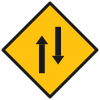
Question 3: C. Traffic will soon come toward you on this road
The two-way traffic sign warns that oncoming traffic will soon use the same road as you.
Handbook: Chapter: Traffic signs — Warning signs
Question 4: D. Stop, whichever way you are going
On a two-lane road, traffic going both ways must stop for a school bus with flashing red lights and its stop arm out.
Handbook: Chapter: Right of way — School buses
Question 5: A. So drivers can tell them apart even from behind
Their unique shapes let drivers tell what they are even when the front is covered by snow or seen from behind.
Handbook: Chapter: Traffic signs — Sign shapes and colors
Question 6: A. Slow down and grip the wheel firmly
Strong crosswinds can push your car. Slow down and keep a firm grip on the wheel.
Handbook: Chapter: Safe driving and hazards — Night and weather
Question 7: A. Wait for the green, then one car goes
Ramp meters let cars on in turns: "Only one car may proceed each time the light is green," and going through the red light is illegal.
Handbook: Chapter 6: Driving conditions — Freeway ramp meters
Question 8: B. The full width of a lane
A motorcycle needs the full width of a lane. Never share a lane with one.
Handbook: Chapter: Sharing the road — Motorcycles
Question 9: C. Stay back and do not pass on the right
Trucks swing wide to make right turns. Stay back and never try to pass on the right.
Handbook: Chapter: Sharing the road — Large trucks and buses
Question 10: B. No closer than 30 feet
Parking is not allowed "Within 30 feet of any flashing light, stop sign or traffic control signal on the side of a public road."
Handbook: Chapter 3: Traffic laws and vehicle operation — Parking
Question 11: B. 0.08 percent
A person "with an alcohol concentration of 0.08 percent or higher" in control of a vehicle can be arrested for DWI.
Handbook: Chapter 8: Driving under the influence of alcohol or drugs — Minnesota Driving While Impaired (DWI) law
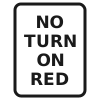
Question 12: D. You may not turn, even after you stop
This sign means no turn on red. You must stop and wait for a green light before you turn.
Handbook: Chapter: Traffic signs — Regulatory signs
Question 13: A. The three-second rule
Applying the "Three-Second Rule" helps you keep a safe distance; it "is for standard-length vehicles driving in ideal conditions."
Handbook: Chapter 6: Driving conditions — Three-Second Rule
Question 14: B. Let it finish its turn before you go
Vehicles still in the intersection when the light changes must be allowed to clear it before you go.
Handbook: Chapter: Right of way — Signals and right of way
Question 15: C. They can make driving unsafe
Medicines that cause drowsiness can slow your reactions and make driving unsafe.
Handbook: Chapter: Alcohol, drugs and penalties — Drugs and medicine
Question 16: D. At about 9 and 3 o'clock
Holding the wheel at about 9 and 3 o'clock gives good control and keeps your arms clear of the airbag.
Handbook: Chapter: Safe driving and hazards — Vehicle control
Question 17: C. Ease off the gas and steer back gently
Ease off the gas, then steer back onto the pavement gently once you have slowed down.
Handbook: Chapter: Emergencies and vehicle equipment — Running off the road
Question 18: C. Your license can be suspended
Repeated traffic violations can lead to your license being suspended, along with higher insurance costs.
Handbook: Chapter: Alcohol, drugs and penalties — Penalties
Question 19: A. Never drive faster than is safe for conditions
The basic speed rule means you must never drive faster than is safe for the road, weather and traffic, whatever the posted limit.
Handbook: Chapter: Speed and following distance — Basic speed rule
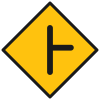
Question 20: A. Cars may enter from a road on the right
This side road sign warns that a road joins from the right, so cars may enter your road.
Handbook: Chapter: Traffic signs — Warning signs
Question 21: B. It is a slow-moving vehicle
An orange triangle with a red border marks a slow-moving vehicle, such as a tractor.
Handbook: Chapter: Sharing the road — Slow-moving vehicles
Question 22: D. At least 10 inches
Sit at least 10 inches from the steering wheel so a deploying airbag does not hurt you.
Handbook: Chapter: Safe driving and hazards — Seat belts and airbags
Question 23: B. Drinking quickly on an empty stomach
Drinking quickly on an empty stomach raises blood alcohol faster, since nothing slows its uptake.
Handbook: Chapter: Alcohol, drugs and penalties — How alcohol affects you
Question 24: C. It is getting ready to stop
Flashing yellow lights mean the bus is about to stop. Slow down and get ready to stop.
Handbook: Chapter: Right of way — School buses
Question 25: B. Others may not expect it, and it can cause a crash
Changing lanes in an intersection surprises other drivers and people crossing, so it often causes crashes.
Handbook: Chapter: Turning, passing and lane use — Changing lanes
Question 26: B. All cross traffic
At an uncontrolled "T" intersection, "you must yield to all cross traffic if you are the one turning."
Handbook: Chapter 4: Sharing the road — Right of way and yielding
Question 27: A. Your license is revoked for at least six months
"If you drive over 100 mph, your driving privileges will be revoked for at least six months."
Handbook: Chapter 3: Traffic laws and vehicle operation — Speed limits and fines
Question 28: C. Away from the curb
Facing uphill with a curb, turn the wheels away from the curb so the tire rests against it if the car rolls back.
Handbook: Chapter: Parking and stopping — Parking on hills
Question 29: D. Cover the brake so you can stop fast
Taking your foot off the gas and covering the brake cuts the time it takes to stop if a child runs out.
Handbook: Chapter: Safe driving and hazards — Defensive driving
Question 30: B. 25 mph
Lane splitting is allowed "At no more than 25 miles per hour" (25 mph) and "No more than 15 miles per hour over the speed of traffic."
Handbook: Chapter 4: Sharing the road — Sharing the road with motorcyclists
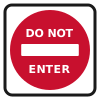
Question 31: C. At the end of a one-way road or exit ramp
Do not enter signs face drivers at the wrong end of a one-way road or a highway exit ramp, so no one drives in against traffic.
Handbook: Chapter: Traffic signs — Regulatory signs
Question 32: D. Wait until there is room past the tracks
Never stop on railroad tracks. Wait before the tracks until there is room for your whole car on the far side.
Handbook: Chapter: Parking and stopping — Stopping at railroad tracks
Question 33: A. Straight ahead until you start to turn
Keep the wheels straight. If you are hit from behind, you will not be pushed into oncoming traffic.
Handbook: Chapter: Turning, passing and lane use — Turns
Question 34: A. In the exit lane, after leaving the main lanes
Keep your speed in the main lanes and slow down once you are in the exit lane.
Handbook: Chapter: Turning, passing and lane use — Highway driving
Question 35: C. Well before the intersection
Move into the correct lane well before the intersection so you do not swerve at the last moment.
Handbook: Chapter: Turning, passing and lane use — Turns
Question 36: A. No, unless signs or markings allow it
Driving on the shoulder to pass is generally not allowed unless signs or markings say you may.
Handbook: Chapter: Turning, passing and lane use — Passing
Question 37: A. Drop back behind the car you were passing
If you cannot finish the pass safely, slow down and drop back into your lane behind the car you were passing.
Handbook: Chapter: Turning, passing and lane use — Passing
Question 38: C. More fines and a longer suspension or jail
Driving while suspended usually leads to more fines, a longer suspension, and possibly jail.
Handbook: Chapter: Alcohol, drugs and penalties — Penalties
Question 39: B. 100 feet
"You must return to the right side of the road before coming within 100 feet of an oncoming vehicle."
Handbook: Chapter 3: Traffic laws and vehicle operation — Passing
Question 40: C. Honk or rev your engine
Watch for blind pedestrians with a cane or guide dog, and "Do not use your horn or rev your engine as it may distract them."
Handbook: Chapter 4: Sharing the road — Watch for pedestrians
Practice test 2 of 10 for the Class D knowledge test (instruction permit) (Minnesota DVS): 40 questions, 32 to pass — the commonly reported format; Minnesota DVS does not publish the count. Official pass mark: 80%. Our practice tests are untimed.