Question 1 of 50Safe driving and hazards
Practice test 2 of 10 — New Jersey permit test
Practice test 2 questions
Question 2 of 50Safe driving and hazards (New Jersey)
What does New Jersey's "Maggie's Law" make illegal?
Question 3 of 50Right of way (New Jersey)
In a New Jersey weave lane, a car coming from the ramp meets a car leaving the expressway. Who must yield?
Question 4 of 50Right of way
At an intersection with no signs, you want to turn left. An oncoming car is going straight. What should you do?
Question 5 of 50Safe driving and hazards
Which of these is a cognitive distraction?
Question 6 of 50Right of way (New Jersey)
A pedestrian is in a marked crosswalk ahead of you in New Jersey. What must you do?
Question 7 of 50Safe driving and hazards (New Jersey)
In which case may a New Jersey driver use a hand-held phone while driving?
Question 8 of 50Speed and following distance
Why is following distance measured in seconds instead of feet?
Question 9 of 50Alcohol, drugs and penalties
Can an energy drink make up for the effects of alcohol?
Question 10 of 50Speed and following distance
What does it mean to "overdrive" your headlights?
Question 11 of 50Road signs
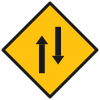
You are on a one-way street and see this sign. What does it mean?
Question 12 of 50Right of way
You are in the middle of an intersection when an ambulance with a siren comes up behind you. What should you do?
Question 13 of 50Sharing the road
Why should you be careful when a motorcycle's turn signal is on?
Question 14 of 50Alcohol, drugs and penalties (New Jersey)
What is the fine for a first offense of using a hand-held phone while driving in New Jersey?
Question 15 of 50Turning, passing and lanes
Why should you not swing wide when you make a right turn?
Question 16 of 50Road signs
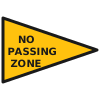
Why is this sign placed on the left side of the road?
Question 17 of 50Right of way
Why must drivers always yield to trains at a crossing?
Question 18 of 50Speed and following distance (New Jersey)
On a snow-covered New Jersey road, what following time does the manual advise?
Question 19 of 50Parking and stopping
How should you back out of an angled parking space?
Question 20 of 50Signals and pavement markings
A bicycle symbol with two V-shaped chevrons above it is painted in the middle of a traffic lane. What does it tell you?
Question 21 of 50Alcohol, drugs and penalties
Which ability does alcohol usually affect first?
Question 22 of 50Right of way
You are at a stop sign and want to turn left. Cross traffic does not stop. What do you need before you go?
Question 23 of 50Road signs
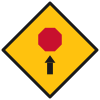
What should you do when you see this sign?
Question 24 of 50Right of way
You are pulling into a driveway and a person is walking on the sidewalk. What should you do?
Question 25 of 50Alcohol, drugs and penalties (New Jersey)
In New Jersey, how many points on your record within three years lead to a yearly surcharge?
Question 26 of 50Alcohol, drugs and penalties (New Jersey)
What does New Jersey's implied consent law mean for drivers?
Question 27 of 50Road signs
A "LOW CLEARANCE" sign shows a height. What does it warn you about?
Question 28 of 50Signals and pavement markings (New Jersey)
A New Jersey driver cuts through a gas station lot to skip a red light. Is that legal?
Question 29 of 50Road signs (New Jersey)
In New Jersey, you see orange work zone signs next to a lower speed limit sign. What happens to traffic fines there?
Question 30 of 50Right of way
A person is crossing the middle of a block, not at a crosswalk. What is true?
Question 31 of 50Safe driving and hazards (New Jersey)
New Jersey law requires headlights when you can see only how far ahead or less?
Question 32 of 50Turning, passing and lanes
Why should you avoid changing lanes in an intersection?
Question 33 of 50Road signs
A sign says "SOFT SHOULDER". What should you do?
Question 34 of 50Turning, passing and lanes
What is a blind spot?
Question 35 of 50Turning, passing and lanes
Before you change lanes, how should you check your blind spot?
Question 36 of 50Right of way
A person with a white cane or a guide dog is at a crossing. What should you do?
Question 37 of 50Right of way (New Jersey)
An emergency vehicle with its lights on has just passed you in New Jersey. How far back must you stay?
Question 38 of 50Speed and following distance
What is a "space cushion"?
Question 39 of 50Road signs
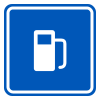
What does this blue sign beside the highway tell you?
Question 40 of 50Safe driving and hazards
You need to make a phone call while driving. What is the safest choice?
Question 41 of 50Sharing the road
Where should you take extra care to watch for children?
Question 42 of 50Speed and following distance
The best way to avoid hitting a car that stops suddenly in front of you is to:
Question 43 of 50Turning, passing and lanes
In general, when may you pass another car on the right?
Question 44 of 50Emergencies and equipment
Your hood flies up while you are driving. What should you do?
Question 45 of 50Speed and following distance
Why should you avoid driving right beside other cars on a multi-lane road?
Question 46 of 50Road signs
Most diamond-shaped signs:
Question 47 of 50Emergencies and equipment (New Jersey)
After a New Jersey crash with injury or over $500 in damage, no police report was filed. What must you do?
Question 48 of 50Right of way
Two lanes merge into one. What is the best way to handle it?
Question 49 of 50Road signs
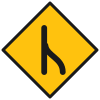
You are on the main road and see this sign. What is the best thing to do?
Question 50 of 50Right of way
You are pulling out of a driveway onto a street. Who must you yield to?
1 of 50
Answer each question to see the explanation. Keyboard: A–D or 1–4 to answer, N next, P previous.
Answers and explanations (text version)
The correct answer to each question above, why it is right, and where it comes from. Try the test first.
Question 1: B. Slow down, and pull off the road to stop
Slow down with low beams on. If you must stop, pull fully off the road so cars behind do not hit you.
Handbook: Chapter: Safe driving and hazards — Night and weather
Question 2: A. Knowingly driving while impaired by lack of sleep
Maggie's Law makes it illegal in New Jersey to knowingly drive while impaired by lack of sleep, treating it as recklessness under vehicular homicide.
Handbook: Chapter 5: Defensive Driving — Tired Driver/Highway Hypnosis
Question 3: A. The car coming from the ramp
In a New Jersey weave lane, the driver entering from the ramp must yield the right-of-way to the driver leaving the expressway.
Handbook: Chapter 4: Safe Driving Rules and Regulations — Special Highway, Parkway, and Turnpike Conditions
Question 4: D. Yield to the oncoming car
A driver turning left must yield to oncoming traffic that is close enough to be a hazard.
Handbook: Chapter: Right of way — Uncontrolled intersections
Question 5: B. Daydreaming about your plans
A cognitive distraction takes your mind off driving, such as daydreaming, even if your eyes are on the road.
Handbook: Chapter: Safe driving and hazards — Distracted driving
Question 6: B. Come to a full stop
New Jersey law says you must stop for a pedestrian in a marked crosswalk, which means a full stop, not just slowing or yielding.
Handbook: Chapter 4: Safe Driving Rules and Regulations — Pedestrians in a Crosswalk
Question 7: D. To report a fire or a traffic crash
New Jersey allows hand-held phone use only in emergencies such as a fire, traffic crash, serious road hazard or medical emergency, with one hand on the wheel.
Handbook: Chapter 4: Safe Driving Rules and Regulations — Cellular Telephones
Question 8: B. Seconds stay right at any speed
A time gap grows with your speed on its own, so a count of seconds stays right at any speed.
Handbook: Chapter: Speed and following distance — Following distance
Question 9: C. No, you are still impaired
Energy drinks may make you feel alert, but you are still impaired by the alcohol in your body.
Handbook: Chapter: Alcohol, drugs and penalties — How alcohol affects you
Question 10: B. Going too fast to stop within your lights' reach
You overdrive your headlights when you drive too fast to stop within the distance your lights show.
Handbook: Chapter: Speed and following distance — Speed and road conditions
Question 11: C. Traffic will soon come toward you on this road
The two-way traffic sign warns that oncoming traffic will soon use the same road as you.
Handbook: Chapter: Traffic signs — Warning signs
Question 12: C. Clear the intersection, then pull over
Do not stop in an intersection. Clear it first, then pull to the right and stop.
Handbook: Chapter: Right of way — Emergency vehicles
Question 13: A. It may not turn off on its own
Many motorcycle turn signals do not turn off on their own, so wait to see the rider actually turn.
Handbook: Chapter: Sharing the road — Motorcycles
Question 14: B. $200 to $400
New Jersey fines a first hand-held phone offense $200 to $400, with higher fines for later offenses.
Handbook: Chapter 4: Safe Driving Rules and Regulations — Cellular Telephones
Question 15: B. Others may think you are turning left
Swinging wide confuses other drivers and can lead a car to pass on your right. Keep close to the curb.
Handbook: Chapter: Turning, passing and lane use — Turns
Question 16: C. So a driver about to pass will see it
A driver getting ready to pass looks to the left, so the no-passing zone pennant is placed there where it will be seen.
Handbook: Chapter: Traffic signs — Warning signs
Question 17: B. Trains cannot stop quickly or steer away
A train cannot steer and may need a mile or more to stop, so you must always yield to it.
Handbook: Chapter: Right of way — Railroad crossings
Question 18: D. Six seconds or more
On snow-covered roads, New Jersey advises a following distance of six seconds or more.
Handbook: Chapter 5: Defensive Driving — Reduced Visibility
Question 19: C. Slowly, looking all around you
Back out slowly and look all around. Your view may be blocked by the cars next to you.
Handbook: Chapter: Parking and stopping — Angle parking
Question 20: B. Bikes may use the full lane, so expect them in it
This shared-lane marking means bikes may use the full lane, so expect cyclists in it and pass only when safe.
Handbook: Chapter: Traffic signals and pavement markings — Pavement markings
Question 21: D. Judgment
Alcohol affects judgment first, so a driver may feel fine while making poor choices.
Handbook: Chapter: Alcohol, drugs and penalties — How alcohol affects you
Question 22: B. A safe gap in traffic from both ways
When turning left onto a road where traffic does not stop, you cross both lanes, so you need a safe gap from both ways.
Handbook: Chapter: Right of way — Stop signs and intersections
Question 23: B. Slow down and get ready to stop
This sign warns of a stop sign ahead. Slow down so you can stop at it.
Handbook: Chapter: Traffic signs — Warning signs
Question 24: B. Stop and let them pass first
People on the sidewalk have the right-of-way at a driveway. Stop and let them pass.
Handbook: Chapter: Right of way — Pedestrians
Question 25: C. 6 points
New Jersey drivers with 6 or more points within three years pay a surcharge of $150 for six points and $25 for each extra point.
Handbook: Chapter 7: Driver Privilege and Penalties — Violation Surcharges and Point Violations
Question 26: B. You agree to a breath test after a DUI arrest
Under New Jersey's implied consent law, by using the state's roads you have agreed to a breath test after an arrest for an intoxicated driving offense.
Handbook: Chapter 7: Driver Privilege and Penalties — Breath Test
Question 27: D. An overpass or bridge with limited space above
A low clearance sign shows how much space there is under an overpass or bridge, so tall vehicles can avoid it.
Handbook: Chapter: Traffic signs — Warning signs
Question 28: C. No, it is a traffic violation
New Jersey makes driving on public or private property to avoid a traffic signal or sign a motor vehicle violation, worth 2 points.
Handbook: Chapter 4: Safe Driving Rules and Regulations — Intersections
Question 29: B. They are doubled
The New Jersey manual says all traffic fines are doubled in work zones, where reduced speed signs are posted with orange signs.
Handbook: Chapter 11: Appendix: Driver Safety — Road Work Signs
Question 30: B. They should yield, but you must still avoid them
Pedestrians outside a crosswalk should yield to cars, but drivers must still take care not to hit anyone.
Handbook: Chapter: Right of way — Pedestrians
Question 31: C. 500 feet
New Jersey requires headlights whenever visibility is 500 feet or less, as in fog, mist or smoke.
Handbook: Chapter 4: Safe Driving Rules and Regulations — Using Headlights
Question 32: B. Others may not expect it, and it can cause a crash
Changing lanes in an intersection surprises other drivers and people crossing, so it often causes crashes.
Handbook: Chapter: Turning, passing and lane use — Changing lanes
Question 33: A. Avoid driving on the edge of the road
A soft shoulder sign means the edge of the road is loose or soft. Avoid driving onto the shoulder.
Handbook: Chapter: Traffic signs — Warning signs
Question 34: D. An area near your car your mirrors do not show
A blind spot is an area near your car that your mirrors do not show, so you must turn your head to check it.
Handbook: Chapter: Turning, passing and lane use — Changing lanes
Question 35: B. Turn your head and look over your shoulder
Mirrors do not show everything. A quick look over your shoulder checks the blind spot before you move.
Handbook: Chapter: Turning, passing and lane use — Changing lanes
Question 36: D. Stop and let them cross
A white cane or guide dog means the person may be blind. Always stop and let them cross; do not honk.
Handbook: Chapter: Right of way — Pedestrians
Question 37: D. At least 300 feet
After an emergency vehicle passes, the New Jersey manual says to "keep at least 300 feet behind a signaling emergency vehicle."
Handbook: Chapter 4: Safe Driving Rules and Regulations — Stopping Regulations
Question 38: D. Open space around your car on all sides
A space cushion is room around your car on all sides so you have time and space to react.
Handbook: Chapter: Speed and following distance — Managing space
Question 39: A. Fuel is available at or near the next exit
Blue signs show services for drivers. A gas pump symbol means fuel is available near the next exit.
Handbook: Chapter: Traffic signs — Guide and service signs
Question 40: A. Pull over to a safe place first
Pull over to a safe place before using your phone, since calls take your mind off driving.
Handbook: Chapter: Safe driving and hazards — Distracted driving
Question 41: C. Near schools, parks, and playgrounds
Children near schools, parks and playgrounds may run into the road without looking.
Handbook: Chapter: Sharing the road — Pedestrians
Question 42: D. Keep a safe following distance
A safe following distance gives you time to react and stop if the car ahead stops suddenly.
Handbook: Chapter: Speed and following distance — Following distance
Question 43: C. When it is turning left and there is room
You may pass on the right when the car ahead is turning left or on a road with two or more lanes your way, if it is safe.
Handbook: Chapter: Turning, passing and lane use — Passing
Question 44: B. Look through the gap and pull over
Look through the gap under the hood or out the side window, slow down and pull off the road.
Handbook: Chapter: Emergencies and vehicle equipment — Vehicle failures
Question 45: A. You may be in their blind spot and boxed in
Driving beside other cars can leave you in their blind spot with no room to move if something happens.
Handbook: Chapter: Speed and following distance — Managing space
Question 46: B. Warn you of a hazard or change ahead
Diamond-shaped signs are warning signs. They tell you about a hazard or change in the road ahead.
Handbook: Chapter: Traffic signs — Sign shapes and colors
Question 47: D. Send a written report to the MVC within 10 days
When a New Jersey crash causes injury or more than $500 in damage and no police report is filed, send a written report to the MVC within 10 days.
Handbook: Chapter 5: Defensive Driving — What to Do in Case of a Crash
Question 48: D. Take turns and let one car in at a time
When lanes merge, take turns and leave room so each driver can merge smoothly and safely.
Handbook: Chapter: Right of way — Right-of-way basics
Question 49: A. Watch for cars joining and adjust your speed
At a merge, both drivers share the job. Watch for cars joining and adjust your speed or lane to help them merge.
Handbook: Chapter: Traffic signs — Warning signs
Question 50: C. All traffic and people walking
When entering a street from a driveway or alley, yield to all traffic on the street and to people on the sidewalk.
Handbook: Chapter: Right of way — Entering a roadway
Practice test 2 of 10 for the Knowledge Test (NJ MVC): 50 questions · 40 of 50 (80%) to pass · no time limit.