Question 1 of 20Road signs
Question 1 of 20Road signs
Question 2 of 20Road signs
Question 3 of 20Road signs
Question 4 of 20Road signs
Question 5 of 20Rules of the road · Alcohol, drugs and penalties
Question 6 of 20Rules of the road · Speed and following distance
Question 7 of 20Rules of the road · Parking and stopping
Question 8 of 20Rules of the road · Safe driving and hazards
Question 9 of 20Rules of the road · Safe driving and hazards
Question 10 of 20Rules of the road · Alcohol, drugs and penalties
Question 11 of 20Rules of the road · Signals and pavement markings
Question 12 of 20Rules of the road · Sharing the road
Question 13 of 20Rules of the road · Emergencies and equipment
Question 14 of 20Rules of the road · Signals and pavement markings
Question 15 of 20Rules of the road · Alcohol, drugs and penalties
Question 16 of 20Rules of the road · Safe driving and hazards
Question 17 of 20Rules of the road · Right of way
Question 18 of 20Rules of the road · Signals and pavement markings
Question 19 of 20Rules of the road · Speed and following distance
Question 20 of 20Rules of the road · Parking and stopping
Answer each question to see the explanation. Keyboard: A–D or 1–4 to answer, N next, P previous.
The correct answer to each question above, why it is right, and where it comes from. Try the test first.
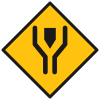
Question 1: B. A median will split the two directions
This sign warns that a divided highway begins, so a median will split the two directions of traffic.
Handbook: Chapter: Traffic signs — Warning signs
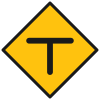
Question 2: B. It ends, and you must turn left or right
The T-shaped symbol warns that your road ends at a crossing road, so you must turn left or right.
Handbook: Chapter: Traffic signs — Warning signs
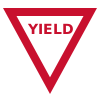
Question 3: B. Slow down or stop and let that car go first
At a yield sign you must give way. Slow down, or stop if needed, and let the car with the right-of-way pass first.
Handbook: Chapter: Traffic signs — Regulatory signs
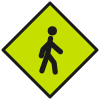
Question 4: A. People may be crossing the road ahead
This pedestrian crossing sign warns that people may be crossing. Slow down and yield to anyone in the crosswalk.
Handbook: Chapter: Traffic signs — Warning signs
Question 5: C. Your license can be suspended
Repeated traffic violations can lead to your license being suspended, along with higher insurance costs.
Handbook: Chapter: Alcohol, drugs and penalties — Penalties
Question 6: D. Open space around your car on all sides
A space cushion is room around your car on all sides so you have time and space to react.
Handbook: Chapter: Speed and following distance — Managing space
Question 7: B. No stopping or parking
In many states a red curb means no stopping or parking. Check your state for its curb colors.
Handbook: Chapter: Parking and stopping — Curb markings
Question 8: A. Pull over to a safe place first
Pull over to a safe place before using your phone, since calls take your mind off driving.
Handbook: Chapter: Safe driving and hazards — Distracted driving
Question 9: C. Take a break and move your eyes often
Long, dull drives can make you drowsy. Take breaks and keep your eyes moving.
Handbook: Chapter: Safe driving and hazards — Fatigue
Question 10: C. It is as illegal as driving drunk
Driving under the influence of drugs is treated as seriously as driving under the influence of alcohol.
Handbook: Chapter: Alcohol, drugs and penalties — Drugs and medicine
Question 11: B. They may start to cross, watching for turning cars
The walking person means people may start to cross, but they should still watch for cars that are turning.
Handbook: Chapter: Traffic signals and pavement markings — Traffic signals
Question 12: D. They are small and hard to see
Motorcycles are small and easy to miss, so look twice before turning, most of all when turning left.
Handbook: Chapter: Sharing the road — Motorcycles
Question 13: D. Pull off the road and turn on hazards
Pull off the road as far as you can and turn on your hazard lights so others can see you.
Handbook: Chapter: Emergencies and vehicle equipment — Breakdowns
Question 14: B. Wait until there is room to clear the intersection
Do not enter an intersection unless there is room to clear it, even on green. Blocking it holds up cross traffic.
Handbook: Chapter: Traffic signals and pavement markings — Traffic signals
Question 15: A. Yes, if your driving is impaired
Yes. You can be charged below the limit if alcohol or drugs have impaired your driving.
Handbook: Chapter: Alcohol, drugs and penalties — Legal limits
Question 16: D. A booster seat with lap and shoulder belt
A New York child aged 4 to 7 must use an approved child restraint, often called a booster seat, with a lap and shoulder belt.
Handbook: Chapter 8: Defensive Driving — Seat Belts, Child Safety Seats, and Air Bags
Question 17: C. It is getting ready to stop
Flashing yellow lights mean the bus is about to stop. Slow down and get ready to stop.
Handbook: Chapter: Right of way — School buses
Question 18: B. You may turn left; oncoming cars must stop
A green arrow gives you a protected turn in that direction. Oncoming traffic should be stopped, but still watch for people in the crosswalk.
Handbook: Chapter: Traffic signals and pavement markings — Traffic signals
Question 19: A. Gravity keeps pulling the car forward
Going downhill, gravity keeps pulling the car forward, so it takes longer to stop; slow down and leave more space.
Handbook: Chapter: Speed and following distance — Stopping distance
Question 20: B. Park
Put an automatic car in park and set the parking brake before you get out.
Handbook: Chapter: Parking and stopping — Parking on hills
Practice test 1 of 10 for the Written test (Class D learner permit knowledge test) (NYS DMV): 20 questions · 14 of 20, including at least 2 of the 4 road sign questions to pass · no time limit.