Question 1 of 20Parking and stopping
Practice test 1 of 10 — Vermont permit test
Practice test 1 questions
Question 2 of 20Safe driving and hazards
How often should you check your mirrors?
Question 3 of 20Alcohol, drugs and penalties
Can you be charged with impaired driving below the legal blood alcohol limit?
Question 4 of 20Parking and stopping
In general, may you park on a bridge or in a tunnel?
Question 5 of 20Licensing and insurance (Vermont)
In the first 3 months of a Vermont junior license, who may ride along as a passenger?
Question 6 of 20Right of way
You are joining a highway from an on-ramp. Who has the right-of-way?
Question 7 of 20Speed and following distance (Vermont)
What is the top speed on a Vermont Interstate unless another limit is posted?
Question 8 of 20Right of way
Two lanes merge into one. What is the best way to handle it?
Question 9 of 20Emergencies and equipment (Vermont)
Under Vermont law, what may hang from your rearview mirror?
Question 10 of 20Road signs
A sign says "SLOWER TRAFFIC KEEP RIGHT". What does it mean?
Question 11 of 20Speed and following distance
Why is following too closely dangerous?
Question 12 of 20Safe driving and hazards (Vermont)
Police pull you over in a dimly lit place in Vermont. What should you do after you stop?
Question 13 of 20Alcohol, drugs and penalties
What is the only thing that sobers up a person who has been drinking?
Question 14 of 20Emergencies and equipment (Vermont)
What is the least tread depth that tires must have in Vermont?
Question 15 of 20Right of way
You are coming up to a roundabout and someone is waiting at the crosswalk before it. What should you do?
Question 16 of 20Right of way
You arrive at a T-intersection at the same time as a car on the through road to your right. Who goes first?
Question 17 of 20Turning, passing and lanes
Why is weaving from lane to lane dangerous?
Question 18 of 20Speed and following distance
Why is following distance measured in seconds instead of feet?
Question 19 of 20Turning, passing and lanes
When might you need a three-point turn?
Question 20 of 20Road signs
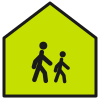
What does this sign tell you?
1 of 20
Answer each question to see the explanation. Keyboard: A–D or 1–4 to answer, N next, P previous.
Answers and explanations (text version)
The correct answer to each question above, why it is right, and where it comes from. Try the test first.
Question 1: A. No, it is not allowed
Parking on a sidewalk, even partly, is not allowed. It blocks people walking and those who use wheelchairs.
Handbook: Chapter: Parking and stopping — Where not to park
Question 2: B. Every few seconds
Check your mirrors every few seconds so you always know what is behind and beside you.
Handbook: Chapter: Safe driving and hazards — Seeing and scanning
Question 3: A. Yes, if your driving is impaired
Yes. You can be charged below the limit if alcohol or drugs have impaired your driving.
Handbook: Chapter: Alcohol, drugs and penalties — Legal limits
Question 4: A. No, unless signs say you may
In general, parking on a bridge or in a tunnel is not allowed unless signs say you may.
Handbook: Chapter: Parking and stopping — Where not to park
Question 5: A. No one, unless a qualified adult is in front
For the first three months a Vermont junior driver "is restricted to driving alone"; passengers may ride only if a parent, guardian, instructor or licensed adult 25 or older is in the front seat.
Handbook: Chapter 5: Graduated Driver's License Program — Graduated Driver's License Program
Question 6: B. Traffic already on the highway
When joining a highway, yield to traffic already on it and merge into a safe gap.
Handbook: Chapter: Right of way — Entering a roadway
Question 7: B. 65 mph
The maximum speed on a Vermont Interstate "is 65 miles per hour or as posted" (65 mph).
Handbook: Chapter 7: Driving Safely and Studying for Your Permit — Speed Limits and Safe Speeds
Question 8: D. Take turns and let one car in at a time
When lanes merge, take turns and leave room so each driver can merge smoothly and safely.
Handbook: Chapter: Right of way — Right-of-way basics
Question 9: C. Nothing at all
Nothing at all may hang there: Vermont law says "there shall not be anything hanging from the rearview mirror or sun visors."
Handbook: Chapter 7: Driving Safely and Studying for Your Permit — You Must Take Proper Care of Your Vehicles
Question 10: B. Slower drivers should use the right lane
If you are driving slower than other traffic, keep to the right lane so faster cars can pass on the left.
Handbook: Chapter: Traffic signs — Regulatory signs
Question 11: B. You may not be able to stop in time
Following too closely leaves too little time to react and stop if the car ahead stops suddenly.
Handbook: Chapter: Speed and following distance — Following distance
Question 12: A. Turn on your inside lights
If you are stopped in a dimly lit area, Vermont says to turn on the vehicle's interior lights "after stopping, and before the officer approaches."
Handbook: Chapter 7: Driving Safely and Studying for Your Permit — Police Stops
Question 13: C. Time
Only time lets the body remove alcohol. Coffee, cold showers and fresh air do not lower your blood alcohol.
Handbook: Chapter: Alcohol, drugs and penalties — How alcohol affects you
Question 14: B. 2/32 inch
The Vermont manual says "Tires must have at least 2/32" of tread depth" (2/32 inch), and worn-out tires are not safe or legal.
Handbook: Chapter 7: Driving Safely and Studying for Your Permit — You Must Take Proper Care of Your Vehicles
Question 15: C. Stop and let them cross before entering
Crosswalks are often placed just before a roundabout entry. Yield to people crossing before you enter.
Handbook: Chapter: Right of way — Roundabouts
Question 16: C. The car on the through road
At a T-intersection, the driver on the road that ends yields to traffic on the through road, whatever its side.
Handbook: Chapter: Right of way — Uncontrolled intersections
Question 17: D. It raises the chance of a crash
Weaving in and out of lanes surprises other drivers and raises the chance of a crash.
Handbook: Chapter: Turning, passing and lane use — Changing lanes
Question 18: B. Seconds stay right at any speed
A time gap grows with your speed on its own, so a count of seconds stays right at any speed.
Handbook: Chapter: Speed and following distance — Following distance
Question 19: D. To turn around on a narrow street
A three-point turn is used to turn around on a street too narrow for a U-turn.
Handbook: Chapter: Turning, passing and lane use — Turns
Question 20: C. A school is near and children may cross
This school sign means a school is near and children may be crossing. Slow down and obey any school speed limit.
Handbook: Chapter: Traffic signs — Warning signs
Practice test 1 of 10 for the Learner permit knowledge test (online permit test) (Vermont DMV): 20 questions · 16 of 20 (80%) to pass · no time limit.