Question 1 of 20Safe driving and hazards
Practice test 2 of 10 — Vermont permit test
Practice test 2 questions
Question 2 of 20Emergencies and equipment
Your right wheels drift off the edge of the pavement. What should you do?
Question 3 of 20Sharing the road
Why do buses and large trucks need extra room when they turn?
Question 4 of 20Safe driving and hazards
Another driver makes a rude gesture at you. What should you do?
Question 5 of 20Right of way (Vermont)
How far from the nearest rail must a Vermont driver stop when a crossing's lights are flashing?
Question 6 of 20Signals and pavement markings
The light turns yellow just as you reach the stop line at speed and cannot stop safely. What should you do?
Question 7 of 20Right of way (Vermont)
A Vermont town snowplow with flashing lights is working on the road ahead. What does the law require?
Question 8 of 20Signals and pavement markings
White lines between lanes separate:
Question 9 of 20Alcohol, drugs and penalties (Vermont)
According to the Vermont manual, a driver has a first phone-use conviction in a work zone where workers are present. How many points are added?
Question 10 of 20Signals and pavement markings
What must you do at a steady red traffic light?
Question 11 of 20Turning, passing and lanes
You need to turn at the next intersection. When should you get into the correct lane?
Question 12 of 20Parking and stopping (Vermont)
A Vermont fire station has signs posted. How far from its driveway must you park on the other side of the street?
Question 13 of 20Safe driving and hazards
Bright sun is shining in your eyes. What can help?
Question 14 of 20Safe driving and hazards (Vermont)
Why are moose hard to see at night, according to the Vermont manual?
Question 15 of 20Signals and pavement markings
What should you do at a flashing red light?
Question 16 of 20Right of way
A green light lets you go straight, but a car is still turning left in front of you from the last light. What should you do?
Question 17 of 20Safe driving and hazards
You need to make a phone call while driving. What is the safest choice?
Question 18 of 20Speed and following distance
Driving well over the limit on a short trip usually:
Question 19 of 20Parking and stopping
May you park in a marked bike lane?
Question 20 of 20Road signs
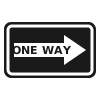
What does this sign tell you about the road?
1 of 20
Answer each question to see the explanation. Keyboard: A–D or 1–4 to answer, N next, P previous.
Answers and explanations (text version)
The correct answer to each question above, why it is right, and where it comes from. Try the test first.
Question 1: D. At about 9 and 3 o'clock
Holding the wheel at about 9 and 3 o'clock gives good control and keeps your arms clear of the airbag.
Handbook: Chapter: Safe driving and hazards — Vehicle control
Question 2: C. Ease off the gas and steer back gently
Ease off the gas, then steer back onto the pavement gently once you have slowed down.
Handbook: Chapter: Emergencies and vehicle equipment — Running off the road
Question 3: A. The back wheels take a tighter path
The back wheels of a long vehicle follow a tighter path than the front, so it needs extra room to turn.
Handbook: Chapter: Sharing the road — Large trucks and buses
Question 4: C. Stay calm and let it go
Do not respond to an angry driver. Stay calm, avoid eye contact, and give them room.
Handbook: Chapter: Safe driving and hazards — Road rage
Question 5: B. At least 15 feet
Vermont law says to stop "not less than 15 feet from the nearest rail" when lights flash, gates are down, or a train is coming.
Handbook: Chapter 7: Driving Safely and Studying for Your Permit — Rules of the Road at Railroad Crossings
Question 6: D. Go on through the intersection with care
Stop for a yellow light if you safely can. If you are too close to stop safely, go on through the intersection with care.
Handbook: Chapter: Traffic signals and pavement markings — Traffic signals
Question 7: A. Go with caution and yield to it
Vermont law requires drivers to yield to a state, city or town maintenance vehicle working on a highway; near a snowplow you "must proceed with caution and yield the right of way."
Handbook: Chapter 7: Driving Safely and Studying for Your Permit — Move Over Law
Question 8: B. Lanes of traffic moving the same way
White lane lines separate lanes of traffic moving in the same direction.
Handbook: Chapter: Traffic signals and pavement markings — Pavement markings
Question 9: B. 2 points
In a Vermont work zone with workers present, a phone-use conviction brings "two points" for a first conviction (2 points) and five for later ones.
Handbook: Chapter 7: Driving Safely and Studying for Your Permit — Cell Phones and other Electronic Devices
Question 10: D. Stop and wait behind the stop line
A steady red light means stop. Wait behind the stop line or crosswalk until you may legally go.
Handbook: Chapter: Traffic signals and pavement markings — Traffic signals
Question 11: C. Well before the intersection
Move into the correct lane well before the intersection so you do not swerve at the last moment.
Handbook: Chapter: Turning, passing and lane use — Turns
Question 12: A. At least 75 feet
Where there are signs, Vermont bans parking near a fire station driveway, including "across the street within 75 feet of the driveway."
Handbook: Chapter 7: Driving Safely and Studying for Your Permit — Parking Your Vehicle
Question 13: C. Use the sun visor and slow down
Use the sun visor or sunglasses and slow down until you can see clearly.
Handbook: Chapter: Safe driving and hazards — Night and weather
Question 14: D. Their eyes may not shine in your lights
Deer eyes reflect headlights, but the Vermont manual says moose are taller and "their eyes may not reflect in the vehicle's headlights."
Handbook: Chapter 7: Driving Safely and Studying for Your Permit — Moose and Deer Safety
Question 15: C. Stop fully, then go when it is safe
Treat a flashing red light like a stop sign. Stop fully, then go when it is safe.
Handbook: Chapter: Traffic signals and pavement markings — Traffic signals
Question 16: B. Let it finish its turn before you go
Vehicles still in the intersection when the light changes must be allowed to clear it before you go.
Handbook: Chapter: Right of way — Signals and right of way
Question 17: A. Pull over to a safe place first
Pull over to a safe place before using your phone, since calls take your mind off driving.
Handbook: Chapter: Safe driving and hazards — Distracted driving
Question 18: A. Saves very little time and adds a lot of risk
Speeding on most trips saves only a few minutes but raises the chance and harm of a crash.
Handbook: Chapter: Speed and following distance — Basic speed rule
Question 19: B. Generally no, since it blocks cyclists
Generally you may not park in a bike lane, since it forces cyclists into traffic.
Handbook: Chapter: Parking and stopping — Where not to park
Question 20: C. All traffic moves the way the arrow points
A one way sign means all traffic on that road moves only in the direction the arrow shows.
Handbook: Chapter: Traffic signs — Regulatory signs
Practice test 2 of 10 for the Learner permit knowledge test (online permit test) (Vermont DMV): 20 questions · 16 of 20 (80%) to pass · no time limit.