Question 1 of 32Road rules
Practice test 2 of 10 — Victoria learner permit test
Practice test 2 questions
Question 2 of 32Road rules
You will turn right at a roundabout with two lanes. Which lane and signal should you use as you approach?
Question 3 of 32Road rules
You are angle parking. No sign or marked bay shows the angle. At what angle must you park?
Question 4 of 32Signs and markings
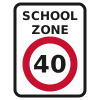
You are driving past a school while this sign's limit applies. What is the most you may drive at?
Question 5 of 32Safe driving
How should a lap-sash seatbelt be worn?
Question 6 of 32Road rules
In Victoria, what is the speed limit on a freeway or a country road outside a built-up area when no sign shows a limit?
Question 7 of 32Hazards and sharing the road
How do young new drivers usually compare with experienced drivers?
Question 8 of 32Hazards and sharing the road
A truck shows a 'Do Not Overtake Turning Vehicle' sign. At least how long is the truck?
Question 9 of 32Signs and markings
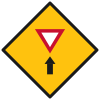
This sign warns of a Give Way sign ahead where you will cross a shared path. Who must you give way to there?
Question 10 of 32Road rules
You face a Give Way sign and are going straight. An oncoming car, also facing a Give Way sign, is turning right. Who gives way?
Question 11 of 32Safe driving
A driver in Victoria has their licence cancelled for drink driving. What must they fit to their car once relicensed?
Question 12 of 32Learner and P-plate rules
How long is a Victorian learner permit valid for?
Question 13 of 32Safe driving
What does a blood alcohol concentration (BAC) of .05 mean?
Question 14 of 32Hazards and sharing the road
You have just overtaken a car. How can you tell it is safe to move back into its lane?
Question 15 of 32Road rules
In Victoria, someone is injured in a crash and police do not come to the scene. What must you do?
Question 16 of 32Learner and P-plate rules
In Victoria, what is the youngest age at which you can get a learner permit?
Question 17 of 32Road rules
You park at the side of a two-way road. Which way must your car face?
Question 18 of 32Safe driving
You see a pedestrian standing close to the road edge ahead. What is a good first step?
Question 19 of 32Hazards and sharing the road
You see reflective warning triangles set out on the road ahead. What do they usually warn you about?
Question 20 of 32Hazards and sharing the road
What does it mean to 'scan' the road while driving?
Question 21 of 32Safe driving
Your brakes suddenly fail while driving. Which action does the handbook advise?
Question 22 of 32Safe driving
The Victorian handbook warns how far a car at 60 km/h may travel, at worst, before it can stop. What is that figure?
Question 23 of 32Learner and P-plate rules
Does the Victorian peer passenger limit apply to P2 drivers?
Question 24 of 32Learner and P-plate rules
Besides the 12-month limit, which demerit total can also lead to a Victorian learner or P licence being suspended?
Question 25 of 32Hazards and sharing the road
When should you do a head check as well as using your mirrors?
Question 26 of 32Road rules
In Victoria, you pass a stopped police car with its red and blue lights flashing. What is the most you may drive at?
Question 27 of 32Road rules
Your car's registration has run out. May you drive it on the road?
Question 28 of 32Learner and P-plate rules
In Victoria, what must you pass before you can sit the drive test for your P licence?
Question 29 of 32Road rules
In Victoria, an ambulance with flashing lights is stopped on the other side of a road divided by a median strip. Must you slow to 40 km/h?
Question 30 of 32Hazards and sharing the road
During a head check, what is the longest you should take your eyes off the road ahead?
Question 31 of 32Signs and markings
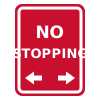
In Australia, you need to stop for a moment where this sign applies. Do hazard warning lights make it legal?
Question 32 of 32Safe driving
Where must you never fit a rearward-facing child restraint?
1 of 32
Answer each question to see the explanation. Keyboard: A–D or 1–4 to answer, N next, P previous.
Answers and explanations (text version)
The correct answer to each question above, why it is right, and where it comes from. Try the test first.
Question 1: B. No more than 100 m apart for at least 500 m
A road counts as a built-up area if it has street lights no more than 100 metres apart over a distance of 500 metres or more.
Handbook: Ch 4 Rules and responsibilities — Speed limits: built-up areas (p. 79)
Question 2: C. The right lane, signalling right
To turn right at a roundabout, approach in the right lane and signal right, then signal left before your exit if you can.
Handbook: Ch 4 Rules and responsibilities — Turning: making turns at roundabouts (p. 120)
Question 3: B. 45 degrees
Where no angle is shown by signs or marked bays, you must angle park at 45 degrees.
Handbook: Ch 4 Rules and responsibilities — Parking: angle parking (p. 146)
Question 4: B. 40 km/h
The sign shows a 40 km/h school zone, so you must not drive faster than 40 km/h while it applies.
Handbook: Ch 4 Rules and responsibilities — Speed limits: school speed limits (p. 80)
Question 5: D. Over the shoulder and low on the hips
A seatbelt should run over your shoulder and across your chest, with the buckle low on your hips.
Handbook: Ch 4 Rules and responsibilities — Seatbelts (p. 77)
Question 6: C. 100 km/h
In Victoria the default limit on freeways and roads outside built-up areas is 100 km/h, unless signs show a different limit.
Handbook: Ch 4 Rules and responsibilities — Speed limits: freeways and country roads (p. 80)
Question 7: B. Good reaction time, weaker hazard perception
Young drivers often have good reaction times but weaker hazard perception, and spotting hazards early matters more.
Handbook: Ch 2 Learning to drive — Hazard perception (p. 39)
Question 8: B. 7.5 metres
This sign means the truck is at least 7.5 metres long and may need part of two lanes to turn. Don't pass alongside it.
Handbook: Ch 4 Rules and responsibilities — Sharing the road with trucks and other heavy vehicles (p. 143)
Question 9: A. People and bicycle riders on the path
At a Give Way sign or line, you must give way to vehicles and also to people walking or riding a bicycle on a shared path crossing in front of you.
Handbook: Ch 4 Rules and responsibilities — Give Way rules: at Stop or Give Way signs not at intersections (p. 101)
Question 10: D. The oncoming car turning right
When both of you face Give Way signs, you need not give way to the oncoming car turning right; that car must give way to you.
Handbook: Ch 4 Rules and responsibilities — Give Way rules: Stop or Give Way signs at an intersection (p. 102)
Question 11: B. An alcohol interlock device
After a drink-driving cancellation in Victoria, drivers must fit and use an alcohol interlock for at least 6 months once relicensed.
Handbook: Ch 4 Rules and responsibilities — Alcohol (p. 74)
Question 12: D. 10 years
In Victoria, a learner permit is valid for 10 years from when it is issued.
Handbook: The 10 steps to getting your licence — Step 4: Pay for and be granted your learner permit (p. 13)
Question 13: D. .05 grams of alcohol in 100 mL of blood
BAC measures grams of alcohol in every 100 millilitres of blood, so .05 means .05 grams (50 mg) of alcohol in 100 mL.
Handbook: Ch 4 Rules and responsibilities — Alcohol (p. 71)
Question 14: D. Both its headlights show in your mirror
One way to know it is safe to return is when you can see both headlights of the overtaken car in your mirror.
Handbook: Ch 4 Rules and responsibilities — How to overtake safely (p. 130)
Question 15: C. Report it at the nearest open police station
If someone is injured and police are not at the scene, you must report the crash at the nearest open police station.
Handbook: Ch 4 Rules and responsibilities — Crash responsibilities (p. 158)
Question 16: B. 16 years
In Victoria, you must be at least 16 years old to sit the learner permit test and get your permit.
Handbook: The 10 steps to getting your licence — Step 2: Book your learner permit test (p. 10)
Question 17: B. The same way as traffic on that side
When you park, your car must face the same direction as traffic travelling on that side of the road.
Handbook: Ch 4 Rules and responsibilities — Parking: parallel parking (p. 146)
Question 18: C. Slow a little and cover the brake
When you see a possible hazard such as a pedestrian, slow a little and move your foot near the brake so you can stop.
Handbook: Ch 3 Managing risk — Keys to reducing your risk of a crash (p. 60)
Question 19: D. A broken-down truck or a fallen load
Reflective warning triangles warn of a broken-down truck or fallen load ahead. Slow down and pass with care.
Handbook: Ch 4 Rules and responsibilities — Sharing the road with trucks and other heavy vehicles (p. 143)
Question 20: A. Look ahead, to the sides and in mirrors
Scanning means taking in the whole scene by looking ahead, to the sides and in your mirrors, again and again.
Handbook: Ch 2 Learning to drive — Hazard perception (p. 40)
Question 21: C. Pump the brake pedal hard and fast
If your brakes fail, pump the brake pedal hard and fast, use the handbrake carefully, and change to a lower gear if you can.
Handbook: Ch 2 Learning to drive — Checking your progress (p. 46)
Question 22: D. Up to 67 metres
The handbook warns that at 60 km/h you may travel up to 67 metres before you can stop.
Handbook: Ch 4 Rules and responsibilities — Speed limits (p. 83)
Question 23: D. No, it applies to P1 drivers
In Victoria, the limit of one passenger aged 16 to under 22 is a P1 condition. It is not a P2 condition.
Handbook: Key points — The Graduated Licensing System (p. 26)
Question 24: B. 12 points in any 3 years
In Victoria, learner and P drivers may also be suspended for getting 12 or more demerit points in any 3-year period.
Handbook: Ch 4 Rules and responsibilities — Penalties (p. 154)
Question 25: C. Before changing lanes or merging
Do a head check as well as using mirrors when changing lanes, merging, reversing or pulling out to overtake.
Handbook: Ch 2 Learning to drive — Hazard perception (p. 40)
Question 26: C. 40 km/h
In Victoria you must not exceed 40 km/h when passing a stopped or slow emergency or enforcement vehicle with flashing lights or siren on.
Handbook: Ch 4 Rules and responsibilities — Sharing the road with police and emergency vehicles (p. 141)
Question 27: A. No, it must be registered first
A car must be registered: you must not drive a vehicle without current registration, or one that is unroadworthy.
Handbook: Ch 4 Rules and responsibilities — Legal responsibilities: registration and roadworthiness (p. 156)
Question 28: A. The Hazard Perception Test
In Victoria, you must pass the computer-based Hazard Perception Test before you can sit the drive test.
Handbook: The 10 steps to getting your licence — Step 7: Pass your probationary licence test (p. 19)
Question 29: A. No, not when a median strip divides you
You do not need to slow down for emergency vehicles on the opposite side of a divided road separated by a median strip.
Handbook: Ch 4 Rules and responsibilities — Sharing the road with police and emergency vehicles (p. 141)
Question 30: A. 1 second
A head check is a quick look over your shoulder. Don't take your eyes off the road ahead for more than 1 second.
Handbook: Ch 1 The challenges of driving — Some facts about new solo driving (p. 34)
Question 31: B. No, the rule still applies
Stopping and parking rules still apply when your hazard warning lights are on, so the rule still applies and you must not stop.
Handbook: Ch 4 Rules and responsibilities — Parking: zone signs (p. 150)
Question 32: A. In a front seat with a passenger airbag
A rearward-facing child restraint cannot be used in a front seat that has a passenger airbag. The back seat is safer.
Handbook: Ch 4 Rules and responsibilities — Seatbelts (p. 78)
Practice test 2 of 10 for the Learner Permit Test (VicRoads): 32 questions · 25 of 32 (78%) to pass · no time limit.