Question 1 of 20Signs and markings
Victoria road signs test: free practice with 20 sign questions.
Question 1 of 20Signs and markings
Question 2 of 20Signs and markings
Question 3 of 20Signs and markings
Question 4 of 20Signs and markings
Question 5 of 20Signs and markings
Question 6 of 20Signs and markings
Question 7 of 20Signs and markings
Question 8 of 20Signs and markings
Question 9 of 20Signs and markings
Question 10 of 20Signs and markings
Question 11 of 20Signs and markings
Question 12 of 20Signs and markings
Question 13 of 20Signs and markings

Question 14 of 20Signs and markings
Question 15 of 20Signs and markings
Question 16 of 20Signs and markings
Question 17 of 20Signs and markings
Question 18 of 20Signs and markings
Question 19 of 20Signs and markings
Question 20 of 20Signs and markings
Answer each question to see the explanation. Keyboard: A–D or 1–4 to answer, N next, P previous.
The correct answer to each question above, why it is right, and where it comes from. Try the test first.
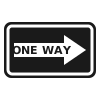
Question 1: A. Close to the right side of the road
When turning from a one-way road into a two-way road, turn from a position close to the side you are turning towards, so the right side for a right turn.
Handbook: Ch 4 Rules and responsibilities — Turning: turning and one way roads (p. 118)
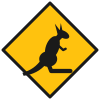
Question 2: B. Animals may move onto the road suddenly
Animals are unpredictable and may wander or dart onto the road, so slow down when you see them.
Handbook: Ch 4 Rules and responsibilities — Speed limits: country roads and animals (p. 82)
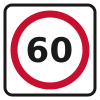
Question 3: B. Drive at up to 60 km/h
A speed limit sign shows the most you may drive in good conditions, here 60 km/h, and you must choose a safe speed within it.
Handbook: Ch 4 Rules and responsibilities — Speed limits (p. 79)
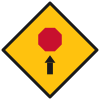
Question 4: C. Slow down and prepare to stop
This warning sign tells you a Stop sign is ahead, so slow down and prepare to stop completely at it.
Handbook: Ch 4 Rules and responsibilities — Road signs: intersection control warning signs (p. 87)
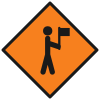
Question 5: A. Be ready to obey the hand-held sign
Hand-held signs are often used at work sites, so be prepared to obey the hand-held sign the worker shows.
Handbook: Ch 4 Rules and responsibilities — Road signs: hand-held signs (p. 85)
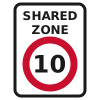
Question 6: C. Give way to the person walking
In a shared zone drivers must give way to pedestrians, and the limit is 10 km/h unless the sign shows a different one.
Handbook: Ch 4 Rules and responsibilities — Speed limits: shared zones (p. 81)
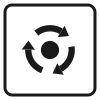
Question 7: A. The left side
In a roundabout you must always keep to the left of the central island.
Handbook: Ch 4 Rules and responsibilities — Give Way rules: giving way at roundabouts (p. 107)
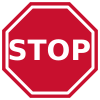
Question 8: C. Come to a full stop before going on
At a Stop sign you must come to a full stop every time, then give way before going on, even if the road looks clear.
Handbook: Ch 4 Rules and responsibilities — Give Way rules: Stop or Give Way signs at an intersection (p. 102)
Question 9: B. The lights may change before you arrive
A green light may change to yellow or red before you reach the intersection, so the lights may change before you arrive and you should be able to stop safely.
Handbook: Ch 4 Rules and responsibilities — Speed limits: green lights can change to red (p. 81)
Question 10: B. A regulatory sign you must obey
Keep left signs are regulatory: they tell you which way you must go, and you must obey them.
Handbook: Ch 4 Rules and responsibilities — Road signs: obey these traffic signs (p. 84)
Question 11: B. Before you enter the curve
Slow down before entering a curve and speed up gently as you leave it; braking in a curve can make you lose control.
Handbook: Ch 4 Rules and responsibilities — Speed limits: curving roads (p. 82)
Question 12: D. Children may not judge your speed well
Children are easily distracted and find it hard to judge the speed of approaching vehicles, so take extra care.
Handbook: Ch 4 Rules and responsibilities — Speed limits: school speed limits (p. 80)
Question 13: B. Slow down, look and listen for trains
At level crossings without gates, booms or lights, slow down and look and listen for trains in both directions.
Handbook: Ch 4 Rules and responsibilities — Railway level crossings (p. 145)
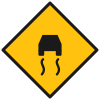
Question 14: D. Oil and dirt rise to the surface
When rain first starts, oil and dirt are washed to the road surface, and skidding can happen until more rain washes them away.
Handbook: Ch 4 Rules and responsibilities — Speed limits: slippery roads (p. 82)
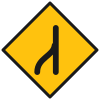
Question 15: B. The car that is further behind
Where lanes merge with no lines marked, you give way to any vehicle with any part ahead of yours, so the car further behind gives way. This is zip merging.
Handbook: Ch 4 Rules and responsibilities — Give Way rules: zip merging (p. 110)
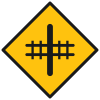
Question 16: C. Still check for trains as you approach
Train times can change without notice, so always check for trains as you approach a level crossing.
Handbook: Ch 4 Rules and responsibilities — Railway level crossings (p. 145)
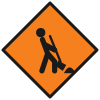
Question 17: D. Slow down and obey the lower limit
At road work sites, temporary speed limits guide traffic safely, and all drivers must slow down and obey them.
Handbook: Ch 4 Rules and responsibilities — Speed limits: road works (p. 82)
Question 18: B. Slow down and take care
Warning signs alert you to possible danger ahead, and taking notice of them usually means you should slow down.
Handbook: Ch 4 Rules and responsibilities — Road signs: warning signs (p. 86)
Question 19: D. When all the animals have crossed
At a Stop sign at a stock crossing, you must stop before the crossing and wait until all the animals have crossed the road.
Handbook: Ch 4 Rules and responsibilities — Sharing the road with animals: give way to stock signs (p. 144)
Question 20: C. Vehicles on the continuing road
At a T-intersection, a driver on the road that ends must give way to vehicles travelling along the continuing road.
Handbook: Ch 4 Rules and responsibilities — Give Way rules: giving way at T-intersections (p. 105)
Victorian/Australian road signs and markings as covered in the Road to Solo Driving handbook (test questions are based on all four chapters). 16 correct (80%) is our practice mark, not an official pass mark.
Our own simplified drawings of the signs learners meet most. The full list, with meanings, is in the Australia sign library; the official reference is the Road to Solo Driving handbook.
Stop completely at the stop line, then give way to all traffic before moving on.
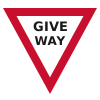
Slow down and stop if needed to let other traffic go first.
The maximum legal speed until another limit is shown.
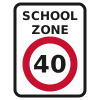
A lower speed limit applies during the school times shown on the sign.
Pedestrians and vehicles share this space; give way to pedestrians and keep to the low limit shown.
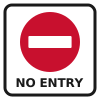
You must not drive into this road from this direction.
Keep to the left of the island or divider ahead.
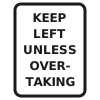
Stay in the left lane except when overtaking; the sign applies on roads where it is posted, which each state sets by speed limit.
Traffic travels only in the direction of the arrow.
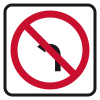
You must not turn left here.
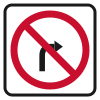
You must not turn right here.
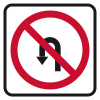
You must not make a U-turn here.
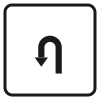
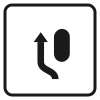
You may make a U-turn here, giving way to all other vehicles and pedestrians.
You are entering a roundabout; give way to vehicles already in it and travel clockwise.
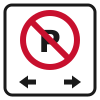
You may stop for up to 2 minutes to drop off or pick up passengers or goods, but must stay within 3 m of the vehicle.
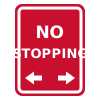
You must not stop at any point in the direction of the arrows unless forced to by traffic or an emergency.
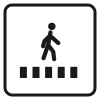
Marks a pedestrian (zebra) crossing; give way to anyone on or entering it.
Marks the level crossing; give way to trains and stop if one is approaching.
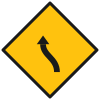
The road bends left ahead; slow to a safe speed before the curve.
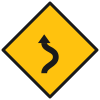
Several bends lie ahead; keep your speed down.
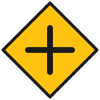
A road crosses ahead; watch for vehicles from both sides.
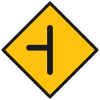
A side road joins from the left ahead.
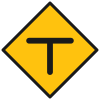
The road ends at a crossing road ahead; you will need to turn left or right.
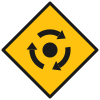
A roundabout is coming up; slow down and prepare to give way.
Two lanes become one ahead; merge smoothly and give way as required.
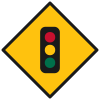
Traffic lights are ahead; be ready to stop.
A stop sign is ahead; slow down and prepare to stop.
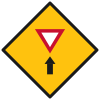
A give way sign is ahead; slow down and be ready to give way.
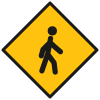
People may be walking on or crossing the road ahead.
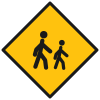
Children may be crossing ahead, often near a school; slow down.
Kangaroos or other wildlife may be on the road; slow down, especially at dawn and dusk.
The road may be slippery when wet; slow down.
A railway level crossing is ahead; slow down and look for trains.
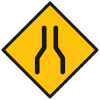
The road becomes narrower ahead; take care with oncoming traffic.
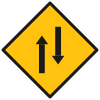
Oncoming traffic shares the road ahead.
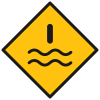
Water may cover the road here; never drive into floodwater.

An obstruction is ahead and all traffic must go around it in the direction the chevrons point, here to the left.

An obstruction is ahead and all traffic must go around it in the direction the chevrons point, here to the right.

Marks the nose of an island or obstruction that traffic may pass on either side.
Roadwork is ahead; slow down and follow any temporary speed limit.
A person with a stop/slow bat is controlling traffic ahead; be ready to stop.