Question 1 of 50Vehicle loading
Practice test 2 of 10 — UK (Great Britain) theory test
Practice test 2 questions
Question 2 of 50Vehicle handling
It is a wintry day and the road you are on is clear. What should you be ready for?
Question 3 of 50Motorway rules
Unless police or traffic officers tell you to, where on a motorway may you reverse?
Question 4 of 50Road and traffic signs
You see a driver's right arm out of the window, turning in an anticlockwise circle. What do they intend to do?
Question 5 of 50Hazard awareness
You are on a busy road in heavy rain. What extra hazard should you expect?
Question 6 of 50Road and traffic signs
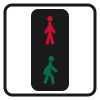
At this crossing the amber light is flashing and nobody is on the crossing. What may you do?
Question 7 of 50Vulnerable road users
You want to turn left. A cyclist on your left is going straight on past the junction. What should you do?
Question 8 of 50Road and traffic signs
Long goods vehicles carry vertical rear markings. Which of these must also carry them when it is placed in the road?
Question 9 of 50Alertness
While you are reversing, where should you mainly be looking?
Question 10 of 50Safety and your vehicle
Your car pulls to one side whenever you brake. What is the most likely cause?
Question 11 of 50Rules of the road
You are about to leave your car parked at the roadside. What must you do?
Question 12 of 50Other types of vehicle
When a Class 3 mobility scooter is used on the road, which way should it travel?
Question 13 of 50Road and traffic signs

Two junctions of this type are placed close together. How should you treat them?
Question 14 of 50Incidents, accidents and emergencies
A casualty does not respond when you speak to them. How should you open their airway?
Question 15 of 50Essential documents
For how long must a learner's supervisor have held a full licence for that type of car?
Question 16 of 50Road and traffic signs

May you drive a car along a route marked with this sign?
Question 17 of 50Hazard awareness
Some children on the pavement ahead are looking the other way. What is the main risk?
Question 18 of 50Road and traffic signs
At traffic lights, the left lane is a filter lane with its own green arrow pointing left. You want to go straight ahead. What should you do?
Question 19 of 50Road and traffic signs
You are well back from the traffic lights when the amber light comes on by itself. What should you do?
Question 20 of 50Safety margins
You are driving past shops at 20 mph. About how far will it take you to stop in good conditions?
Question 21 of 50Safety margins
Which vehicles need a greater distance to stop than a car?
Question 22 of 50Motorway rules
Red lights flash and a sign shows that every lane is closed. What must you do?
Question 23 of 50Hazard awareness
You are driving along a main road that has many side roads joining it. What should you be ready for?
Question 24 of 50Incidents, accidents and emergencies
A piece of glass is stuck in a casualty's wound. What should you do?
Question 25 of 50Attitude
You have just overtaken a lorry, and its driver flashes their headlights. What does the Highway Code say this signal should mean?
Question 26 of 50Rules of the road
You need to turn your car round. Which of these should you avoid?
Question 27 of 50Alertness
Your mirrors are set up well. Why should you still look round at times?
Question 28 of 50Vehicle loading
Why should heavy or sharp items inside your car be secured?
Question 29 of 50Road and traffic signs
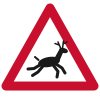
Animals are close to the road after this sign. Which of these should you avoid?
Question 30 of 50Safety margins
A driver doing 40 mph on a dry road sees a hazard. What is the typical total distance needed to stop?
Question 31 of 50Motorway rules
Which of these motorcyclists must not ride on a motorway?
Question 32 of 50Vehicle loading
You are carrying a load on a roof rack. What must you make sure of?
Question 33 of 50Rules of the road
You are approaching a level crossing and the half barriers start to come down. What should you do?
Question 34 of 50Road and traffic signs
Short yellow marks are painted across the kerb, with a small plate nearby. What do these marks restrict?
Question 35 of 50Hazard awareness
You are driving along a residential street lined with parked cars. Why should you keep your speed down?
Question 36 of 50Essential documents
A police officer asks to see your documents, but you do not have them with you. What may happen?
Question 37 of 50Vulnerable road users
Why might a cyclist ride about a door's width out from parked cars?
Question 38 of 50Vulnerable road users
The lights turn green at a junction with an advanced stop line. Cyclists are waiting ahead of you. What should you do?
Question 39 of 50Road and traffic signs
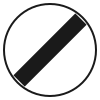
Your car is towing a caravan. You pass this sign on a single carriageway. What is your limit?
Question 40 of 50Vulnerable road users
When you pass a horse-drawn carriage, at least how much space should you allow?
Question 41 of 50Hazard awareness
Why should you take extra care when overtaking at night?
Question 42 of 50Motorway rules
You are going through a contraflow in motorway road works. What should you do at its start and finish?
Question 43 of 50Motorway rules
Which of these vehicles must not be used on a motorway?
Question 44 of 50Hazard awareness
Why should you avoid tinted glasses when driving at night?
Question 45 of 50Safety and your vehicle
You spill some fuel on the forecourt while filling up. What should you do?
Question 46 of 50Vehicle loading
Your caravan starts to snake from side to side while you are towing. What should you do?
Question 47 of 50Rules of the road
Which vehicles may drive over the central marking of a mini-roundabout?
Question 48 of 50Incidents, accidents and emergencies
A crash involves a tanker with hazard warning plates. What should you do?
Question 49 of 50Hazard awareness
The car in front of you pulls out to overtake a slow tractor. What should you do?
Question 50 of 50Safety margins
Where might a strong gust of wind suddenly push your car off course?
1 of 50
The timer starts when you answer the first question. Keyboard: A–D or 1–4 to answer, N next, P previous.
Answers and explanations (text version)
The correct answer to each question above, why it is right, and where it comes from. Try the test first.
Question 1: C. Your headlight aim
A heavy load can tilt the car, so headlight aim may need adjusting to avoid dazzling other road users.
Handbook: Highway Code rule 98
Question 2: D. Conditions changing over a short distance
In icy or snowy weather, be ready for road conditions to change over a short distance. Take note of travel bulletins and signs.
Handbook: Highway Code rule 230
Question 3: D. Nowhere, not even on a slip road
You must not reverse on any part of a motorway, including slip roads, hard shoulders and emergency areas, unless an officer tells you to.
Handbook: Highway Code rule 263
Question 4: C. Turn or move in to the left
Circling the right arm anticlockwise out of the window is the arm signal for moving in to the left or turning left.
Handbook: Highway Code: Signals to other road users
Question 5: D. Spray making it hard to see
Rain and spray from other vehicles can make it hard to see and to be seen, so keep well back.
Handbook: Highway Code rule 227
Question 6: C. Go on with caution
If the amber light is flashing and the crossing is empty, you may go on with caution.
Handbook: Highway Code rule 196
Question 7: C. Wait and let them pass first
Do not cut across a cyclist going straight ahead when you turn; wait and let them pass the junction first.
Handbook: Highway Code rule H3
Question 8: D. A builder's skip
The vertical rear markings used on large goods vehicles must also be fitted to builders' skips placed in the road.
Handbook: Highway Code: Vehicle markings
Question 9: C. Through the rear window
Reverse slowly, checking all around and looking mainly through the rear window.
Handbook: Highway Code rule 202
Question 10: B. A brake fault or wrong tyre pressures
Pulling to one side when braking is most likely a brake fault or wrongly inflated tyres. Get a garage to check it at once.
Handbook: Highway Code Annex 6
Question 11: C. Switch off the engine and put on the handbrake
Before leaving your car you must switch off the engine, headlights and fog lights, and put on the handbrake.
Handbook: Highway Code rule 239
Question 12: C. In the same direction as the traffic
On the road, Class 3 powered wheelchairs and scooters should travel in the same direction as the traffic.
Handbook: Highway Code rule 42
Question 13: D. Each one separately, giving way to the right
At double mini-roundabouts you treat each roundabout separately and give way to traffic from the right at each.
Handbook: Highway Code rule 189
Question 14: C. Lift the chin forward with your fingers
If there is no response, open the airway by placing your fingers under the chin and lifting it forward.
Handbook: Highway Code Annex 7
Question 15: C. 3 years
The supervisor must have held a full licence for that type of car, automatic or manual, for at least 3 years.
Handbook: Highway Code Annex 3
Question 16: C. No, it is for pedal cycles only
This blue sign marks a route for pedal cycles only, so cars must not use it.
Handbook: Highway Code: Traffic signs
Question 17: D. They may step out without seeing you
Children who are looking the other way may step into the road without seeing you, so slow down and be ready to stop.
Handbook: Highway Code rule 146
Question 18: C. Stay out of the filter lane
A filter lane is only for traffic going the way of the arrow. Do not enter the filter lane unless you want to go that way.
Handbook: Highway Code rule 177
Question 19: D. Stop at the stop line
A steady amber light on its own means stop at the stop line. You only go on if you are so close that stopping could cause a crash.
Handbook: Highway Code: Light signals controlling traffic
Question 20: C. 12 metres
At 20 mph the typical stopping distance is 12 metres: 6 metres of thinking distance and 6 metres of braking distance.
Handbook: Highway Code rule 126
Question 21: D. Large vehicles and motorcycles
Large vehicles and motorcycles need a greater distance to stop, so allow for this when you follow them.
Handbook: Highway Code rule 126
Question 22: D. Not go past the sign in any lane
When all lanes are shown as closed, the road is closed. You must not go past the sign in any lane, or use the hard shoulder, unless an officer tells you to.
Handbook: Highway Code rule 258
Question 23: C. Vehicles emerging from the side roads
Where there are junctions, be prepared for road users emerging, even when you are on the main road.
Handbook: Highway Code rule 146
Question 24: C. Build up padding around it
Do not remove anything stuck in a wound. Build up padding on either side without pressing on the object.
Handbook: Highway Code Annex 7
Question 25: A. Only that they are there
Headlight flashes should only tell others that the driver is there. Never treat a flash as an invitation; use your own judgement.
Handbook: Highway Code rules 110, 111
Question 26: B. Reversing from a side road into a main road
Avoid reversing from a side road into a main road. Use a quiet side road or drive round the block instead.
Handbook: Highway Code rules 200, 201
Question 27: C. Mirrors do not cover every area around you
Mirrors do not cover every area, so there are blind spots you can only check by looking round.
Handbook: Highway Code rule 161
Question 28: B. They could hurt people in a crash
Loose heavy or sharp items could be thrown forward in a crash and hurt people inside the car.
Handbook: Highway Code rule 98
Question 29: A. Sounding your horn
Do not scare animals by sounding your horn, revving your engine or speeding up as you pass.
Handbook: Highway Code rule 214
Question 30: D. 36 metres
At 40 mph a car typically takes 36 metres to stop: 12 metres while the driver reacts and 24 metres while braking.
Handbook: Highway Code rule 126
Question 31: B. A rider with a provisional licence
Riders with a provisional motorcycle licence must not use motorways, and nor may riders of motorcycles under 50 cc.
Handbook: Highway Code rule 253
Question 32: D. It is secure and does not stick out dangerously
Any load must be secure and must not stick out dangerously, so it cannot fall off or hit anyone.
Handbook: Highway Code rule 98
Question 33: B. Stop and wait behind the white line
Half barriers lower because a train is coming. Stop behind the white line and never zig-zag round them.
Handbook: Highway Code rule 293
Question 34: A. Loading and unloading
Yellow marks on the kerb mean loading and unloading is not allowed at the times on the nearby plates. You may still stop for passengers.
Handbook: Highway Code: Road markings
Question 35: C. People may step out between them
Pedestrians, especially children, may step out from between parked vehicles, so drive carefully and slowly.
Handbook: Highway Code rules 205, 206
Question 36: D. You must show them at a police station within 7 days
If you cannot show your licence, insurance and MOT certificate when asked, you may have to take them to a police station within 7 days.
Handbook: Highway Code Annex 3
Question 37: C. To avoid doors opening suddenly
Cyclists leave a door's width, about 1 metre, from parked cars so they are not hit if a car door is opened.
Handbook: Highway Code rules 67, 213
Question 38: C. Give them time and space to move off
Allow cyclists waiting at an advanced stop line enough time and space to move off when the lights turn green.
Handbook: Highway Code rule 178
Question 39: B. 50 mph
A car towing a caravan or trailer has a national limit of 50 mph on a single carriageway, lower than a car alone.
Handbook: Highway Code rule 124
Question 40: D. 2 metres
Pass horse riders and horse-drawn vehicles wide and slow, allowing at least 2 metres of space.
Handbook: Highway Code rule 215
Question 41: B. It is harder to judge speed and distance
At night and in poor visibility it is harder to judge speed and distance, so take extra care before overtaking.
Handbook: Highway Code rule 163
Question 42: A. Slow down and leave a bigger gap
At the start and finish of a contraflow, slow down and leave a bigger gap, as changes in road camber can affect how stable your car is.
Handbook: Highway Code rule 290
Question 43: C. A farm tractor
Agricultural vehicles such as a farm tractor must not use motorways. Cyclists, horse riders and pedestrians are also banned.
Handbook: Highway Code rule 253
Question 44: A. They can restrict your vision
At night or in poor visibility, do not wear tinted glasses or visors if they restrict your vision.
Handbook: Highway Code rule 94
Question 45: B. Tell the attendant straight away
Report any spilled fuel to the petrol station attendant straight away, as it can be a hazard to others.
Handbook: Highway Code Annex 6
Question 46: B. Ease off the accelerator and slow gently
If a trailer snakes, ease off the accelerator and reduce speed gently to regain control. Do not brake harshly.
Handbook: Highway Code rule 98
Question 47: C. Large vehicles that cannot get round it
All vehicles must pass round the central marking of a mini-roundabout, except large vehicles that are physically unable to get round it.
Handbook: Highway Code rule 188
Question 48: D. Keep well away and call 999 with the plate details
Keep well away, do not try to rescue casualties, and call 999 giving details of the plates and labels. Do not use a phone close to it.
Handbook: Highway Code rules 284, 285
Question 49: B. Check it is safe before you follow
Do not assume you can simply follow a vehicle that is overtaking; there may only be room for one, so check before you follow.
Handbook: Highway Code rule 163
Question 50: C. As you pass a gap in a hedge
Strong gusts can blow vehicles off course on open roads, when passing bridges or at a gap in a hedge.
Handbook: Highway Code rule 232
Practice test 2 of 10 for the Car theory test (DVSA): 50 questions · 43 of 50 (86%) to pass · 57 minutes.