Question 1 of 20Road and traffic signs
UK road signs test: free practice with 20 sign questions.
Question 1 of 20Road and traffic signs
Question 2 of 20Road and traffic signs

Question 3 of 20Road and traffic signs

Question 4 of 20Road and traffic signs
Question 5 of 20Road and traffic signs
Question 6 of 20Road and traffic signs
Question 7 of 20Road and traffic signs

Question 8 of 20Road and traffic signs
Question 9 of 20Road and traffic signs
Question 10 of 20Road and traffic signs
Question 11 of 20Road and traffic signs
Question 12 of 20Road and traffic signs
Question 13 of 20Road and traffic signs
Question 14 of 20Road and traffic signs
Question 15 of 20Road and traffic signs
Question 16 of 20Road and traffic signs
Question 17 of 20Road and traffic signs
Question 18 of 20Road and traffic signs
Question 19 of 20Road and traffic signs
Question 20 of 20Road and traffic signs
Answer each question to see the explanation. Keyboard: A–D or 1–4 to answer, N next, P previous.
The correct answer to each question above, why it is right, and where it comes from. Try the test first.
Question 1: D. It shows a ban, not an instruction
Blue circles with no red border mostly give positive orders; a red ring shows the sign is a ban instead.
Handbook: Highway Code: Traffic signs
Question 2: D. Each one separately, giving way to the right
At double mini-roundabouts you treat each roundabout separately and give way to traffic from the right at each.
Handbook: Highway Code rule 189
Question 3: A. Yes, a bicycle is a vehicle too
This sign bans entry to vehicles, and a bicycle is a vehicle; only a plate below the sign can make an exception.
Handbook: Highway Code: Traffic signs
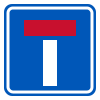
Question 4: A. No way out for vehicles at the end
This sign shows there is no way out for vehicles at the far end of the road.
Handbook: Highway Code: Traffic signs
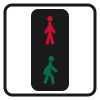
Question 5: A. It has a flashing amber phase
Pelican crossings have a flashing amber phase after the red light; puffin and toucan crossings do not, and work like normal traffic lights.
Handbook: Highway Code rule 197
Question 6: A. One telling them to give way to you
Priority signs work in pairs: you see that you have priority, and oncoming drivers see a sign telling them to give way to you.
Handbook: Highway Code: Traffic signs
Question 7: B. Stay behind it
You must not overtake after this sign, so stay behind the car even if it is driving slowly at 10 mph under the limit.
Handbook: Highway Code rule 165
Question 8: C. An order you must obey
Blue circular signs give orders, and you must obey all traffic signs that give orders.
Handbook: Highway Code rule 109
Question 9: B. Nobody, so be ready to give way
At an unmarked junction nobody has priority, so approach with care and be ready to give way.
Handbook: Highway Code rule 146
Question 10: A. Sounding your horn
Do not scare animals by sounding your horn, revving your engine or speeding up as you pass.
Handbook: Highway Code rule 214
Question 11: C. Merge in turn
Where lanes are restricted at road works, merge in turn with the other traffic.
Handbook: Highway Code rule 288
Question 12: D. The one nearest the crossing
You must not overtake the moving vehicle nearest the crossing, or the one nearest it that has stopped for pedestrians.
Handbook: Highway Code rule 191
Question 13: D. Vehicles from your immediate right
At a mini-roundabout you give way to vehicles coming from your immediate right.
Handbook: Highway Code: Traffic signs
Question 14: A. Obey the sign and let the sat nav reroute
You must obey signs giving orders, so follow the sign and let the sat nav reroute you another way.
Handbook: Highway Code rule 109
Question 15: C. As two separate crossings
A zebra crossing with a central island counts as two separate crossings.
Handbook: Highway Code rule 195
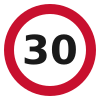
Question 16: B. 30 mph
In Wales the usual limit on lit roads is 20 mph, but a sign can set a local limit of 30 mph and you must obey it.
Handbook: Highway Code rule 124
Question 17: B. As an unmarked junction, with great care
If traffic lights are not working, treat the junction as an unmarked junction and go on with great care.
Handbook: Highway Code rule 176
Question 18: C. Slowly, ready for vehicles emerging
Where there are junctions, keep your speed down and be ready for vehicles emerging from the side roads.
Handbook: Highway Code rule 146
Question 19: A. Until a sign ends the ban
You must not overtake after this sign until you pass a sign that shows the ban has ended.
Handbook: Highway Code rule 165
Question 20: A. When someone has stepped onto it
At a zebra crossing you must give way once someone has stepped onto the crossing.
Handbook: Highway Code rule 195
GB traffic signs as published in the official 'Know your traffic signs' book (one of the 3 books the multiple-choice questions are based on). 16 correct (80%) is our practice mark, not an official pass mark.
Our own simplified drawings of the signs learners meet most. The full list, with meanings, is in the United Kingdom sign library; the official reference is the The Highway Code (plus 'Know your traffic signs' and 'Driving - the essential skills').

Stop at the line, then give way to traffic on the major road before moving off.
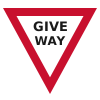
Give way to traffic on the road ahead; you need not stop if the way is clear.
Vehicles must not enter the road from this direction.
You must not go faster than 30 mph here.
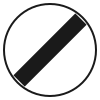
The national limit for your type of vehicle and road now applies.
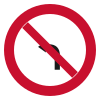
Left turns are not allowed.
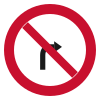
Right turns are not allowed.
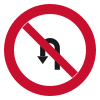
You must not turn round to go back the way you came.
You must not overtake other vehicles.

No vehicles may use the road (pushing a bicycle is allowed).
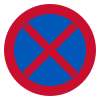
You must not stop on the main carriageway at any time, even to pick up or set down.
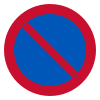
You must not wait or park here during the times shown, though you may stop briefly to load or let people in or out.
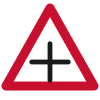
A crossroads is ahead; watch for traffic from both sides.
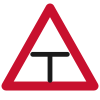
The road ends at a T-junction ahead.
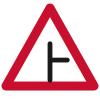
A side road joins ahead.
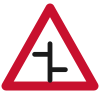
Two side roads join ahead, offset from each other.
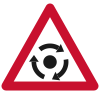
A roundabout is ahead; slow down and get into the correct lane.
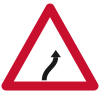
The road bends right ahead.
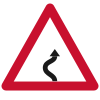
Two bends follow each other, the first to the left.
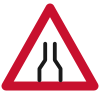
The road gets narrower on both sides ahead.
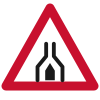
The central reservation ends; traffic in both directions will share one road.
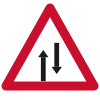
Expect oncoming traffic on the road ahead.
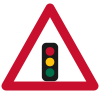
Traffic lights are ahead; be ready to stop.
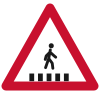
A pedestrian crossing is ahead; be ready to stop for people crossing.
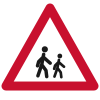
Children may be crossing or near the road, often by a school.
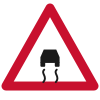
The surface may be slippery; slow down and avoid harsh braking.
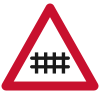
A railway level crossing with barriers or gates is ahead.
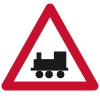
A railway level crossing without barriers is ahead; look and listen for trains.
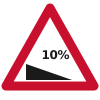
A steep downhill is ahead; use a lower gear and control your speed.
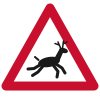
Wild animals such as deer may be on the road.
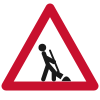
Road works are ahead; slow down and follow temporary signs.

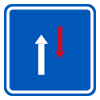
Oncoming traffic has priority through the narrow section; wait for it to clear.
You have priority over oncoming traffic through the narrow section ahead, but still take care.
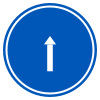
You must go straight on.
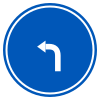
You must turn left (or turn left ahead if on a plate).

Keep to the left of the island or obstruction.
Give way to traffic from the right and go clockwise around the central marking.
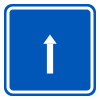
Traffic on this road goes one way only, in the direction of the arrow.
The road is a dead end; there is no exit at the far end.
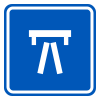
Motorway rules apply from this point.
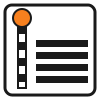
Flashing amber beacons and black-and-white stripes mark a crossing where you must give way to people who have stepped onto it.
A light-controlled crossing; a flashing amber light means give way to anyone still crossing, then go if clear.

Mark 300, 200 and 100 yards to an exit or concealed level crossing.